Wednesday, May 31, 2006

Weather Changes In Southern California


Today the thermometer climbed to 102 degrees F. in our shaded backyard. At a 9:00 PM it is still over 80 degrees F.

Only a week ago the temperature was a cool 65 degrees F. and it was raining. In drought challenged Southern California that should be a good thing. But to have almost an inch of rain at the end of May is odd. Usually our measurable rain falls between October and April. When change comes gradually it can be hard to see, but this year the small changes are becoming more noticeable if you take time to look.

In 2005 our autumn rain, never arrived. The native sycamore trees didn’t seed. When the flocks of lesser and American goldfinches arrived in January and February, the food they were looking for wasn’t available. People who have finch feeders in their backyards saw record numbers of goldfinches.

Quenching rains came in December and January, but unusually-warm February weather raised the temperature into the 80s for two weeks. Plants bloomed early, many of the local birds shifted into breeding mode.

Now, it is May 31st.
The Allen’s hummingbird is close to hatching her second clutch of eggs. The California towhees, the black phoebes, the house finches and Northern mockingbirds have already fledged their first batch of offspring and are working on their second. The Bewick’s wrens are sitting on their third clutch.

In 2005 the house finches raised three separate families of offspring by late summer. Midway through August the population was exploding and avian pox ran rampant through the house finches and goldfinches. I even saw a spotted towhee with the telltale tumors of avian pox. The combination of disease and a dry fall, which made food less available, crashed the house finch numbers back to normal by December. But what will happen this year?

On a larger scale, we are seeing a huge increase in some species of migratory birds. For the past four years, in my yard, I have spotted one black-headed grosbeak, typically for a single day as it passes through in the spring. This year I had six individuals for over two weeks. I’d like to think my bachelor has found a girl and told a few friends how wonderful my yard is, but the reality is everyone I know who feeds birds has at least one black-headed grosbeak frequenting their feeder. Several have four or five, one woman has between 10-15 daily. Brilliant blue lazuli buntings are becoming frequent visitors at feeders, (though I must admit I haven’t had one). And there have been two confirmed sightings of Northern cardinals in the San Fernando Valley in the past two weeks. While it is exciting to see these birds, this obviously is not their usual migratory path. Where do they usually migrate to? Why aren’t they there? Has something changed in Central America or Mexico where they are coming from?

An hour ago, I caught sight of the hermit thrush. For seven years he has arrived in late October and migrated north in March. Last fall, he dropped in three weeks early. Now, it is nearly June and he is still here. Why? If he doesn’t travel north will he fail to find a mate and breed this year?

The hillside behind my house is dotted with native Catalina and holly cherry. Typically by late May these deep green shrubs are covered with dime-sized lime-colored fruit which will ripen to a dark red morsel by autumn. Only a few bushes have the peppercorn-sized beginnings of cherries. The fruit will ripen months later than the birds and other animals expect.

At a casual glance the Southern California hillsides are green, there are birds at the park and a swallowtail butterfly glides between the sycamore trees. But look closely, glance at a few notes you jotted down last year, or the year before, and there are small changes. How will all these small changes add up in the next few years? I don’t know. But change is an active force. Just as a snowball rolling downhill can suddenly become an avalanche, small changes may become massive before our eyes.

Saturday, May 13, 2006

Water - How Much?


Water, turn on the tap and gurgling life gushes forth. How easy it is to take this luxury for granted. Do you know how much water you use in a day? Have you ever given it a thought? Most people in the world must know; for them clean water is not readily available.

It was an eye-opening experience traveling in Turkey to be responsible every day for the water we wanted to consume. Water streamed out of the facet in our comfortable and modern hotel room, but the water was not consumable. In the picturesque heart of Istanbul’s old city, our room had a sign taped above the bathroom sink warning us not to drink the tap water or use it for brushing our teeth.

If you had a bottle of drinking water to last you 24 hours, would you remember to save enough for brushing your teeth or for a swallow or two when you wake up in the middle of the night? How much water do you need to brush your teeth?

The Turkish travel company that arranged our trip had a unique policy: every lunch included in our tour package came with drinking water. For all of the other travelers we encountered water was treated like any other beverage, it was an additional charge.

How much are you willing to pay for drinking water? Do you know how much it weighs? Are you willing to purchase water in 3 liter bottles to ensure a better price, knowing that then you will have the burden of carrying the extra weight?

It took us a few days and a couple of experiences paying for expensive small bottles of water from the hotel minibars to get an understanding of how much water we, two adults, needed over the course of a day. Without taking in to account, cooking, bathing, lavatories or laundry, we each simply drank 2 to 3 liters of water every day. We bought large bottles and poured their contents into small bottles for use during the day. We stocked up when we found it at a good price. We bartered for it when fellow travelers misjudged their own liquid needs. It was an ever-present concern, did we have enough drinking water? Did we need more? When we needed more, would be able to find it?

Looking out my office window at the verdant trees, gardens and lawns designed to mimic an English countryside in a Mediterranean climate, I know all of this green is dependent on a tap that turns on and delivers water. An ever-growing human population in southern California requires more and more water. Where will it come from? Who or what will we take it from?

My great grandfather was born in a small high-desert town in the Owen’s Valley. He was a young man when the residents there decided to lease their water rights for 99 years to the burgeoning metropolis of Los Angeles. He said he always knew the people of the Owen’s Valley would regret selling what they couldn’t replace: water.

When I watch the goldfinches waiting in line to sip from my neighbor’s slowly leaking sprinkler head or observe the California towhee splashing gleefully in the bird bath, I see in them a true understanding of the precious nature of water. As summer heats up, more species of birds will visit my backyard for the small pool of fresh water than for the birdseed in the feeders.

Clean water, most living things can’t survive without it. How much did you use today? If you couldn’t turn on the tap, if you couldn’t buy it, where would you get it from?

Monday, May 01, 2006

Guardians of Apollo – The Starred Agama (Laudakia stellio)


Something is watching–something still, silent, ancient. Dark eyes glare from beneath a ridged gray brow.

How long had they been studying me? What were they thinking?

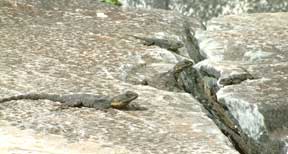
In the Temple of Apollo, on a hillside in Turkey, a gathering of starred agamas (Laudakia stellio) stood their ground. They observed–heads raised, muscles tense. Their clawed feet clinging to the stones surrounding the heart of the temple, the site of the oracle. For centuries, humans had come to this place asking questions, seeking wisdom.

I took a slow step forward.

The largest among them, an adult male, gazed right through me. The female, lifted her head, stretched her neck, making her nearly foot-length body appear even longer.

Climbing the marble steps and descending into the inner vault of the temple, my attention had been riveted on towering columns and rising marble walls. I had looked right past the prickly gray creatures that seemed as one with the weathered stone. But now I was face to face with these guardians of ancient truth.

After the Greek engineers and architects had spent their brilliance and later generations promoting “modern” beliefs had lost the genius of these ancient pagan builders, who was left to guard the old ways? The starred agamas.

Agamids in general are considered one of the oldest families of lizards. They have primitive teeth and tails that typically can not be regenerated if broken. They are ambush hunters who stoically wait for prey. When a starred agama visually spots an ant, bee, or wasp, they move quickly to capture it in a single bite. While agamids range throughout Asia, Africa and Australia, only one group is found in Europe, Laudakia stellio. There are various subspecies of L. stellio in Turkey, Greece, Cyprus, Egypt, Lebanon, Iraq, but they all share a large head with a visible ear opening, a long tail composed of segments with evenly spaced spikes, and a generally flattened body. They also frequent ruins–the ruins of ancient human civilizations. Coincidence? I wonder.

The lizards before me were displaying a high level of territoriality, typical of agamids. The ruff of jagged scales around the neck stood out, especially on the female. But what was she guarding, just a crack in a piece of marble? Then I realized this was not a haphazard group of lizards, there was an adult male, adult female and numerous subadults of varying sizes. (The male is to the left, female on the left edge of the crack, one youngster just to her right and one just above her head to the left.)

A researcher has recently determined that similar groups of Cunningham’s skinks in Australia are actually family groups, where offspring stay with their parents for up to seven years. Was this a family of starred agamas? There are suggestions in the scientific literature that they may form family groups, but no one has really studied the topic.

I took a slow step forward. The female and the youngsters dashed for the protection of the stone crevasse. But the male stood his ground. Beneath the rays of Apollo, the starred agama and I came to an understanding, we both revered the warming fingers of the sun on this cool spring day. Basking was something we had in common.

As I laid a reverent hand of the warm marble, the energy of the place filled me. “Open your heart,” the oracle said, “and you will find your place in the world.”

As we traveled through numerous ancient sites in Turkey, I spotted starred agama families time and time again. Most human visitors seemed to overlook these reptiles among the tumbled-down stones of ruins, just as they overlooked the subtle power of these ancient places. We humans like to think we know so much. But who has been watching whom longer. The starred agamas stand in witness over our lost past. Perhaps they know us, far better than we understand them.

Monday, April 24, 2006

I Saw A Brant! - Malibu Lagoon 4/24/2006

This year the weather in southern California has been unusual–the rains were late, the winter warm, the spring frequently cold. The cedar waxwings typically decrease in number as summer approaches, but I’ve been seeing more. Twenty-three of these crested beauties with their black, bandit masks have just landed in the tree across from my office window.

Many spring and summer birds, like orioles and Western kingbirds, arrived early. Yet, numerous winter residents have yet to fly north. As we pass mid-April, a fair number of local species have already raised their first clutch of offspring–Western scrub jay, house finch, black phoebe, and California towhee. The female Allen’s hummingbird in my backyard not only successfully mothered two nestlings through wet cold days, I caught her this morning with a new paramour. Her next pair of eggs will be filling the nest soon.

It shouldn’t have surprised me then that Malibu Lagoon would also reflect this mixing of migrants. Winter visitors still paddled around the estuary snacking on the aquatic plants and crustaceans. There were American wigeons and a group of six brants. All my books agree the brant, Branta bernicla, is a common bird. This small, short-necked goose appears primarily dark in color with a black upper body and a white “necklace” high on its neck. They may be “common” in specific localities, but I’ve never seen one before.

It is always a thrill to see a new bird species, especially when it is one you’ve been looking for. I’ve been keeping an eye out for a brant ever since I saw the movie, “Winged Migration.” The travels of these feathered wonders fascinates me.

On the west coast, this mallard-sized goose spends the winter along the Pacific Continental United States. When spring arrives, it picks up and flies to Alaska’s Aleutian Islands for a quick stopover before heading to the the northern tundra of Alaska and Canada. Every year they make this grand journey, and most of it is flown over open ocean. In the east, brants winter along the mid-Atlantic coast then migrate to Canada’s most northern tundra. In Europe, where they are called Brent geese, they summer along the coast of the North Sea, in Ireland, Britain, and Denmark, then fly north to the tundra of Greenland or Siberia for the summer.

What an amazing thing to stand on a beach in Southern California and watch a dark-headed goose slurping up a piece of slippery sea greens, knowing that in a month or so that same beak may be nipping at new green growth along the shore of the Beaufort Sea. When the senior U.S. Senator from Alaska, Ted Stevens (R), claims there is nothing but barren “frozen wasteland” along the north shore, he wants you to forget that summer comes even to the tundra. He and the oil companies hope all of us will forget about the thousands of birds that rely on the delicate tundra for their breeding grounds.

I’ve walked on the Alaskan summer tundra and plucked dime-sized blueberries from five-inch tall bushes. You may never visit the far Arctic tundra, but the brant flies there every year.

The female makes her shallow-bowl nest on a small rise in the soggy tundra. Sitting snugly on the nest, the female lays with her head down on the turf. Stretched out flat in this way, the brant is completely vulnerable but she also blends in with the flat tundra. Having no profile makes it harder for predators to spot the nesting goose. Perhaps Senator Stevens just hasn’t looked close enough.

I saw my first brant, today. Soon these six birds will be making their way to the far northern tundra. Wouldn’t it be a shame, if you didn’t have a chance to see one too?

Friday, April 14, 2006

Tortoises of Turkey - Spur-thighed tortoise, (Testudo graeca ibera)

Traveling in Turkey I expected to see migrating wood storks, various gulls, and hooded crows, I didn’t expect tortoises.

In California, our state reptile, the desert tortoise (Gopherus agassizii) is threatened. Its numbers in the wild are declining despite conservation efforts. Even field researchers looking for the dinner-plate-sized adults can wander the desert for hours or even days without spotting an individual. The notion that we would casually see wild tortoises, not once, but several times, during our eight days of traveling the Turkish countryside, never occurred to me.

The first sign that tortoises were about was auditory. One of our fellow travelers heard a thumping knock-knock sound and went to investigate. What he found were two tortoises trying to have a romantic interlude. When a shell covers the majority of your body, physical contact of a serious nature is seldom quiet.

As we roamed the Aegean region investigating countless Greek, Roman, and Byzantine ruins, we continued to encounter tortoises. The sunny spring days were filled with lush green hillsides and vibrant wildflowers. The undisturbed landscape around the various ancient ruins provided a sanctuary for tortoises. Even though the Turkish people consider it a sign of prosperity to have a tortoise on their property, it is difficult for the herbivorous tortoises to compete with domestic sheep and goats. Abundant domestic chickens can also pose a threat to tortoise eggs and hatchlings.

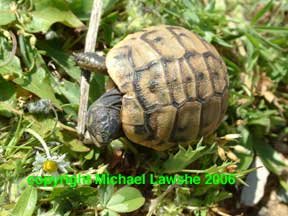
The spur-thighed tortoise (Testudo graeca ibera) is small to medium in size–about the size and shape of a pineapple. The shell is slightly elongated with slight flares around the rear legs. We saw individuals light yellow-green in color to a dark gray-black. This species is quite common in western Turkey and appears in various subspecies throughout the Aegean and Mediterranean. The species in general (Testudo graeca) is also referred to as the Greek tortoise.

One thing was true of all of the spur-thighed tortoises we encountered. They were enjoying spring, either procreating or sampling the lush grasses, clovers, and wildflowers, especially buttercups. In either case, they paid us little mind as we observed and then walked on.

During the 20th century, the spur-thighed tortoise was one of the most popular tortoises in the European pet trade. Countless individuals were collected from the wild and some regional populations were completely depleted. Fortunately this practice was made illegal toward the end of the last century. Combined with the Turkish culture which considers it bad luck to kill a tortoise, legal regulation has helped some populations recover.


In a few areas the tortoises appear to be doing exceedingly well. While exploring an Aegean island and attempting to find a trail to a hillside ruin, we discovered six individual tortoises. They ranged from a breeding pair, to a female digging a hillside nest, to a tiny youngster foraging near the pebbly beach. This little guy was probably last year’s hatchling and experiencing his first spring. He was barely 4 cm (1.5 inches) across.

Traversing said hillside for less than two hours, going up and down, trying to find a pathway to the ruin, we actually covered only a small area of the shrubby slope. The fact that we saw six tortoises of varying ages was good evidence of a robust island population.


There is something timeless about tortoises. They have an air of ancient wisdom. Their ancestors waded through primordial swamps before the dinosaurs. The fact that they wander now through the ruins of long-gone human civilizations seems appropriate. In many places around the world tortoises are not protected, not honored, and instead are snatched from their homes to appease a misguided human desire to own them. How wonderful it was to see tortoises basking in the sun, trundling through a carpet of wild poppies, and enjoying a wild life in Turkey.

Monday, April 10, 2006

Reality In Blue - Solar Eclipse Turkey 2006


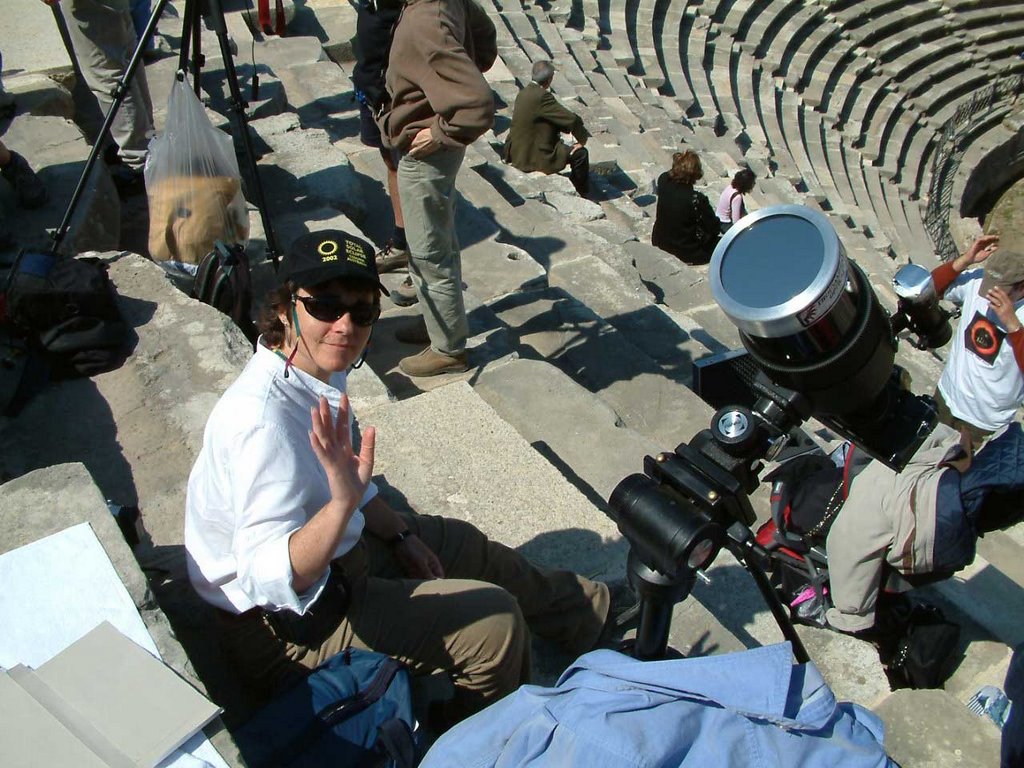
March 29, 2006, a solar eclipse dazzled over Turkey. A dark orb hung in the sky haloed in glowing white wisps of solar corona. Crowds gazing up from the dark shadow of the moon found the sun blocked from view and cheered at the wondrous sight. For those who took a moment to glance at the surrounding ancient ruins and countryside, there was the realization that a total solar eclipse offers an alternative perception of the world. For as the moon blocks our vision of the sun, it also blocks direct light from our star and thereby introduces us to an image of our world we would not ordinarily see.

As the sun slips behind the moon, the light that bathes the earth is unlike any other. The “normal” color spectrum, by which we expect to see our world, alters. The balance between the long lightwaves of red and the short lightwaves of blue is skewed–blue becomes dominant.

Typically as sunlight grows faint each evening and shadows stretch ever longer, we expect a reddish tint. The long waves of red light travel in a straight direction and paint the rosy hues of sunset and sunrise. They make the world appear warm and romantic. Blue lightwaves, however, have a tendency to scatter because they are short in length. As the sun drops beyond the horizon, we slid momentarily through the cool blue of twilight.

But a solar eclipse brings a retreat of daylight even at midday. There are no long shadows. As more and more of the sun’s direct rays are blocked by the moon, the dispersed short lightwaves of blue swath the world in alien hues. Gradually, fine differences in color become more pronounced. In the Roman theater in Side, near Antalya, Turkey, the subtle grays and browns in the ruin’s marble friezes became more distinct and the relief of the sculpture more defined.

As more sunlight is lost, a unique opportunity arises to experience a new perception of the world. The green tones of plants become more vibrant. Stone and earth, that may have appeared as mere backdrops, become vivid and alive. The deep blue of the sea mutes. Human skin tones gray toward paler. The temperature not only of the light, but also the air, plunges.

It is easy for humans to lose track of what it is important, to place emphasis on a few temporary things while life races past. But during the assent into a total solar eclipse the familiar illusion of reality transforms, flexes, reaches beyond itself to another place. What we see changes. How much we actually perceive depends on the individual, but the opportunity is there to touch another dimension of being–a completely different way of perceiving the world.

What is real? The rich green laurel leaves that I see awash in blue eclipse light or the laurel leaves I saw two hours earlier, dulled by the brilliant midday sun. If I close my eyes and touch the laurel leaf, perhaps my impression would be completely different.

The moments we give ourselves to question reality are few. Perhaps I chase solar eclipses for the opportunity each of these cosmic events offers, however momentary, to experience a unique instant of time, place and perception. The eclipse in Turkey was blue from horizon to horizon because of the high layer of clouds and the subsequent diffusion of blue lightwaves. There were no visible stars. There were small, but brilliant, red solar flares at the positions of 12:00 and 4:30. The atmosphere was buoyant and chaotic because of the energized crowd in the theater at Side. It was different from South Australia 2002, CuraƧao 1998, and Hawaii 1991.

Each solar eclipse offers a different view of our tiny planet. An opportunity to feel the rush of a shadow created by a perfectly placed moon. The chance to experience the universe moving forward without regard for humans. Where will you be in 2008? Canada, Greenland, Siberia, Mongolia? Don’t let the opportunity slip by; there is always 2009–India, Bhutan, China?

Sunday, September 04, 2005

Urban Wildlife


It's easy to go looking for wildlife in wild areas, harder to open your eyes and your mind to the wild creatures that have found ways to exist in the eddies and cracks of the manufactured world humans call civilization. Yet these sturdy prevailing creatures and plants are here forcing a foothold in unwelcoming environs. Last night as we were dropped off at the curb after an evening out, we were pleasantly surprised to see an eight inch female alligator lizard on our steps. She was using the lure of our walkway lights to catch her fill of insects. Five feet away was one of her latest offspring. Only two and a half inches long, this miniature of its mother moved with her same serpentine wiggle.

This morning a swarm of tiny (1 mm) insects are creating a moving matrix on the dry ground beneath the Grevillia robusta in the backyard. They aren't on the moist ground where the sprinklers sprayed last night and they aren't 10 feet away on the hillside. I don't know what they are, but after three days of over 103 F degrees weather, the ground is alive with them. I'm hoping they are lizard food.

I spotted an uncommon Lorquin's admiral butterfly winging its way through the parking lot over the stripmall. A pale orb spider has a wonderful web next to the mail box. The jungle is all around us, waiting to reclaim the Earth.

Monday, May 23, 2005

2nd Annual Island Fox Festival Huge Success!

Small, cute, and critically endandgered. What more do you need to have a little attention directed your way? The island fox from the Channel Islands off California is about the size of a small house cat. On four of the six islands, the subspecies of this special fox have declined in number over 90% since the mid-1990s.

You don't have to go to a far off land to help save endangered plants and animals. The island fox is imperiled because of imbalances in the island ecosystem created by man–DDT, viruses and diseases from domestic pets, human introduction of nonnative plant and animals species, and native animals such as the golden eagle which have stepped in to fill the predatory bird void that DDT created when the fish-eating bald eagles were driven into extinction on the islands. In the late 1990s, golden eagles began preying on the unsuspecting foxes. In five years, the island fox population on San Miguel Island dropped from ~450 to 15.

The 2nd Annual Island Fox Festival at the Los Angeles Zoo on May 21, 2005 brought the foxes' story to children and adults.
It is natural to want to help save a cute creature like the island fox, but the complexity of the problem requires all of us working together and understanding that conservation sometimes requires difficult choices.

It is easy to tell people in a distant rainforest that they shouldn't cut down the forest trees. It is more difficult when the choices of action are your own. The more we know, the more information we have, the better we will all be at making informed choices to help preserve the land and the liviing things that we have the greatest voice about–those in our own backyard.