Showing posts with label
snake with checkerboard pattern.
Show all posts
Showing posts with label
snake with checkerboard pattern.
Show all posts
Seeing a snake in the wild is unusual, spotting a wild snake that has just caught its prey and is in the process of feeding is rare.
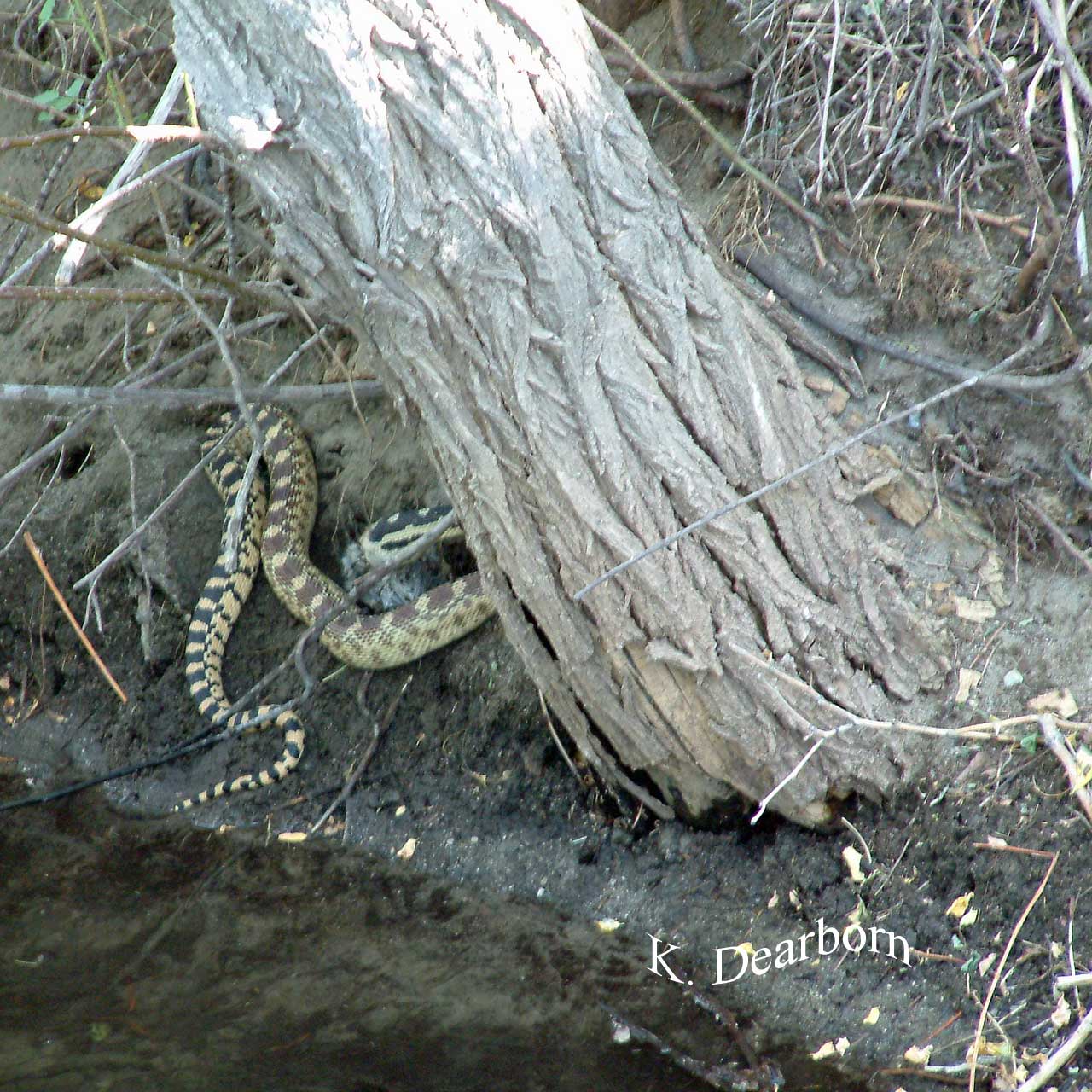
While fishing on a stream in the Eastern Sierra mountains, we happened on a gopher snake that had just constricted a pack rat and was starting to swallow it. You can see the bottom edge of the pack rat's stick nest in the top right of the photo.
When a snake is swallowing its food, it is vulnerable to predators. It was evening and this gopher snake was not happy when it initially realized it was being observed. But we kept our distance and just watched and the large gopher snake settled into consuming its catch.
The snake was approximately 1.75 inches in diameter, while the rodent was about the size of my fist. It took 5-10 minutes for the six-foot snake to swallow it's large meal.
Once the large rodent was swallowed, several of the observers were surprised that there wasn't an equally large lump in the snake's body. But a snake body is very muscular and unless a meal is supersized, the food is compressed down and sent on its way to the very efficient digestive system. Most likely, this snake will not need to feed again for at least 3-4 weeks.
Amazingly, within 20 feet of this sizable adult gopher snake, we also saw a new hatchling (about the width of cotton yarn) swimming up the stream and a yearling (about the width of a pen and 2 ft long). Obviously this stream-side ecosystem was providing enough varied-size prey for multiple generations of gopher snake.
Note the pattern on the gopher snake, kind of checker-board black with yellowish. Frequently, gopher snakes are mistaken for rattlesnakes and killed without hesitation. These snakes are important rodent predators and not dangerous to humans.
I am hoping that one day a gopher snake will one day take up residence in my yard. However, we do have a ring-necked snake that has moved in. But we have what gopher snakes are named after, more on that soon.
I don't usually post other people's photos, but in this case I am hoping to save a few lives.
Ask yourself, What is the most dangerous element of your life? My answer is Ignorance and Fear - the IF factor.
What IF it bites me? What IF it's an animal carrying a disease? What IF it is a poisonous snake? Ignorance and Fear led to the death of this snake. The neighbor of a friend, killed this gopher snake and then asked her if it was dangerous?
They had a perfect view of the tail. Do you see a rattle?
 NO.This is a native gopher snake. This species is vital for controlling rodent populations. Ironically, my friend is currently having to hire an exterminator to deal with a rat problem. This snake was attracted to the large number of rats in the neighborhood. It was trying to reduce the number of rats by eating them. Gopher snakes are active during the day which makes them vulnerable to people spotting them. Their coloration is similar to a Southern Pacific rattlesnake, because both species are trying to blend in with our native chaparral.
However, take a good look at this snake. It has a narrow head, not the triangular head of a rattlesnake. It has a fairly thin, long body for moving quickly. Rattlesnakes have typically stout bodies and move more slowly. They are ambush hunters who wait for food to come their way.  The gopher snake has a checkerboard pattern on its skin. Local rattlesnakes have a diamond pattern.
Gopher snakes DO NOT have rattles. The ONLY venomous or poisonous snakes that are naturally found in the Los Angeles area are rattlesnakes.
A gopher snake can sometimes make a rattling sound by rapidly vibrating its tail against dry grass or leaves. It does this to protect itself. The gopher snake has evolved to occasionally make a rattling sound so that predators will think it is a rattlesnake and leave it alone.
Unfortunately, people are the most dangerous animals on the planet. We kill things then try to understand what they are. The worst part of this story is that not only did these uninformed people kill a beneficial snake, by doing so, they now have made their property more attractive to rattlesnakes. Gopher snakes are efficient rodent predators. With the gopher snake gone, a rattlesnake has a better opportunity to move in an try to eat the neighborhood rats.
Gopher snakes are YOUR FRIENDS. They eat rodents and make your property less attractive to rattlesnakes. Honor them. Respect them. Don't play the IF game and kill them.