Showing posts with label green lynx spider. Show all posts

Friday, July 20, 2012

Green Lynx Spider Stalking Yellow Jackets

What killed this yellow jacket wasp?
Yellow jackets are a kind of wasp and many people fear them. Their black and yellow coloration is mistaken for honey bees and people are afraid of being stung. 


We have a low number of yellow jackets in the yard, but when you see them at a protein food source, like a hawk cast, it appears they are numerous. Video. When we first moved to this house 18 years ago, we couldn't eat on our patio without being harassed by 10-20 yellow jackets. We put out traps for them.


The problem was that we didn't have a balanced ecosystem. The previous owners sprayed for insects, baited for snails and planted mostly non-native plants. Gradually we have restored a more natural flora, which in turn attracts native animals–from insects to raccoons.


The Cooper's hawks are feeding their youngsters in the backyard. The young hawks are dropping bits of meat, this feeds the yellow jackets. But the yellow jackets are also eating the caterpillars that show up on my tomatoes. And the yellow jackets have a predator too.
Green lynx spider feeding on a beetle

This lovely green lynx spider prowls the vegetable garden leaving behind the dried exoskeletons of yellow jackets and other insects. Egg sac. We do less and the natural balance of biodiversity does more.

More on California spiders:
red jumping spider
trashweb spider
trapdoor spider 
cobweb spider 

Friday, January 07, 2011

Backyard Biodiversity Project 2011

Around the world biologists are gathering information on animal and plant biodiversity in wild places, but I can’t help but wonder how much we are missing in our own backyards. We raise money to save distant rain forests and try to change the daily lives of people in far away lands but what actions do we take to positively impact the ecosystems where we live?


I’ve seen amazing transformations in small areas of my yard by removing introduced exotic plants and restoring native plants to the landscape. Native Plants. The Mexican mountain marigold (pictured) provides food for pollen-eating insects even in the winter. I keep trying small gestures to provide more opportunities for native species. Bee Box.


Just in the last two months we’ve seen an amazing biodiversity in spider species without really trying: red jumping spider, trapdoor spider, green lynx spider. In the past I’ve found small areas around the house are home to numerous spider species. Here Be Spiders.


This afternoon I checked on the green lynx spider egg casing. It has survived the December rains, but for the past week the mother protecting the egg sac has been gone. Did she perish in the cold weather? Temperatures have been in the mid-30s to 40s at night. This spider species only lives about a year and adults typically do not survive winter weather.


According to several university websites, females lay their eggs in an egg sac in autumn. We saw this egg sac in the second week of November. The female guards the eggs for 2 weeks until they hatch. The mother opens the tough webbing of the egg sac to release the spiderlings and she provides protection and sometimes food for the next 2-3 weeks. See University of CA, Irvine photos. When the young spiders disperse, her job is done. The youngsters will overwinter, but their mother will die.


Last year we had an unusually warm December and early January. We discovered our first green lynx spider in the yard with her egg sac on the scented geraniums in the vegetable garden. By February, drenching winter rains destroyed the egg sac.


This year it has been almost 2 months since I first discovered the green lynx spider and her egg sac, but again the spiderlings have not hatched. I don’t know if the female realized the eggs were not going to hatch and abandoned them or if she died. Typically, a female will guard her egg sacs until she perishes from starvation. Last week the female was looking very thin.


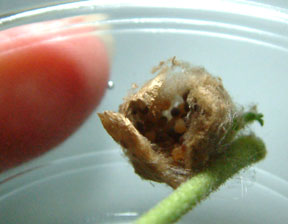
What happened to these eggs? I decided to open up the egg sac and see whether or not the eggs were viable. Looking through my microscope I could see that about a third of the eggs seemed infertile, they were dark and showed no development. Another third or more appeared plump and ranging from an orangy-yellow to pale white. A few appeared to have been forming into spiderlings, the shape of the carapace was somewhat apparent. But these embryos on their way to becoming spiderlings, seemed slightly dried-up. 


Considering we had nearly a week of rain in mid-December, this seems odd. But something with the weather was not right for these eggs to develop. For a second year in a row beautiful green lynx spiders have failed to reproduce in the garden.


Are there more green lynx spiders in the yard and I’ve just missed them? Are their other spiders failing to reproduce? This leads me back to the Backyard Biodiversity Project.


Are there creatures to waiting to be discovered right here in a backyard in Los Angeles, California? I think so. I plan to take a scientific look at the creatures and plants living in our small yard in one of the largest cities in the world. I’ve started the Backyard Biodiversity Project before only to be interrupted by acceptance to graduate school. Now I’m plunging into the year with the intention of spending the next 12 months on this project.


What’s in your backyard?

Tuesday, November 16, 2010

Something Lurking in the Garden

 The warm autumn weather has brought a few surprise encounters. The photo shows a pair of mating praying mantises. Notice how the male (on top) is slightly smaller and measurably slighter in build. He also appears to have much longer antennae.

I came across this pair at dusk as I was running out of the house. I wasn't the only one startled by the large insects. Fik, one of our male Allen's hummingbirds, was quite disturbed to have the pair on his feeder.

I'm not sure why the large female praying mantises tend to hang out on the hummingbird feeders. Are they hunting insects that might come to the feeders or are they really set on grabbing a hummingbird? Fik wasn't taking any chances, he stayed on the far side of the feeder.

I know you are probably wondering, did the female mantis consume her male companion following mating? I don't know. I took the photo and had to run. I saw the female the next evening, but have yet to locate her egg casing. I wonder if she is one of the offspring that emerged in the back yard in June. Praying mantises.


Meanwhile a new mother-to-be has attached her tan-colored egg sac to the scented geranium, a green lynx spider. This is the second year that one of these free-living predators has stopped to have a family on the geraniums in the garden. Last year, winter storms destroyed the egg sac despite the mother's attempts to keep the nursery safe and dry. It will be interesting to see what happens this year. 

Friday, February 05, 2010

Rain in Los Angeles

It's been raining all day and I can't help but worry about the hummingbird chicks. Fortunately the rain has been light and there has been no wind.

The mother has built her nest on top of a nest that was successful last year. It is in a fairly protected location, but the cool temperatures and duration of the rain will tax her own survival as well as the chicks.

The green lynx spider has not fared well in the wet weather. She abandoned her egg sac. Whether she survived and moved on or perished, I'm not sure.

The slender salamanders, however, are loving this weather. We spotted a mating pair last night before the rain started. We've seen a total of 5 individuals (including two mating pairs) in the last three weeks. That's more than we've seen in the last 4 years. Perhaps the prolonged periods of rain will mean an increase in their population.

Thursday, January 28, 2010

Damage to Homes After California Rain

A stroll through the yard revealed that the recent rains affected residents in the yard even more than they affected us. Oh sure, we were concerned with diverting water and the mud flow that came down the canyon. Mud.

But this trapdoor spider had the door of her home slide down the hill and completely off her tunnel.


If you look closely, however, you can see she is connecting a new tunnel to the soggy door. Apparently, the well-constructed door is more difficult to replace than the tunnel. Rather than make a new door, she is building a new home beneath the relocated door.


Even the slightest erosion of the clay substrate reveals the soil that has been reinforced by the trapdoor spider's handiwork. Here a burrow door sticks up, slightly raised, from the surrounding level of the dirt. This spider didn't loose its home, but some of its security has been temporarily washed away. Trapdoor spiders


For both spiders the ground, and therefore the trapdoors that protect them, remain soggy and soft. With their tunnels exposed and damaged, they have suffered much more than we have from the week-long rain.

Meanwhile the green lynx spider has survived, but her offspring have not. Will she lay another egg sac? And the preying mantis eggs laid in November? They remain safe on the twig where their mother laid them.

Eight inches of rain on a southern California hillside over 6 days can be a challenge for the creatures living on that hillside. We humans tend to think only of ourselves when we are faced with challenges or discomfort. But extreme weather events can be life threatening for smaller creatures. They are directly connected to a small area of habitat. For them the ramifications of climate change are more immediate.

Saturday, January 23, 2010

Surviving the California Rain

Five days of drenching rain.

The green lynx spider continues to hold on to her geranium stem.

But her egg sac? It looks as though it may be completely saturated. Her drive to produce viable offspring may have been thwarted by the wet weather. Still she holds on and stands guard. Before the rain

Throughout the week, the bird feeders have been a center of activity. The feeders have provided food to birds even in the rain. This afternoon, however the Cooper's hawk was also using the feeders. I caught him just after he had made an attempt to catch one of the doves eating at feeder. He stopped for just a moment on top of the feeder before heading up into the wet trees. Video of a Cooper's hawk.

How the tiny hummingbirds survive the driving rain amazes me. I've been looking for nesting attempts. So far I haven't found any. I'm sure that any initial nests will have been abandoned because of the weather.

Thursday morning we spotted a disoriented California towhee sitting beside the neighbor's brick wall. The towhee's feathers were tattered. It may have been an older individual. It wasn't injured. It just seemed exhausted. We shooed it away from the street and open sidewalk and up into the bushes along our yard. At least there it had shelter from the elements. At times there have been several species of birds sitting on the patio to escape the worst of the rain and hail.

Since Monday, our tiny niche of biodiversity in Woodland Hills, California has received over 7 1/2 inches of water. I'm sure that isn't much in many other places, but in California it is a fair amount. Our annual rainfall averages only 16 inches.

A two-foot wall of mud flowed down our little canyon and was stopped by our fence. No disaster, but enough mud to close off the cottontails' regular path under the fence.

A sunny moment and a rainbow. The rain has quenched our drought parched landscape, but for some the intensity of the rain has been too much.

Monday, January 18, 2010

True Californians Surviving the Rain

Finally, Southern California is getting the rain it needs. While people are running around placing sand bags and fearing a deluge, the native plants and animals seem to be taking it all in stride.

The house finches and lesser goldfinches were busy at the feeder in the rain. While the white-crowned sparrows were rubbing their feathers on the damp foliage to bathe. When the rain was at its hardest, the finches and an Allen's hummingbird took shelter under the patio. But it was only for a short time.

One neighbor couldn't come out of the rain.

No matter how hard the drops fell, the green lynx spider was in the middle of it. In the past two days she has moved her egg sac closer to some leaves for greater protection. Still, she and the hazelnut-sized bundle are quite exposed to the downpour. This afternoon, the egg sac seemed to be quite wet. Are the eggs inside soaked or dry? I don't know. It will be interesting to see how she and her offspring fare over the next few days.

Just under two and a quarter inches of rain fell today. This evening the sky is clear and the stars are icy white. Tonight feels like winter. We'll see if the predictions of more rain come to pass.

Wednesday, January 06, 2010

Lessons from a Spider

Awareness. Over the course of this year I intend to focus on awareness. Not the level of being where you are familiar with the existence of something outside of yourself, but an intimate consciousness of how you are connected to everything else.

I can realize intellectually that my daily actions affect the world around me, but not until that knowledge becomes innate, not until I can look at every pen on my desk, every morsel on my plate, and every bottle on the shelf as an extension of myself, will I truly change my behavior.

The time has come to question our food, our daily actions and the economic systems of the late-20th century. The earth can not afford our excesses any longer and neither can we.

But true awareness is difficult when there is so much surrounding us, bombarding our senses on a daily basis. I can’t begin to count the number of things on my desk, little alone in my office. Living in the moment, being responsible for your actions can be impossible when your mind and your life is cluttered with so many things.

I thought I was focused on the world around me while I was cutting some flowers yesterday. Having put the roses and geraniums into a vase, I casually noticed a dried leaf on the geranium. When I pulled it off and it seemed to stick, I quickly realized there was spider web involved.


At that point I stopped to really look. A beige egg sac was stuck to my garden glove. Without a second thought I took it back outside and transferred it to the geranium. If I had really been paying attention, I wouldn’t have been startled when I came back to find a quarter-sized green lynx spider anxiously looking for her egg sac.

My thoughts were elsewhere as I snipped the stalks of geranium and I had destroyed the carefully constructed nursery of this lovely spider.

I’ve never seen a green lynx spider in my yard before. Honestly, she was much larger than I expected. The green lynx spider is a new species to add to my growing backyard biodiversity list. (trapdoor spiders, other spiders)

I returned the mother spider to the geranium and put her beside the egg sac. It didn’t take her too many minutes to recover from the disaster and start reattaching her precious offspring to the plant.

There couldn’t be a better lesson about awareness. The green lynx spider is preying on insects in my garden. Her webbing is providing building materials for the hummingbirds who are beginning to look for nest sites. This spider has taken up residence because our yard is a pesticide free zone with native plants that attract native insects. Everything was balancing out just fine until I blundered along not paying attention. Fortunately, like most of the natural world, she seems fairly resilient. The egg sac has been reattached and she has renewed her vigilant position as guardian.

Focusing on Green Holiday Actions for the thirty-one days of December, reinforced for me the variety of active choices we can all make toward living wiser on the land. I intend to offer ideas that have worked for me and my family to make a positive change toward living a greener life. Each month I will offer up a life-changing practice that I am attempting. It should be a year of discovery and, hopefully, increased awareness.

My yard is blessed with spiders weaving intricate futures, may I learn from their industry.