Monday, February 24, 2014

Stop Yogurt Cups That Kill Wildlife

What seems like benign trash to us, can be life-threatening to small animals. A deadly example is the design of the Yoplait plastic yogurt cup.

http://www.change.org/petitions/for-35-years-yoplait-cups-have-been-killing-wildlife?recruiter=36398084&utm_campaign=signature_receipt&utm_medium=email&utm_source=share_petition

Yogurt is an attractive food to many animals. The shape of the Yoplait container makes it easy for a squirrel or skunk head to go in, but nearly impossible to come back out.

Wildlife Emergency Services, a non-profit animal rescue organization, sees many animals trapped in these containers every year. Minimal changes in the yogurt cup's design could make a huge difference and save the lives of wild animals. Check out video of the deadly yogurt cup design.
 
Wildlife Emergency Services has a petition on Change.org in an attempt to encourage a change in the container design.
It's important. Will you sign it too? Here's the link:

http://www.change.org/petitions/for-35-years-yoplait-cups-have-been-killing-wildlife?recruiter=36398084&utm_campaign=signature_receipt&utm_medium=email&utm_source=share_petition

Thursday, February 20, 2014

Great Backyard Bird Count 2014 Bigger Than Ever

Last weekend, people around the world counted birds in their backyards, local parks, neighborhoods and wildlife areas. India turned out a large number of people submitting this year. In total, 132,656 observation lists have been submitted as of today. The last day to submit lists from the Feb. 14-17 Great Backyard Bird Count is Feb. 28th.

It was fascinating to watch the world map on the GBBC website as lists were turned in and their location marked. As I watched, someone in Australia posted their list. There were observers in Iceland, several lists from New Zealand, multiple locations in Africa; people all over the world providing science with a snapshot of bird numbers and activity. Check out the GBBC map.

Malibu Lagoon State Park
I went out to Malibu Lagoon one morning and to Santa Barbara the next. It was a beautiful weekend for spending time outside. Several of us saw a peregrine falcon at Malibu Lagoon and the best sighting at the estuary wildlife refuge in Santa Barbara was two pairs of greater scaups.

My favorite birds this weekend, however, were in my own backyard. The Allen's hummingbird babies are feathering out. It won't be long before they start trying out their wings.

We found their nest in January.

And this weekend I spotted a second hummingbird nest. This female Allen's is sitting on two white eggs. The warm weather in California may bring us a series of nesting hummingbirds this year.

Allen's hummingbird on nest

Now that you've counted birds for the Great Backyard Bird Count, think about FeederWatch or eBird
  • FeederWatch: Count birds in your backyard two consecutive days every week or bi-weekly, Nov. - April.
  • eBird: Count birds where and whenever you see them and enter your lists in the largest citizen scientist database in the world.

Wednesday, February 12, 2014

Go Count Birds - Great Backyard Bird Count

Do something romantic this weekend - Go to your favorite outdoor location and count birds. 

Friday, Feb. 14 - Monday, Feb. 17 
is the

http://www.birdcount.org

Across four days each year, people across the country count bird species to take a snapshot of avian populations. 

  • You can count for 15 minutes or longer. 
  • Watch from a stationary location, like a window, take a walk in your neighborhood, or visit a park.
  • Watch in your yard or even from a terrace.

I even try to count the parking-lot birds at my local coffee house at least once over the GBBC weekend. All wild birds are important. If you don't see anything, that is important too.

The Great Backyard Bird Count is one of the country's largest citizen scientist opportunities. What you count is important for scientists who study bird populations, migration, the impact of climate change, and specific species information. 

The mourning dove pictured here is typically in the top ten species list for every U.S. state. They are daily visitors to our yard. But last year, mourning doves fell off the lists for some states. Will they be back on the top ten list across the country this year? Or will they continue to decline? 

The more people that count, the greater the nationwide picture of how birds are doing. 

Check out the Great Backyard Bird Count website for more information. And GO Count!

Monday, February 10, 2014

Footprint in the Garden

Sometimes the visitors to your backyard habitat, come and go under the cover of night. We don't know they've dropped in unless they leave a calling card. 


This morning, we found this print in some damp soil. At first glance it looks like the handprint of a tiny person. But I don't think we currently have any trolls or gnomes. 

Typically, a "tiny handprint" appearance is the sign of a North American raccoon. We questioned that at first because the raccoon usually has plumper ends to the digits and visible claw marks. However, it must have been how the animal was walking and the dampness of the soil. 

We have been seeing raccoons off and on since last summer. At about two inches across, this is probably an adult raccoon.

Friday, January 31, 2014

Staghorn fern and Sago palm

While I'm trying to restore native plants to our yard, two of my non-natives are doing extremely well. An Australian plant–a staghorn fern (Platycerium bifurcatum)–and a plant from a Japanese island–the cycad commonly called a sago palm (Cycas revoluta). The funny thing, neither plant is what it's name suggests.

The staghorn fern was a wedding gift over twenty years ago. I nearly killed it twice. Finally it is thriving because I stopped forcing it to live in the shade. The staghorn isn't really a fern at all and it was a revelation to see these epyphite plants growing in the wild in the Australian rainforest. While we might think of these plants as delicate forest dwellers, the staghorn is a sturdy plant that likes to live high in the forest canopy reaching for the sun.


The staghorn fern lives on other plants, usually trees. It settles into crevasses where water and nutrient rich plant debris collect. It doesn't have much in the way of roots and survives on the branches of others. You can see the leaves of a staghorn fern on the left side of this photo from Morris Gorge, north of Cairns, Queensland Australia.

Once I moved my staghorn onto a deciduous tree, where shade was provided in the heat of summer and sunlight was available in the winter, it begun to look like its rainforest relatives. The Australian rainforest has dry periods and seasons of rain, just like we do in California. Temperatures can dip into the 40s. While the staghorn would probably be more robust along the coast where the higher humidity would be more to its liking, it seems to feel somewhat at home on a slope where the evening breeze stirs the air.

The sago palm is not a palm at all, but a cycad. Cycads are amazing plants with an ancient heritage. Their relatives lived alongside some of the earliest land animals. This cycad's palm-like appearance often makes people think it belongs in a tropical rainforest. When I planted two in the yard several years ago I worried that hot dry summers might take a toll on these exotic plants. However the sago palm thrives in our Mediterranean climate as long as its roots are well-drained. 

Our plants receive little water other than rainfall. Even with this year's drought, they are robust.

While neither of these plants contribute food or habitat to our native creatures, they do provide visual beauty in the garden. Neither is invasive in our environment, so they offer an opportunity for something different in the yard.

Monday, January 27, 2014

Bird Nesting Time in California

Here in California where winter rains have eluded us and the days have been spring-time warm, it is hard to believe the rest of the country is shivering through ice storms and record low temperatures.

Allen's hummingbird nest 1/27/14
The birds are gauging that the warm weather means spring. The Bewick's wren is singing to attract a mate. The oak titmouse has found a mate and the pair have been checking out bird houses.

Amazingly, we already have an Allen's hummingbird sitting on two tiny eggs. I'm not sure when they were laid, but I do know that this little architect lined the inside of her nest with natural cotton fiber that I put out. The cotton fiber is the cream colored material on the inside of the nest.

January should be the depth of winter. We should have wet weather that puts a damper on nesting for another month or so. Unfortunately, that isn't the case. The birds are breeding and nesting, so it is time to put out quality materials to supplement what they can find naturally.

I make a knotted holder out of natural wool yarn that is too rough for making garments. Then I fill these holders with natural raw cotton fiber. 

Hummingbirds, bushtits and lesser goldfinches are just a few birds that prefer to use soft plant fibers to line their nests. Nature's Nest.
  
Anna's hummingbird with Nature's Nest.

Placement is important too. Nesting fiber needs to be located where birds can find it, sit beside it on adjacent branches to gather fiber, and the location should be far enough from feeders that small birds are not intimidated by larger birds eating.

I have to make sure that nesting material is on small branches to avoid tree squirrels stealing the nesting material for their own use.

The continuing drought means plant fibers are not as abundant as they should be. Man-made fibers are easy to find around human homes, but those fibers can be problematic, even dangerous, to bird hatchlings. Materials that cause nest failure.

Bird houses should be cleaned out too, so new occupants can move in. Mosaic bird house.

It's January, but this year in California, birds are already starting to nest.

Monday, November 04, 2013

Warm Autumn Impacting Tortoise Hibernation


There are signs of autumn all around. The leaves of the peach tree are daily turning red and golden.


The toyon fruit (aka California holly) is turning red and attracting the attention of the hungry hermit thrush.

But the on-again, off-again autumn weather is making someone grumpy. The angle of the sunlight signals autumn–time to hibernate–but the warm days keep tempting the desert tortoise to stay up.


As you can tell from the photo, this guy is not asleep. His son, has gone in for the winter. Typically, the old guy is in by mid-October, but this year he can't seem to commit to hibernation. He comes out, sits in the sun, takes a few bites of food then grumbles back into his den. Today he stuck his head out and immediately turned around.

He wants to be asleep, but the warm weather is confusing. Some of the migrating birds have been off in their annual cycles as well. For this desert tortoise who has been in captivity, since the mid-1970s, fluctuating climate is an irritation, but for desert tortoises in the wild there can be serious consequences. If they miss time hibernation, they can get caught away from a protective den when the weather does turn cold. They could use up food reserves before they hibernate.

They do not digest food well without basking in the sun and having hot temperatures. They need to stop eating and completely digest what is in their stomachs before going into a deep sleep. Undigested food in their system can rot while they are hibernating, causing them problems. When tortoises awaken in the spring they have expectations of flowering plants and new greenery that they depend on to replenish themselves after months of not eating or drinking. Changing climate can impact all of the timing in this delicate dance making survival even more of a challenge for wild tortoises.

This grumpy guy has us as caretakers to make sure he has food and vitamin supplements. Wild desert tortoises are on their own. Tortoises around the world need our help. They are important members of their ecosystems and all too frequently they are taken out of the wild, both to their detriment and that of the other plants and animals that depend on them.

Tortoises in Turkey
I recommend book Life in a Shell

Tuesday, October 29, 2013

White Film on Bird Bath Water

Have you ever had your bird bath instantly go from clean to layered with a gray filmy scum?


It's ash. Not necessarily ash from a burning fire, but often from a bird that has come through a burned area.


The first time I saw this was several years ago when a group of white-crowned sparrows arrived during fall migration and we had just had a wildfire that burned miles of hillside north of us. The white-crowns seemed to line up at the bird bath and when they were done the water was almost soapy. 

This past spring a large swath of the Santa Monica Mountains at the Camarillo Grade was severely burned. The area is northwest of us, up the coast. When I saw the state of the water I had changed the evening before, I knew that a bird had arrived who was flying down the coast. The amount of water splashed around suggested something larger than a white-crowned sparrow.

Then we heard an unfamiliar call, an American kestrel. This is a small bird of prey, much smaller than our resident Cooper's hawk or red-tailed hawk. We spotted the female kestrel sitting in the top of a dead tree calling. It's been years since we've seen kestrels in our neighborhood. It could be that this bird was returning to territory that was burned out. It will be interesting to see if she stays or moves on.

Rinsing out the ash only took a moment or two. It was nice to know we helped a traveler freshen up. That is what being an oasis of habitat is all about.

Saturday, October 26, 2013

Painted Lady Butterfly

The milkweed and the butterfly bush are blooming and providing nectar for butterflies.


This beautiful painted lady butterfly stopped to rest and eat before continuing on its travels.  Some springs we have seen mass migrations of these butterflies.

In the past week I've also seen a mourning cloak, monarch and a checkered white in the yard. I'm hoping that the drift of nectar producing native plants we've added to the front hillside will attract and nourish a growing number of our native butterflies. Creating habitat for wildlife begins with providing natural food, shelter and water.

Wednesday, October 23, 2013

Cooper's Hawk Comes for a Bath

We had a visitor this morning: an adult Cooper's hawk. Typically they come to hunt the mourning doves and band-tailed pigeons, but this morning the bird bath was the main attraction.

Even birds of prey need a drink or a bath now and then. Both the red-tailed hawks and the Cooper's hawks seem to prefer the still, raised bird bath over the bubbling fountain 20 feet away. The juncos and the hermit thrush prefer a shallow dish placed under a rose bush. Water is vital for creating habitat.


Placing water in an open space enables birds to see any lurking dangers and frequently allows them to feel comfortable enough to happily splash and play in the water.


Cooper's hawks are frequent visitors and have even nested next door. This, however, was a pleasant surprise, a special moment shared because wild creatures see our yard as a safe and natural place to visit. Create habitat in your yard and you'll expand your own experiences.

Tuesday, October 15, 2013

Planting CA Natives in Fall

I love the autumn weather in California. The hot dry summer has come to an end and the promise of rain means it is time to plant native vegetation.

This past weekend we traveled north to the Santa Barbara Botanic Garden to take advantage of their Fall Plant Sale (going on through Nov. 3). It is a wonderful place to see the enchantment of native plants and the habitat they create for animals; We saw a variety of birds, butterflies, lizards, a gray squirrel and two deer. We strolled through areas of the garden most like our yard and looked for plants that would thrive in a few of our problem areas: dry, sunny slope and dry partial shade under oaks.

We've discovered that native plants from the Channel Islands, especially San Nicolas Island and Santa Cruz Island, seem to do well on our dry, sunny slope. This beautiful pink yarrow is from San Nicolas Island. We planted yarrows between the Mexican mountain marigold and the San Nicolas buckwheat that we planted two years ago.

This native aster is a low-growing ground cover that we hope will thrive on our front slope.

With the buckwheat, sage, yarrow and milkweed, the front slope is becoming a nectar garden for butterflies.

In the spring, I always have itchy fingers to put plants in the ground, but too often, the summer heat pounds those plants and they do not survive. Autumn is California's season of renewal. Plant now and tender new plants will have nurturing winter rains to help them establish.

A monarch butterfly has been visiting our newly planted milkweed!

Friday, October 11, 2013

Ant Lions and Pocket Gophers

Have you ever seen one of these perfectly conical pits in the dirt?


This is an ant lion pit trap. It is about the circumference of nickel. The ant lion larva waits down at the bottom of its beautifully constructed pit waiting for an ant or other insect to wander in. The angle of the pit's sides make it difficult for the insect to get out easily. As grains of sandy dirt roll down the sides of the pit, the ant lion springs to action and grabs its prey.

In order to make this beautifully formed pit, the ant lion needs a specific texture of sandy dry soil. This summer I have been cursing a gopher that has eaten my wild roses and some of my wild currants. But in the midst of planting new plants, I noticed that everywhere there was a pile of dirt kicked out by the gopher there were ant lion pits.

This soil had the perfect consistency for the the ant lions. Hmm. The gopher's work turning the soil was facilitating the right habitat for the ant lions who are trying to control the ant population.

There are plants that the gopher seems to avoid: lemonade berry, Catalina and hollyleaf cherry and toyon. I'm also trying Cleveland sage and milkweed. There has to be something the gopher doesn't like.


These ant lion larva will survive the winter underground and emerge as winged adults that look somewhat like a small dragonflies in the spring.

Tuesday, October 08, 2013

Hermit Thrush Arrives Early in Southern California

For the past 12 years I have been documenting the birds that daily frequent our yard, the migratory birds that travel through and the species that visit during a specific season. The hermit thrush (Catharus guttatus) is one of my favorites. On the small side, this bird typically arrives alone or with a single companion. It stands with its head raised like an American robin, but it is slighter in size has brown spots on a white chest, a gray-brown back and a russet tail. Spending the winter here in southern California, the hermit thrush is shy and elusive. By the time I spot it, there is no chance to grab the camera. It slips in and out of the shrubs, plucking a toyon berry or any of the variety of reddish round berries on the vegetation.

The only vocalizations are typically soft chirps in the early morning. (Imagine my surprise this summer in Alaska when I heard this beautiful singing bird and it turned out to be my quiet friend. In its breeding grounds, the hermit thrush is known as the songster of the forest.)

Another surprise was that this year the hermit thrush arrived on October 4th. It seemed early and it was. I graphed the arrival dates for the hermit thrush that I have recorded annually since 2001. The vertical axis shows dates with numerical values (November 15 = 11.5).


It's a graphic demonstration of gradual change. The arrival date of the hermit thrush varied dramatically in the first years of the century, fluctuating between mid-October and mid-November. However since 2007 the hermit thrush has been arriving in October. This year was the earliest date I've recorded. 

This corresponds somewhat with our rainfall levels. Since 2007, we have not had the dramatic years of heavy rainfall that we used to have. Another interesting aspect is where did this hermit thrush come from? Did it leave its summer breeding grounds early because of a factor in that far away place?  Is it a different individual bird?

Other migratory birds are passing through and arriving. Last Week. This weekend a female black-throated gray warbler stopped to rest and hunt for insects in the elm tree.

The white-crown sparrows arrived somewhat early too. Interestingly the snowbirds that usually arrive first in our yard are the Oregon juncos, and they have yet to show up. They had been arriving earlier and earlier each September. I wonder what their story is?

Saturday, September 28, 2013

An Oasis of Habitat in Los Angeles

Food, water and shelter–these are the three requirements for all living things. Provide them in your yard and you will create a vital oasis for wildlife.

Taking a suggestion from The California Wildlife Habitat Garden by Nancy Bauer (book review), last weekend I planted a drift of milkweed (Asclepias curassavica). This species of milkweed (also called “blood flower” according the Western Garden Book) is actually native to South America, however it is the easiest species of milkweed to find at garden centers. I planted five plants on a slope, between some native sage and California fuchsia.
 

caterpillar on the underside of leaf
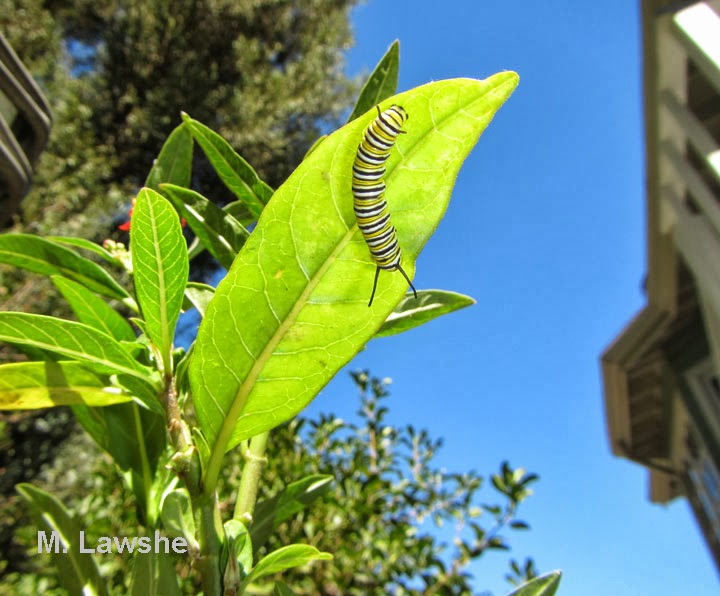
Milkweed is a host plant for monarch butterflies and apparently my plants came with tiny caterpillars already on them. I found the inch-and-a-half-long caterpillar, pictured above, on the underside of a leaf. (Yellow arrow points to leaf with the caterpillar just visible on the underside.) Because the caterpillars eat the plant leaves, placing several plants together in a “drift” creates a sustainable habitat for the future butterflies.


young white-crowned sparrow in background

This week we also had migratory birds arrive. Three white-crowned sparrows flew in: an adult and two youngsters. I would love to know if the adult is one of the white-crowns that spent the winter here last year. This small family of white-crowns has arrived about a 2 weeks earlier than in past years. I thought they might be traveling through, but they have stayed all week.


'sooty' fox sparrow
A second sparrow species, a ‘sooty’ fox sparrow arrived on Friday. 

This is the first time we’ve had a fox sparrow in the yard since 2000. It seems to have settled in, searching for food under the coffeeberry and hollyleaf and Catalina cherries. The native plants provide habitat that other plants do not.

Especially in the dry weather, the water in the bird bath and the fountain provide much needed water for migrating and local birds. Even birds of prey need a drink in hot weather.

It always amazes me when these migrating visitors stop in our yard. How do they find us? Do they see other birds going in and out of the yard? Do they hear or see the running water in the fountain? Are they attracted to the reptiles or native insects?

Do the butterflies smell the bloom of their favorite plants? This morning a bright yellow butterfly traveled through the yard investigating the milkweed and the flowering mallow. In the past, we have occasionally seen monarch butterflies. Perhaps with our addition of the milkweed we will become a habitat oasis for these butterflies as well.

Monday, September 23, 2013

"The California Wildlife Habitat Garden"

Book Review of

The California Wildlife Habitat Garden; How to attract bees, butterflies, birds and other animals by Nancy Bauer 

2012. University of California Press: Berkeley, CA.

CA native plants in our front garden
We all know it: habitat loss is a major cause of plant and animal diversity decline. Typically, the first examples that come to mind are exotic animals like Asian elephants pushed into diminishing forests by growing human populations in India or China. Some people might think of charismatic golden-lion tamarins, small primates, struggling to share coastal forests with the sprawl of Rio de Janeiro in Brazil. But few people, especially those living in California, realize our urban growth is creating similar habitat destruction and decline in our unique California biodiversity.

Nancy Bauer’s book places a well-needed spotlight on creating wildlife habitat specifically in California yards. In five chapters highlighting specific kinds of habitat, she lays out easy to emulate ideas. Each habitat type, whether bird habitat or wildlife pond, includes beautiful photos and a “Garden Profile” of a real garden transformed into a living landscape.
 

Western swallowtail butterfly on native hollyleaf cherry
If a pollinator garden peaks your interest, succinct appendices provide focused information like “Common California Butterflies and Host Plants” or “Top Nectar and Pollen Plant Families.” The watering and mulching information for “Oaks in the Landscape” provided tips that I hope will help our young oak trees be more healthy in the future.

Whether you are up for a dramatic change or willing to gradually create more natural plantings, Bauer’s book is a well-written and valuable resource. For ten years we’ve been gradually replacing exotic ornamental plants in our garden with California natives. Our water use has dropped and the biodiversity in our yard has tripled. With the native plants have come native insects, followed by the birds and reptiles that prey on those insects. If you create an island of habitat, wild creatures will find your oasis. You’ll not only have the pleasure of experiencing the butterflies and birds, but you will know you are providing them food and shelter vital for their survival.  


Habitat comes in all sizes; Even a few will-chosen host plants on a terrace can create habitat. A couple of “Seasonal Plants for Hummingbirds” will transform a sterile patio. Creating habitat is like drops of water collecting to become a stream. Your small habitat connects with a neighbor’s and gradually we create corridors for wildlife. Be inspired by Bauer’s book to make a positive difference. What species will you help save with your wildlife habitat garden?

Other Book Reviews:
"Life in a Shell"
"Feathers; The Evolution of a Natural Miracle"
"Alex and Me"
"The Geese of Beaver Bog"
"Survival of the Sickest"


Thursday, August 29, 2013

Responding to a Common Threat

This morning I awoke to a family of western scrub-jays vocalizing alarm calls. Looking out the window I was intrigued to see a crowd of birds gathering rather than fleeing. Perhaps they only understood the call to mean “trouble” and they wanted to see the source for themselves or perhaps they comprehended specifically what the scrub-jays were alerting and wanted to verify the veracity of the declaration.

Within moments two adult ravens arrived and they took to immediately hazing the threat that seemed to be about 40 ft up along the trunk of a large eucalyptus tree.  Birds of all shapes and sizes–California towhee, spotted towhee, northern mockingbird, Nuttall’s woodpecker, Bewick’s wren and three Allen’s hummingbirds–gathered to see the troublemaker. Some, like the courageous hummingbirds, flew in and out of the foliage near the threat.

My first thought was: great horned owl. A great horned owl has been hooting from the pine tree in the evening and early morning for most of August. We’ve seen the commotion crows and ravens will make as they try to drive a great horned owl out of a tree.

As the ravens took turns diving past the thick growth covering the tree’s trunk, I could hear rustling and occasional strips of bark falling. Then through the foliage I caught a glimpse of the threat: the masked face of a raccoon. An egg thief had been discovered in its daytime refuge and the birds wanted it gone. The young raccoon was slowly making its way down the tree, trying to find a thick patch of branches to hide in for the day. This teenage raccoon has been prowling the area at night.

The political astuteness of birds always amazes me. A scrub-jay poses a predatory threat to a nesting hummingbird. Scrub-jays chase ravens away from their own nesting territory. But here, the birds all saw the raccoon as a greater threat and they quickly banded together in an alliance against a common foe.

If only we humans could trust our long evolved instincts. When one among us breaks the social contract and kills using agents of mass destruction, the benefit of all should be an aligning force encouraging us to make political alliances of the moment. Those who do not act together against such a threat will all suffer the consequences down the line.

Monday, August 12, 2013

Desert Tortoise with a Friend

This discovery in the garden made me laugh. Our young male California desert tortoise has a friend. Can you spot it?


Yes, there is a young western fence lizard sitting on the tortoise's back. They were both basking in the morning sun. You might think the lizard had mistaken the tortoise for a rock. But I don't think so. When the tortoise walked, the lizard held on. Later in the day, the two were in a different location by side-by-side.


 Interested in turtles and tortoises? I recommend Life in a Shell.

Sunday, August 11, 2013

California Praying Mantis

The praying mantis is a vital garden predator; the equivalent of a mountain lion in the chaparral insect world. As a top predator, it helps to keep a natural balance of pollinating, plant-eating and decomposing insects in our restored habitat.

Too often, these predator insects are imported. I have done it myself at times when native species of praying mantis and ladybugs were rare in our yard. I have also guarded egg casings to help make sure that these predators reproduced in our yard.

When I spotted this praying mantis, it looked unusual. The wide abdomen and short wings made me think it was an introduced species–such as a Chinese mantis or Carolina mantis.

Much to my surprise, the deeper I went in to the Bug Guide, the more I realized this is actually a California mantis (Stagmomantis californica). It has been so long since I have seen one of our natives in the yard, I didn't recognize it. I believe it is a female, because of the large size of the abdomen. (male vs female mantids)

Where did I find this native mantis? It was on one of our native sages, hunting for native insects. Native plants are vital to native insects of all kinds.  

Friday, August 09, 2013

Discovery in the Night Garden

Even at night, the yard is filled with biodiversity to be discovered. This common orb weaver spider was getting an early jump on Halloween and building a foot-wide web along the stairway. This wasn't a chance event. This spider specifically was building its web across an area busy with insects attracted to our porch light.

There was another more unexpected visitor at dusk–a young raccoon.

Its glowing eyes prompted us to call it "zombie coon."

The flash from my friend's camera reflected perfectly off of the raccoon's tapetum lucidum. This is an adaptation that allows night-time creatures to see well in the dark. Light that did not directly strike the retina is reflected off of a substance in the back or along the side wall of the eyeball so that it has a second chance to pass through the retina. This allows the greatest amount of available light to reach the optic nerve for vision. 

Tapetum come in a variety of shapes, are located in a variety of places in the eye and are made of a variety of reflective substances. The amazing thing is that this adaptation has evolved in many different nocturnal animals. Alligators and crocodiles, canines (dogs, wolves, coyotes), felines (cats, big and small), ungulates (prey animals like cattle, antelope, deer), rodents and rabbits, sharks, owls and dolphins all have tapedum. 

As members of Order Carnivora, we think of dogs and cats as being closely related to each other. What fascinates me is that the tapetum in a cat (Tabby or African lion) is formed by riboflavin in the tissue along the sides of the inner eyeball, while a dog's tapetum (terrier or wolf) is formed by zinc crystals in the back of the eye. This is a wonderful example of evolution in these two different branches of Order Carnivora.

Raccoons are in the Suborder Caniformia with canines (the same evolutionary branch) and therefore what you see in the photo is the white light of the flash reflecting off the zinc crystals at the back of the eye and streaming back through the pupil. Amazing isn't it? 

In another example of evolution, the tapetum in members of Order Artiodactyla (hippos, deer, antelope and bovines) is formed by collagen in the back of the eye. Whales and dolphins have a tapetum with the same collagen structure. Fossil evidence and DNA have now demonstrated the close evolutionary relationship between whales and hippos.

Most primates, including humans, are one of the few groups of mammals that do not have tapetum. Without fire, or man-made light, humans do not see well in the dark.

Discovery is all around you!

Thursday, August 08, 2013

Valley Carpenter Bee

It may be hard to believe but the 1/2" diameter holes, that have been bored in the trunk of our bottlebrush tree and in a dead apricot stump, were made by valley carpenter bees (Xylocopa varipuncta).

These large bees are not bumble bees, though they do make a loud buzzing sound. And while they are large in size, only the females have a stinger and they are very reluctant to sting. These are bees you should try to attract to your yard. 

male valley carpenter bee
Carpenter bees are native insects and important pollinators. They are more efficient at pollinating than European honey bees, but these native bees are dependent on some of their food coming from native nectar-bearing plants. Many of our sages evolved with these bees.

female valley carpenter bee
There are several species of carpenter bees in the Los Angeles area, but the valley carpenter bee is the largest–typically an inch long. Females are shiny black while the males are a golden yellow.  These large bees are solitary, they do not form a hive.

 The female valley carpenter bee drills into wood, gnawing with powerful jaws. I've watched them and they seem to gradually rotate so that the hole comes out perfectly round. This tunnel into the wood is where she lays her eggs. She places pollen and nectar at the end of the tunnel and lays an egg. Then she closes off the rear section with a pulp wall. In this manner she creates 5-6 small chambers for larva to develop in the tubular nest. When they mature the young bees gnaw their way out of the tunnel and into the world.
female valley carpenter bee arriving at nest tunnel
Females also tunnel into wood to create a hibernation chamber to sleep away the winter. New males will be born in the spring. 

We regularly see several females and an occasional golden-colored male in our garden. They usually follow a regular schedule, visiting specific parts of the yard at the same time each day.

This spring for the first time, I saw two males at the same time. The males were wrestling mid-air struggling over territory. In the end, one of them went off to find a different location.

I love seeing these big bees in the garden. They are gatherers of abundance, yet they are also vital philanthropists spreading pollen as the foundation of tomorrow's garden. 

Plants for native bees:
small bracted dayflower (Commelina erecta)
Fremontia
giant coreopsis (Coreopsis gigantea)
coffee berry