Showing posts with label creating habitat. Show all posts

Tuesday, March 19, 2024

Ceanothus - California's Native Version of Lilac

Ceanothus, commonly called wild lilac, is a chaparral plant that takes the form of a shrub. The clumps of small flowers arranged on the tips of its branches create inflorescences similar to lilacs, but that's where the similarity ends. True lilacs are deciduous and thirsty, while ceanothus are evergreen and drought tolerant.


Ceanothus can also take a variety of shapes: ground-hugging prostrate subspecies, like the popular 'Carmel Creeper', or  shrubs like 'Yankee Point'. Their blooms can range from white (like the 'Snow Flurry' pictured above) to a deep blue-purple ('Julia Phelps').


The ceanothus hybrid 'Ray Hartman' can be shaped into a small tree and this one spent a December indoors in a pot as our decorated holiday tree before it was planted in the yard. In three years, it has nearly tripled in size and is helping provide a natural screen between yards. A prolific bloomer, it attracts a range of bees and butterflies and as it branches out it's creating more shelter for birds.


 The 'Ray Hartman' has become one of my favorite ceanothus and a dependable spring bloomer.

Monday, April 12, 2021

The Joys of Providing Wildlife Habitat


This morning some traveling friends stopped in for breakfast. Three migrating black-headed grosbeak (Pheucticus melanocephalus) were at the bird feeder. (A female is sitting on the right side of the tube feeder above.) They have spent the winter in Mexico or Central America and now they are headed north. They may nest somewhere near-by or they may migrate all the way up to British Columbia, Canada.

It's rewarding to know that they can find our oasis of habitat in the sprawling suburbs of Los Angeles. For more than ten years, black-headed grosbeaks have been stopping here for food and water as they pass through in April and then again in late July or August as they head south. I know this because I keep track in a bird journal.


Especially when the California hillsides are dryer than they should be, our yard provides food, water, and shelter for these migrants to stop and rest for a few days. 

The birds who live here year round are nesting. The native plants are providing nectar for at least four nesting Allen's hummingbirds. 


These Allen's hummingbird chicks hatched on April 10th. (The nest wasn't finished when the first egg was laid.) If you look closely you can see the bits of eggshell inside the nest cup just to the left and above the naked chick.


Two full days old and the chicks still have closed eyes, but they raise their little beaks to be fed whenever a shadow falls across the nest. (See the tiny beak raised for food.) This nest is on our patio. 


Another female nesting in a native hollyleaf cherry shrub in the front yard urged her fully feather chicks to fly on April 10th. (She has been successfully nesting in our yard for several years.)

So far in 2021 we've had four Allen's hummingbird nesting attempts. Two were successful - one with one chick and the other with two chicks.

Creating wildlife habitat is vital for migrating and nesting birds. Too much of their native habitat has been developed and changed. We have watched our yard transform from a sterile suburban yard to a small wildlife reserve. Birds in California face a huge loss of habitat due to development and climate change. You can make a difference with native plants and water.

Monday, March 30, 2015

The Benefits of Creating Wildlife Habitat


A walk in a natural place clears the mind and invigorates the senses. When you create wildlife habitat in your yard, you not only provide homes and dining areas for creatures, you build a natural oasis for yourself.


Take a minute and experience a morning in my California habitat. The plants attract insects, birds, reptiles and the occasional mammal. They also provide a healthy home for the California desert tortoises in my care.

Creating habitat means adding native plants, some for food and some for shelter. Planting natives isn't always successful in the way you envision. 

The lupine I started from seed was growing quite well until the tortoises roused from their winter slumber. I guess a lupine snack was a spring tonic. In moments, my months of nursing the seed to a vigorous plant was chomped away. However, native plants help to keep the tortoises healthier. 

Wildlife habitat also means staying away from insecticides and herbicides, and managing dead wood so that animals have places to nest or hide, while still eliminating fire threat. A small water source is also very important.

To see more creatures living in our wildlife habitat check out the lizards, Valley carpenter bees, gray bird grasshopper, Bewick's wrens and more on The Earth Minute - wildlife.

This week marks a year of one-minute videos sharing biodiversity and wild places from around the world on TheEarthMinute.com

To inspire your own gardening choices check out one-minute visits to L.A.'s Hidden Gardens like the Pierce College Botanical Garden pictured below.


Saturday, October 26, 2013

Painted Lady Butterfly

The milkweed and the butterfly bush are blooming and providing nectar for butterflies.


This beautiful painted lady butterfly stopped to rest and eat before continuing on its travels.  Some springs we have seen mass migrations of these butterflies.

In the past week I've also seen a mourning cloak, monarch and a checkered white in the yard. I'm hoping that the drift of nectar producing native plants we've added to the front hillside will attract and nourish a growing number of our native butterflies. Creating habitat for wildlife begins with providing natural food, shelter and water.

Wednesday, October 23, 2013

Cooper's Hawk Comes for a Bath

We had a visitor this morning: an adult Cooper's hawk. Typically they come to hunt the mourning doves and band-tailed pigeons, but this morning the bird bath was the main attraction.

Even birds of prey need a drink or a bath now and then. Both the red-tailed hawks and the Cooper's hawks seem to prefer the still, raised bird bath over the bubbling fountain 20 feet away. The juncos and the hermit thrush prefer a shallow dish placed under a rose bush. Water is vital for creating habitat.


Placing water in an open space enables birds to see any lurking dangers and frequently allows them to feel comfortable enough to happily splash and play in the water.

Cooper's hawks are frequent visitors and have even nested next door. This, however, was a pleasant surprise, a special moment shared because wild creatures see our yard as a safe and natural place to visit. Create habitat in your yard and you'll expand your own experiences.

Saturday, September 28, 2013

An Oasis of Habitat in Los Angeles

Food, water and shelter–these are the three requirements for all living things. Provide them in your yard and you will create a vital oasis for wildlife.

Taking a suggestion from The California Wildlife Habitat Garden by Nancy Bauer (book review), last weekend I planted a drift of milkweed (Asclepias curassavica). This species of milkweed (also called “blood flower” according the Western Garden Book) is actually native to South America, however it is the easiest species of milkweed to find at garden centers. I planted five plants on a slope, between some native sage and California fuchsia.
 

caterpillar on the underside of leaf
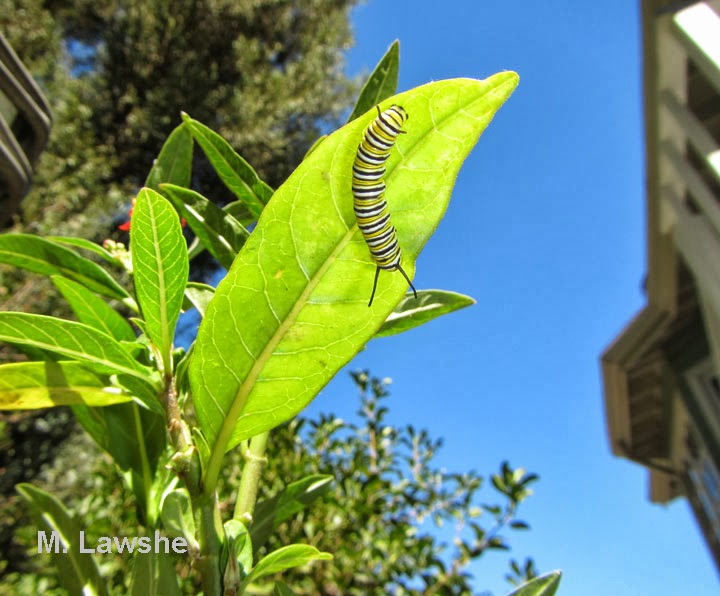
Milkweed is a host plant for monarch butterflies and apparently my plants came with tiny caterpillars already on them. I found the inch-and-a-half-long caterpillar, pictured above, on the underside of a leaf. (Yellow arrow points to leaf with the caterpillar just visible on the underside.) Because the caterpillars eat the plant leaves, placing several plants together in a “drift” creates a sustainable habitat for the future butterflies.


young white-crowned sparrow in background

This week we also had migratory birds arrive. Three white-crowned sparrows flew in: an adult and two youngsters. I would love to know if the adult is one of the white-crowns that spent the winter here last year. This small family of white-crowns has arrived about a 2 weeks earlier than in past years. I thought they might be traveling through, but they have stayed all week.


'sooty' fox sparrow
A second sparrow species, a ‘sooty’ fox sparrow arrived on Friday. 

This is the first time we’ve had a fox sparrow in the yard since 2000. It seems to have settled in, searching for food under the coffeeberry and hollyleaf and Catalina cherries. The native plants provide habitat that other plants do not.

Especially in the dry weather, the water in the bird bath and the fountain provide much needed water for migrating and local birds. Even birds of prey need a drink in hot weather.

It always amazes me when these migrating visitors stop in our yard. How do they find us? Do they see other birds going in and out of the yard? Do they hear or see the running water in the fountain? Are they attracted to the reptiles or native insects?

Do the butterflies smell the bloom of their favorite plants? This morning a bright yellow butterfly traveled through the yard investigating the milkweed and the flowering mallow. In the past, we have occasionally seen monarch butterflies. Perhaps with our addition of the milkweed we will become a habitat oasis for these butterflies as well.

Monday, September 23, 2013

"The California Wildlife Habitat Garden"

Book Review of

The California Wildlife Habitat Garden; How to attract bees, butterflies, birds and other animals by Nancy Bauer 

2012. University of California Press: Berkeley, CA.

CA native plants in our front garden
We all know it: habitat loss is a major cause of plant and animal diversity decline. Typically, the first examples that come to mind are exotic animals like Asian elephants pushed into diminishing forests by growing human populations in India or China. Some people might think of charismatic golden-lion tamarins, small primates, struggling to share coastal forests with the sprawl of Rio de Janeiro in Brazil. But few people, especially those living in California, realize our urban growth is creating similar habitat destruction and decline in our unique California biodiversity.

Nancy Bauer’s book places a well-needed spotlight on creating wildlife habitat specifically in California yards. In five chapters highlighting specific kinds of habitat, she lays out easy to emulate ideas. Each habitat type, whether bird habitat or wildlife pond, includes beautiful photos and a “Garden Profile” of a real garden transformed into a living landscape.
 

Western swallowtail butterfly on native hollyleaf cherry
If a pollinator garden peaks your interest, succinct appendices provide focused information like “Common California Butterflies and Host Plants” or “Top Nectar and Pollen Plant Families.” The watering and mulching information for “Oaks in the Landscape” provided tips that I hope will help our young oak trees be more healthy in the future.

Whether you are up for a dramatic change or willing to gradually create more natural plantings, Bauer’s book is a well-written and valuable resource. For ten years we’ve been gradually replacing exotic ornamental plants in our garden with California natives. Our water use has dropped and the biodiversity in our yard has tripled. With the native plants have come native insects, followed by the birds and reptiles that prey on those insects. If you create an island of habitat, wild creatures will find your oasis. You’ll not only have the pleasure of experiencing the butterflies and birds, but you will know you are providing them food and shelter vital for their survival.  


Habitat comes in all sizes; Even a few will-chosen host plants on a terrace can create habitat. A couple of “Seasonal Plants for Hummingbirds” will transform a sterile patio. Creating habitat is like drops of water collecting to become a stream. Your small habitat connects with a neighbor’s and gradually we create corridors for wildlife. Be inspired by Bauer’s book to make a positive difference. What species will you help save with your wildlife habitat garden?

Other Book Reviews:
"Life in a Shell"
"Feathers; The Evolution of a Natural Miracle"
"Alex and Me"
"The Geese of Beaver Bog"
"Survival of the Sickest"


Monday, August 05, 2013

California's Native Cherry

Native plants are the basis for creating wildlife habitat. The scarlet blush spreading across the Catalina cherry fruit alerts birds, insects and even mammals that this important native chaparral fruit is ripening.

Frequently introduced fox squirrels will ravage the fruit before it can ripen, but as more of our native plants mature there is more fruit for all of our wild visitors to discover. Today the house finches, hooded orioles and mockingbirds are beginning to enjoy these plump cherries. And of course the plants themselves provide nesting locations for birds (Allen's hummingbird).

The native cherries of California’s chaparral are related to the bing cherries and other varieties that humans cultivate, but these are wild growing plants. The Catalina cherry (Prunis ilicifolia lyonii) is found across the southern California Channel Islands (Santa Cruz Island). It is closely related to the holly-leaved cherry (Prunis ilicifolia ilicifolia) found along coastal hillsides on the mainland. But as the name implies, holly-leaved cherry has a leaf with holly-shaped prickles. The chaparral plant evolved this protection to reduce browsing by deer and other large herbivorous animals.

We have both holly-leaved cherry and Catalina cherry growing in our yard. Their close ancestry means we also have hybrids of the two. The Catalina cherry has evolved over the last 10,000 years without a large herbivore. In the Channel Island ecosystem there was no need to protect its leaves from large browsing animals, so the plant stopped expending energy on prickly leaves. The edges of the leaves are smooth.

Instead the Catalina cherry put more resources into larger fruit to attract the Channel Island fox (Urocyon littoralis). The small omnivorous fox relies on fruit for much of its late-summer-to-autumn diet. It can swallow the large pit of the cherry and transport the seed to areas distant from the parent plant in its scat.


While the fruit of the Catalina cherry looks similar to a cherry you might eat, I had my own moment of discovery when I tasted one. This cherry has not been cultivated to western human tastes. It is edible. The skin is somewhat sweet, but the pale flesh is astringent. Only when it is almost over ripe does it lose its bitterness and become palatable. According to Jan Timbrook in her book, Chumash Ethnobotany, the fruit of the cherry or “islay” was more valuable to the native peoples than acorns.

The fruit was used two ways. On occasion the thin layer of very ripe flesh was eaten directly or was mashed and dried to create a kind of fruit leather. However the most valuable part of the fruit was the seed or pit. Typically the fruit was collected in large quantities and allowed to rot. The flesh was then removed and the pit was cracked open to reveal the seed kernel inside. Like acorns, these kernels were poisonous if eaten directly and they had to be specially treated. The kernels were washed a number of times, either in hot or cold water, to leach away a form of cyanide. Once the bitter-tasting poison was gone the kernels were boiled, made into a mash and formed into balls or cakes. According to Timbrook’s sources the cakes are bean-like in texture and taste. 

So valued were islay cakes that they were frequently placed as offerings at sacred locations.

I wonder how the Chumash discovered the process to take advantage of this resource? Why did they even think the seed was valuable? Did they observe bear, deer, rodents, birds or other animals that made use of this plant?

I have often seen the pits opened and the kernels eaten out by some animal, but I’m not sure who. Still more to be discovered in my own yard.  

Saturday, May 04, 2013

Mosaic Bird House

Birds live and nest in my yard. Cavity nesting species can have a difficult time finding natural cavities in an increasingly human altered landscape. Dead trees are quickly removed for fire prevention or because people don't like dead plants. Unfortunately most people don't realize the diversity of life that can continue to live in a dead tree.


I've been putting up birdhouses around my yard for several years. The Bewick's wrens have taken advantage of these dwellings on several occasions. The oak titmouse pair inspects the real estate, but have yet to move in. There is the wine cork house, the lariat house, the wooden nestbox and the chicken pot, which wasn't supposed to be a bird house but the wrens thought otherwise.

The inspiration from my recent visit to a local Garden Show, spurred me to finish this mosaic birdhouse. The structure is a wooden birdhouse purchased from a local craft store. I made a point of looking for a shape and entry size that were attractive to my wrens. 

Bits of leftover tile, glass beads and polished stones were glued onto the structure with a tile adhesive. I topped it with a glass bird that had broken off of a swizzle stick provided by my friend Kim. Grout filed the spaces between the tiles and then the whole thing was sprayed with a sealer.

The intent was decoration, but the Bewick's wren pair are inspecting it already. They've just fledged their second clutch of kids this year. Maybe their third will grow-up in the mosaic house.

Thursday, May 02, 2013

Propagating Epiphyllums

The flower diversity at the Southern California Spring Garden Show prompted Douglas Welch of A Gardener's Notebook and I to talk about plant propagation.

I've successfully grown two variety of epiphyllum for years. The Sunset Western Garden Book gives the common name of "orchid cactus" for epiphyllum. Epiphyllums are a type of cactus with long flat stems that are scalloped along the edges and give the appearance of leaves. The few spines are at the base of these scallops. 

These plants naturally come from the forests of Central and South America where rain is frequent. It is odd to think of forest cactus, but that is what these plants are. They have small shallow roots and typically settle into the nooks and crannies in trees and between rocks. Here in pockets of leaf litter, they thrive on rain water and nutrients washing off the surrounding plants.

The wild plants have large, mostly white-or-cream-colored flowers that bloom at night with a heavy scent. They are pollinated by bats and they produce a fruit that is also eaten by mammals, who then disperse the seeds. Hybridized plants come in a broad spectrum of colors (ESA display at Garden Show) and they tend to flower during the day.

I'm going to share my plants with Douglas. Following the advice of the Epiphyllum Society of America, I cut off a blade and let it heal in a dark dry place for up to 10 days. One of the sections I selected already had a root forming when I cut it.

Douglas can now plant these in a loose soil of bark, sand and potting mix. Let it sit without water for 2 weeks then gradually begin to water occasionally. Once rooted they should be kept moist but not wet. I've found clay pots hold moisture during our hot summer without keeping the plants too wet.  It takes about 2 years for a cutting to bloom.

just about to bloom
To get the right amount of air flow, my pots are up on the edge of a wall in partial shade. The second perk to this location is that the sprinklers just lightly reach them.

While epiphyllums are not native to Southern California, the large valley carpenter bee will visit the blooms. Western fence lizards appreciate the elevated location and linger in the pots. And when the blooms open I am reminded how their shape is perfect for hugging a nectar eating bat. 

Wednesday, June 20, 2012

Discovery in the Garden

For the past few weeks I’ve been crazy busy with work, tasks generated by the wants of people. It sucks you in until it seems important, urgent, even vital. But in reality the pushing of paper from one pile to another, the sprinkling of well-placed words and the measuring of spaces between lines of text is a never-ending job without surprise or discovery. In other words, most of us humans are engaged in lifeless pursuits.

This morning, I went out into the yard for just a few minutes and watched two different species, a valley carpenter bee and an Allen’s hummingbird drinking nectar from the same “lipstick sage.” The amazing thing was they each approached the plant in a different way. The hummingbird drank directly from the red trumpet flower. The bee grabbed onto mature flowers that had turned white and licked at the outside base of the bloom. When it did this, the flower trumpet dropped under its body and the bee was put in a position where its legs went into the flower thereby delivering pollen.

The variety of species that are living in this small suburban plot of land has increased dramatically since I first started documenting and replacing “traditional” landscaping with plants and features that would create habitat. (hummingbird territories)

Discovery is a daily occurrence in a natural habitat; and that natural habitat doesn’t have to be a distant rainforest. Everyday the habitat that surrounds my home offers me real moments of life–survival, birth, death, discovery and change.

Thursday, April 19, 2012

Snake in the Yard

Some people might run screaming if they looked down to see a snake in their backyard, but for me it was a moment of soaring gratification.

Our yard is in the suburbs of Los Angeles. Most wild creatures have to be pushy to find a piece of real estate not overwhelmed by people. Gradually over the 19 years we have lived here we have restored native plants and tried to recreate habitat for California wildlife. Our goal was to create a wildlife refuge in our small yard.


CA slender salamanders, food for ring-necked snake
First the California slender salamanders made their presence known. Allen’s hummingbirds and Bewick’s wrens came to nest. Band-tailed pigeons and California towhees started making daily stops, while white-crowned sparrows, dark-eyed juncos and ruby-crowned kinglets began coming to spend the winter.

The birds brought native plant seeds, black nightshade, and attracted predatory birds like the Cooper’s hawk and red-shouldered hawk. The red-shouldered hawk dropped a western fence lizard into the yard. It took up residence. The western fence lizards have thrived.

And now a ring-necked snake, just a bit bigger around than a pencil and about 18” long, has arrived to hunt the young lizards and the salamanders. There is a natural balance settling over the yard. It  just proves that if you create habitat, wildlife will come.

Sorry there’s no photo. When I saw the snake moving gracefully through the grass, I thought about getting the camera. But I decided to just watch it gradually disappear into a bush and relished a moment of wildness in my “city” backyard.  Next time I'll take a picture, until then, check one of my favorite herp websites for photos CaliforniaHerps.com

Tuesday, May 25, 2010

The Foundation of Habitat

Creating habitat for bird life means starting from the plants and working up.

A well-planted yard provides shelter for birds, but quality habitat requires natural food sources as well.

Native plants like this anemone not only provide shelter, they attract native insects.

When you think of an important pollinating insect you probably think of a honey bee. But the European honey bee is not native to California (or North America for that matter).

Locally we have several species of large carpenter bees and bumble bees that pollinate plants, but many native plants are pollinated by less glorified insects – flies, beetles and moths. You can see the fly feeding on the pollen on the lower area of the flower.

Most native insects can only feed on the pollen of native plants. These insects are important food for larger insects, lizards and birds.


Creating habitat for birds means establishing an environment safe for insects–flies and beetles, as well as the more beautiful butterflies. See crane flies.

Plants and arthropods are the
foundation of habitat. Arthropods include insects, spiders and crustaceans (those little "c-shape" creatures that hop about on the ground when you lift up a pot, and yes, they are related to shrimp). Birds and lizards can establish thriving populations if your yard offers these vital resources. John Fitzgerald of Cornell University spoke last week in Los Angeles on bird conservation. He pointed out that the areas where eastern wood thrushes have declined coincide with areas of increased acid rain. The acidic rain kills the native crustaceans in the plant undergrowth, thereby removing an important food source for the wood thrush. Having a healthy population of creepers and crawlers, supports a healthy population of runners and fliers.

This western fence lizard not only eats its share of insects it also is makes your yard more healthy for you (fence lizard and Lyme's disease). Healthy fat lizards are also potentially a food source for red-shouldered hawks, shrikes and other birds.

If you want to help birds, you need to reexamine your ideal garden. Paradise isn't sterile. The Earth's garden is filled with abundance and diversity, including spiders, aphids and grubs.

Friday, April 16, 2010

Letting Go of the Word “Weed”

The dictionary defines a weed as “a wild plant growing where it is not wanted and in competition with cultivated plants.”

I’m letting go of this notion that wild free-growing plants are unwanted. And in doing so, amazing things are growing in my yard.

This wild cucumber or manroot (Mara macrocarpus) creates a beautiful delicate vine with white flowers in early spring. Now the fruit, these amazing prickly orbs the size of baseballs, are maturing and creating an exotic look. Because this vine is a native, it won’t grow out of control. It will die back to just its root during the summer.

But I didn’t plant this beautiful vine; it appeared.

The easiest way to increase native plants in your yard is to embrace the wild plants that show up on their own.

In an attempt to “control” nature, we label things as “weeds” and yank out the hearty native foliage that sprouts in our yards. Yet these plants typically are best suited for our soil, climate and water availability. These plants often are transported by native animals that depend on this vegetation for food and thereby spread the plant’s seeds.


Some plants that appear can be very invasive, but usually these are not native species. In my own yard I have a terrible problem with Oxalis pes-caprae, a South African species. Nothing eats it, it spreads uncontrollably and it pushes out other plants.

Native species usually have some creature or climate adaptation that controls their growth or spread. Before you pull out a new plant in your yard, identify it. Know What You Grow.

Earlier this year I discovered a black nightshade that had been introduced to the yard. At first I didn’t know what it was. But a friend saw my photos and identified the plant. A little research revealed that the black nightshade is an important native food source for some animals. I left it in. It is growing beautifully with purplish fruit, but the two plants have stayed small and have not spread.

I also have stopped trying to control my natives. I let a young mallow take hold about a yard from its original planted parent. Wild plants grow in the spots that are best suited for them. Yes, if a plant sprouts in a pathway I will remove it, but these self-starters are more likely to thrive in the locations they have chosen.

The valley scrub oak (Quercus agrifolia), that we lovingly planted 12 years ago, died in last year’s drought. But the four valley scrub oaks that were naturally planted by scrub jays are all healthy and growing. Toyon, Catalina cherry and holly cherry, are all natives reproducing naturally and becoming vital to erosion control on our hillside.

It’s my intention to create habitat in my yard, so I am letting go of the word “weed.” I’m embracing the wild plants that find their way to grow in our corner of the city and increase our backyard biodiversity.

Sunday, March 07, 2010

California Natives in Spring

The ceanothus is blooming in bursts of blue-purple flower sprays. This lovely California native is green year round but is shows off in the early spring. Throughout the Santa Monica Mountains large specimens are edged in purple to white blooms, giving them the common name California lilac.

There are a variety of cultivars and this Yankee Point ceanothus hugs the ground, making it perfect along the walkway up to the house.

Meanwhile, the spring rains and the increasing sunlight have awoken the slumbering redbud. While I love our flowering ornamental plum, the tree is older and suffers from termite damage. It is at the later part of its life. Beneath it we have planted a young redbud, a native species that will one day replace the plum. The redbud also blooms and the seedpods it produces are a food source for a variety of birds. Succession is a normal cycle in a habitat and we have chosen to let the plum nurture a native tree to eventually replace it in our wildlife habitat.

Planting native plants doesn't have to be an all or nothing proposition. Gradually adding natives allows you to learn where different species will be successful.

Tuesday, September 08, 2009

One Yard in a Great Big City


It is an amazing thing. I can stand in my kitchen in the San Fernando Valley and eat a bite of lunch while watching a desert cottontail munching on a blade of grass and a young southern California alligator lizard hunting a bug. Both of these creatures are about fifteen feet away from me, albeit on the other side of the glass window.

I live in one of the world's largest cities, but this morning 10 species of native birds were in my yard:
In another month as the migratory birds start passing through, that number will increase dramatically. All kinds of avian visitors will drop in for a day or for the winter.

This morning western fence lizards, adults and juveniles, were hunting insects. An anise swallowtail butterfly was laying eggs on the citrus trees and a tiger swallowtail stopped in for a snack.

What is truly amazing is the same thing isn't true at my neighbors' across the street. Their grass may be green and thick, but few native creatures live there. Our yard didn't start out this way, we have gradually introduced more native plants and added available water to our yard. We are an oasis of habitat in the city.

If you gaze out the window of your car or house and think, Los Angeles is a pretty green place? I challenge you to look at a satellite photo. The green you see is the Santa Monica Mountains and protected land. Photos from space reveal that the greatest area of land in Los Angeles is comprised roof tops, streets, asphalt school yards and parking lots. None of these provide habitat for beleaguered wildlife.

Now, the Station Fire has scorched large tracts of wildlife habitat in the Angeles Forest (just north of Los Angeles). Animals large and small are searching for new areas to find food, water and shelter.

But, every year the city expands and evicts similar numbers of plants and animals. It doesn't have to be that way. A yard can be habitat for wildlife. A narrow strip of land around a parking lot or a school can be planted with natives to provide shelter and food. It might take a little work and a change of priorities, but it is worth it. Every year our species list increases. I don't have to turn on the television to watch a "nature show," its happening right outside my kitchen window.

Thursday, August 14, 2008

A Bird Feeder in Every Yard

A red-shouldered hawk rises from the ground with a large fence lizard clutched in its talons. This isn’t a scene from a nature documentary, this is the view from my kitchen. I don’t live in rural Montana, but rather in the suburbs of Los Angeles, two blocks from one of the busiest freeways in North America, if not the world. How am I so lucky to see wildlife dramas on a daily basis? One main reason – ten years ago, I put out a bird feeder.

I know what you're thinking. “Wait a minute, hawks don’t come to bird feeders and neither do western fence lizards.” And you would be absolutely right, but putting out a bird feeder influenced our entire outdoor living space.

  1. It attracted birds to the yard in a visible way so that I could begin to learn the local bird species.
  2. New knowledge about what different birds were eating encouraged me to reconsider the plants I planted in the yard. I began to relandscape with native plant species to attract birds and butterflies.
  3. We stopped using all forms of toxic pesticides and herbicides in and around our house. Native insects reduced pest insects, lizards and bats moved in to eat the insects.
  4. We added a water feature to provide dependable water to wildlife during drought seasons, a greater variety of birds, including hawks, and rabbits arrived.

Putting out a bird feeder was the beginning of creating a habitat in my yard that supports a wide range of biodiversity. Seven species of birds now nest here - see our hummingbird babies. Two species of lizards reproduce in our garden; western fence lizard. Check out some of the creatures that share our suburban space - Backyard Biodiversity Project.

As I look out my window over the rooftops of track homes, past the Ventura Freeway and the growing amount of pavement and concrete, I take heart in knowing that my yard is an oasis for wild creatures. As cities expand, wild habitat is lost. Birds and animals lose important living, hunting and breeding territory. But it doesn’t have to be that way. You can make a difference. Put out a bird feeder. Begin offering a safe place for wild birds to find dependable food.

  • How do you decide on a bird feeder?
  • What food should you use?
  • What about water?

Each week AnimalBytes will take on an elemental question of how to start and be successful in creating habitat. We’ll start with bird-feeder basics.

Around the globe, wild animals are facing survival challenges as human populations expand and climate change alters weather patterns. If you make your yard, patio or even balcony a safe habitat, together we can change the world for the better.