Showing posts with label water for backyard habitat. Show all posts

Tuesday, January 25, 2022

New Birds in Your Yard?

I don't know why, but today new birds were showing up in my yard and in the yard of friends. In both cases the newcomers were at water features.
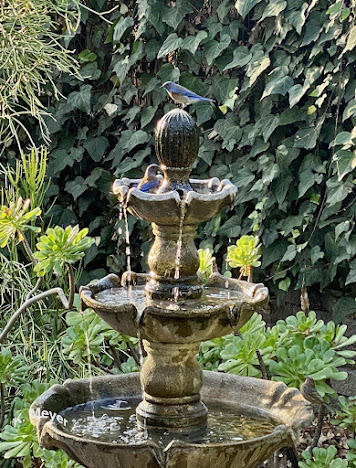
This lovely photo taken by our friend Kathy shows the two western bluebirds (Stalia mexicana) drinking from her fountain. The male is at the top and the female is in the top tier of the fountain. (I love the house finch that is down at the right looking up at the new visitors. You can really see that the bluebirds are bigger than the house finch (Haemorhous mexicanius).

Bluebirds are cavity nesters. They would like to move into a nest in a tree trunk created by a woodpecker. Bluebirds can't create the cavity themselves, so they are dependent on older trees with abandoned cavities. That is hard real estate to find in a sprawling city like Los Angeles. Nest boxes, however, can make all the difference in the world for these birds. Across the U.S., bluebirds depend on nest boxes to raise their chicks.

Learn more about bluebird nest boxes, including plans for one you can build at Audubon: https://www.audubon.org/news/how-build-bluebird-nest-box

We also had new visitors; a pair of northern flickers (Colaptes auratus). Interestingly the female was a western red-shafted subspecies and the male was a yellow-shafted subspecies, typically seen more to the north and east. They came and sipped water from our fountain with their long tongues used for eating ants.
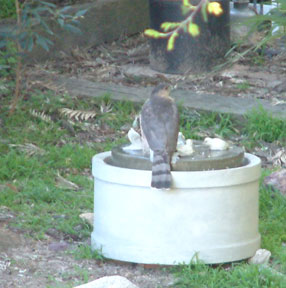
You don't have to put out birdseed to attract birds. Especially in Southern California, water is an important resource for wildlife.

While we had December rain, the past few days have been dry and windy. Both the bluebirds and the flickers were attracted to flowing water in fountains. In the morning our fountain is frequently visited by hummingbirds, warblers, finches, and on occasion a Cooper's hawk (like the one pictured).

A water feature doesn't have to be big to be important to birdlife; it just has to be clean and reliable. Provide water in your yard or on a balcony and you might be surprised who comes to visit.

Friday, September 24, 2021

Water - A Vital Resource for Wild Birds

This morning we awoke to this...


... a swirl of ash on the water dish on the ground. A bird coming south from the fires in northern and central California, stopped for a bath or at least a drink.

Especially in the dry weather we are having water is a vital resource for wildlife. On an especially hot dry day, two weeks ago, we even had this great horned owl drop in for a drink.

great horned owl in ground water dish
  

For long-distance travelers, known stop overs are vital to successful migration. In the past week we've had a female western tanager and a male black-headed grosbeak. Two other migratory birds arrived here in the last 48 hours: a white-crowned sparrow and a male Townsend's warbler. The white-crowned sparrow stopped for food and water, but the warbler stopped to take a bath in our fountain this morning. The native plants may provide him with an insect snack, but we don't directly provide warblers with food. Water and shelter in native vegetation are the draw. 

CA towhee on raised birdbath

You can make a difference for long-distance traveling birds. 

A running fountain, a raised birdbath, or even a shallow dish of water on the ground. 

Different birds and animals have different preferences. Always make sure that the location is safe from domestic cats.

While I was writing this a Cooper's hawk came and drank from the dish. It may be one of the youngsters that spent hot summer days here in 2019. Sitting with their feet in the cool water helps birds cool down. The red-tailed and red-shouldered hawks prefer the raised bird bath. Rabbits and desert tortoises prefer the ground dishes.

Juvenile Cooper's hawks
 

Climate change challenges wildlife survival. Provide clean water and give back to the natural world. (Still water should be replaced every day or every other day.)


Tuesday, July 23, 2019

Juvenile Cooper's Hawks Staying Cool

If you want to attract wildlife to your backyard habitat...provide water.


Especially in the west, where summer temperatures continue to rise each year, water is a vital resource for wildlife. We have a new pair of Cooper's hawks that have recently fledged. Their parents taught them to come to our backyard for water and ...


...to keep cool. For these young birds of prey the option to stand in cool water, helps them cool down. These two have been daily visitors for the past two weeks. At first they stood and watched the house finches and lesser goldfinches on the bird feeder. Now they are beginning to understand that these smaller birds are their prey.


Sometimes they stand in the water for 10-15 minutes at a time. Their mottled feathering really helps them camouflage in the dappled shade.

We provide both still and flowing water in a fountain. We don't want to provide habitat for mosquitoes, so we change out the still water every other day and the fountain's well of water is covered. Mosquito-borne diseases can be deadly to birds and people. Keep your water clean. 

Adult Cooper's hawk in birdbath
Previous Cooper's hawk juveniles