Showing posts with label A Gardener's Notebook. Show all posts

Thursday, May 02, 2013

Propagating Epiphyllums

The flower diversity at the Southern California Spring Garden Show prompted Douglas Welch of A Gardener's Notebook and I to talk about plant propagation.

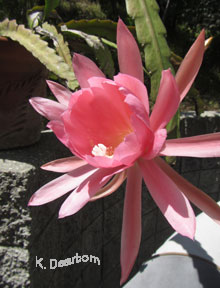
I've successfully grown two variety of epiphyllum for years. The Sunset Western Garden Book gives the common name of "orchid cactus" for epiphyllum. Epiphyllums are a type of cactus with long flat stems that are scalloped along the edges and give the appearance of leaves. The few spines are at the base of these scallops. 

These plants naturally come from the forests of Central and South America where rain is frequent. It is odd to think of forest cactus, but that is what these plants are. They have small shallow roots and typically settle into the nooks and crannies in trees and between rocks. Here in pockets of leaf litter, they thrive on rain water and nutrients washing off the surrounding plants.

The wild plants have large, mostly white-or-cream-colored flowers that bloom at night with a heavy scent. They are pollinated by bats and they produce a fruit that is also eaten by mammals, who then disperse the seeds. Hybridized plants come in a broad spectrum of colors (ESA display at Garden Show) and they tend to flower during the day.

I'm going to share my plants with Douglas. Following the advice of the Epiphyllum Society of America, I cut off a blade and let it heal in a dark dry place for up to 10 days. One of the sections I selected already had a root forming when I cut it.

Douglas can now plant these in a loose soil of bark, sand and potting mix. Let it sit without water for 2 weeks then gradually begin to water occasionally. Once rooted they should be kept moist but not wet. I've found clay pots hold moisture during our hot summer without keeping the plants too wet.  It takes about 2 years for a cutting to bloom.

just about to bloom
To get the right amount of air flow, my pots are up on the edge of a wall in partial shade. The second perk to this location is that the sprinklers just lightly reach them.

While epiphyllums are not native to Southern California, the large valley carpenter bee will visit the blooms. Western fence lizards appreciate the elevated location and linger in the pots. And when the blooms open I am reminded how their shape is perfect for hugging a nectar eating bat. 

Tuesday, April 30, 2013

Finding Inspiration at the Southern California Spring Garden Show

Display by Don Davidson and Fiesta Parade Floats
Last weekend I dashed off to the Southern California Spring Garden Show at the South Coast Plaza with friends. There is something inspiring about the colors and shapes of plants and flowers even when they are showcased indoors.

The colors and textures were dazzling.


notice how the blocks of color are a blend of flowers

The Epiphyllum Society of America illustrated how variation in one plant can make for splendor.


The display gardens were filled with wondrous ideas. "Paint by the Numbers" presented by Living Landscapes (www.LivingLandscapes.us) demonstrated the power of color. (Even though I was looking for some native plants that would also provide habitat.)

"The Art of Exterior" presented by The Garden Gallery highlighted the art of humans and nature. (www.theggallery.com)

While the display garden by the Orange Coast College Horticultural Club & Architecture Technology (www.occhorticultureclub.wordpress.com) integrated natural forms with a complex structure that complimented the organic elements and created airy height.

I've never seen so many different kinds and colors of orchids anywhere in one location. Everywhere you looked there were inspirational shapes, colors, textures, combinations and the simple reminder that nature is rejuvenating.


Visit a local garden show, go for a walk in a local park or nature center. Take in the tonic of spring.

For more inspiration visit my friend Douglas Welch's blog A Gardner's Notebook for video and photos of the Southern California Spring Garden Show. Toward the end of the video, I promise there is a purple orchid like nothing you have ever seen.

Wednesday, May 02, 2007

Beneficial Wild Creatures In Your Garden


When my friend Douglas Welch of A Gardener's Notebook read the post about the benefits of western fence lizards in our garden, he proposed a joint effort on beneficial wild animals you should attract to your garden.

To find out why it’s important to attract this valley carpenter bee to your yard, read my post Beneficial Wild Creatures In Your Garden on A Gardener’s Notebook.