Showing posts with label backyard biodiversity. Show all posts

Friday, January 09, 2015

Encountering a Bull Elk

Why create habitat in your yard? Because when you interact with other living things you have a better understanding of yourself. Sounds a bit heavy-handed, but I believe it. 

A backyard with habitat attracts native species. Today a red-tailed hawk watched me trying to apprehend a pocket gopher. Check out video of our resident Bewick's wrens, valley carpenter bees, lizards, grasshoppers and red jumping spider.

this younger male is small by comparison and still in velvet
Living in a metropolitan area, my interactions with large animals come when I'm off hiking or traveling. This summer I had an amazing encounter with a bull Roosevelt elk (Cervus elaphus roosevelti). He was right off a heavily trafficked trail in Redwoods National Park, but few people noticed him. The Roosevelt elk is the largest subspecies of elk surviving in North America and this male was huge, the size of a large horse. He stood 5 foot to the shoulder, with a long neck, and antlers that reached 3-4 feet up from his head.

Bull Roosevelt elk average a 16-year life span in the wild. The older the male the larger and more branched his antlers. Elk antlers are a renewable resource; they drop off after the breeding season and are grown anew the following year.


The older male shown here is just entering the rut, or breeding season. While the antlers are growing they are covered with a thin layer of tissue and are vascular, blood flows through the bony growth. As the breeding season approaches in the fall, antlers stop growing. Blood stops flowing through the antler and thin skin layer. The tissue covering dries up and the bull rubs his antlers against bushes and other vegetation to remove the velvety covering. Here you can see that this male has been removing velvet that still had some vascular circulation; his antlers appear bloody. 

With the beginning of the rut, male elk are filled with testosterone. Breeding and competing for females take priority over any other activity, even eating. Few males remain the dominant or top breeding male for more than a season. A top male will frequently be so worn out by the end of the rut that he does not have the energy reserves to survive the winter.


two female elk with their calves at twilight
The Roosevelt elk is found only along the northwest coast from northern California, to Oregon and Washington, and on two Alaskan islands where they were introduced. The subspecies was named for President Theodore Roosevelt who created Olympic National Park in Washington state as a preserve for the 20 remaining members of this elk subspecies in the early 1900s. Today over 7,000 individual Roosevelt elk can be found across their range. They are another example of successful conservation, including well-managed hunting. Channel Island Fox.

This large member of the deer family plays an important role in clearing the forest understory. They help keep forests healthy by creating open space for other animals and encouraging the growth of young plants. Healthy elk populations, however, need predators. Let's keep our fingers crossed for the gray wolves making their way back into California and the mountain lions trying to maintain healthy numbers. 


In the mean time, make 2015 the year you make your backyard a habitat for native plants and wildlife.

Tuesday, December 02, 2014

Native Plants from Seed

Sometimes it is hard to find the native plants you are looking for. 

bladderpod seedlings
Seeds can be your answer.

fairy duster

I've admired the bladder pod and fairy duster (Calliandra ssp) in a friend's yard. This summer I asked if I could gather some seed from their plants.

I scattered a few seeds in some pots and watched over them. To my happy surprise, I have small plants.

They aren't quite ready to put in the ground, but some are ready to be moved to their own pots.

lupine seeds from a local native plant organization
Seeds represent future possibility. Not sure what to get someone as a small gift - How about seeds?

Wednesday, April 09, 2014

Mourning Cloak Caterpillars

I first noticed them as a small mass of black threads high in the ornamental plum tree–black caterpillars about the thickness of a pen.

They were clumped together munching on the purple leaves. It has been a while since we have had mourning cloak caterpillars, but I recognized them immediately–bristly black caterpillars with spots of deep red. With all of the nesting birds gathering food for chicks, the caterpillars were fortunate not to be spotted in the top of the tree.

Mourning cloak butterflies are one of the few species, like monarchs that overwinter as adults. A tattered adult frequented the yard a few weeks ago. It must have been a female that laid eggs on the newly emerged plum leaves.

A few days later I saw them again, but the clump had become more dispersed and they seemed plumper. 

On Sunday, I just happened to see one "wandering" up the front of the house. It had trekked down the tree, across the ground, across the walkway and started up the wall. Wandering is the phase of a caterpillar's life when it leaves the food resource it has matured on and goes in search of a quiet place to start its metamorphosis into a butterfly. The caterpillar didn't know how lucky it was, I also spotted an alligator lizard waiting at the trunk of the tree and feasting upon some of the caterpillar's less lucky siblings.

Monday, I watched a second caterpillar troop up the wall of the house.

This individual attached itself to the bottom center of our "Welcome" sign. For about 24 hours it hung there, upside-down, in a "J" position.

But yesterday afternoon I was lucky enough to catch the moment when it dropped its spiky black outer skin and became a chrysalis. For a few moments it twitched and shuddered, hanging from the tiny base of silk that attached it to the ceramic sign. Then it became very still.

In the next 10-14 days it should emerge as a butterfly. How exciting! 

We planted nectar plants to attract butterflies and it seems to have worked. Hopefully, this is just the first of several butterflies species we will have this year.

Thursday, April 03, 2014

Bewick's Wrens Build a Nest

The Bewick’s wrens committed to building a nest in the cow skull on the back patio this spring. Both the male and female are in on this venture, but I can’t tell them apart. Listen for their communications as one works and the other makes suggestions or comments.

Once you watch this, you will never question that birds communicate specific things to each other.


The Bewick’s wren (Thryomanes bewickii) is a medium-sized wren found across the southwestern United States. They are believed to be monogamous. Typically their nest is built in a cavity, like a tree hollow, but they will use a nest house or even a ceramic pot. 


The male is the primary nest builder with the female adding the finishing touches after she has approved the venture. She incubates the eggs, but he helps feed the offspring. Typically, it’s just a 14 day incubation and then just 14 days before the chicks leave the nest. The little ones are moderately feathered when their parents urge them out into the world. The little family tends to stay together for several weeks. The parents move the youngsters to various hollows and hidden areas and gradually teach them to hunt for insects.

For more 1 minute nature videos see TheEarthMinute.com

Each week take a minute to find inspiration in the natural world. Take a one minute hike, a one minute adventure, escape for a minute of exploration. TheEarthMinute.com

Thursday, March 27, 2014

Managing Your Backyard Treescape

Daintree Rainforest, Cape Tribulation, northern Queensland, Australia
When you look into a forest, like the rainforest in northern Queensland Australia, it can be hard to see the individual trees from the forest. 


In man-made woodlands around our homes and workplaces, we get used to a specific look–big tree with smaller shrubs and ground covers. But a wild forest is forever changing and there is a progression of plants: small trees growing up under still standing larger trees. Too often we forget that trees have a lifespan or can be compromised by drought, disease, or poor management.

In our neighborhood we have seen these three variables reduce the large trees dramatically over 20 years. Our once tree-lined streets, now are sunny and mostly treeless.

During a botany walk a few years ago with representatives from some of the major botanical gardens in Southern California, I learned a valuable lesson–think like a forest and plan for succession of large trees. Several of these destination gardens had learned the hard way that wind storms and unexpected disease can wipe out your man-made forest in short order and regrowing those valuable trees takes time.


I know I have two trees that are past their prime. Our flowering plum tree (Prunus cerasifera) can put on a beautiful display in spring, but it is not a long-lived species and termites are now compromising this tree. She probably has a few more years, but it is time to think about succession. What will take this tree's place? Five years ago I planted a native redbud (Cercis occidentalis), just down hill of the plum tree. Finally, it is really taking hold and starting to grow. It too will offer flowers in the spring, but it will also offer food to native birds and insects. And three years ago I discovered a native coast oak (Quercus agrifolia) coming up as a volunteer. I'm grooming these two trees to take the place of the flowering plum.

Last year the arborists discovered a hollow in the Chinese elm (Ulmus parvifolia) that threatens to weaken the tree over the next few years. It will be a loss to our backyard shade when it goes, but we are planning ahead. We planted a native California sycamore (Platanus racemosa) just uphill to eventually take the elm's place.

Succession is natural in wild landscapes and with a little thought, you can make it natural in your landscape as well.

green ant from Australian rainforest
Intrigued by the Australian rainforest. 

Take a 1 minute escape to this far away landscape at TheEarthMinute.com


Saturday, October 26, 2013

Painted Lady Butterfly

The milkweed and the butterfly bush are blooming and providing nectar for butterflies.


This beautiful painted lady butterfly stopped to rest and eat before continuing on its travels.  Some springs we have seen mass migrations of these butterflies.

In the past week I've also seen a mourning cloak, monarch and a checkered white in the yard. I'm hoping that the drift of nectar producing native plants we've added to the front hillside will attract and nourish a growing number of our native butterflies. Creating habitat for wildlife begins with providing natural food, shelter and water.

Friday, October 11, 2013

Ant Lions and Pocket Gophers

Have you ever seen one of these perfectly conical pits in the dirt?


This is an ant lion pit trap. It is about the circumference of nickel. The ant lion larva waits down at the bottom of its beautifully constructed pit waiting for an ant or other insect to wander in. The angle of the pit's sides make it difficult for the insect to get out easily. As grains of sandy dirt roll down the sides of the pit, the ant lion springs to action and grabs its prey.

In order to make this beautifully formed pit, the ant lion needs a specific texture of sandy dry soil. This summer I have been cursing a gopher that has eaten my wild roses and some of my wild currants. But in the midst of planting new plants, I noticed that everywhere there was a pile of dirt kicked out by the gopher there were ant lion pits.

This soil had the perfect consistency for the the ant lions. Hmm. The gopher's work turning the soil was facilitating the right habitat for the ant lions who are trying to control the ant population.

There are plants that the gopher seems to avoid: lemonade berry, Catalina and hollyleaf cherry and toyon. I'm also trying Cleveland sage and milkweed. There has to be something the gopher doesn't like.


These ant lion larva will survive the winter underground and emerge as winged adults that look somewhat like a small dragonflies in the spring.

Saturday, September 28, 2013

An Oasis of Habitat in Los Angeles

Food, water and shelter–these are the three requirements for all living things. Provide them in your yard and you will create a vital oasis for wildlife.
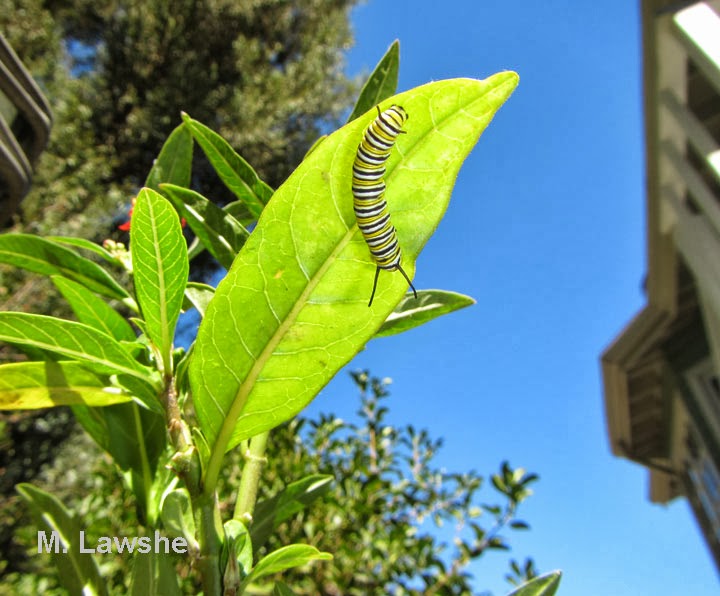
Taking a suggestion from The California Wildlife Habitat Garden by Nancy Bauer (book review), last weekend I planted a drift of milkweed (Asclepias curassavica). This species of milkweed (also called “blood flower” according the Western Garden Book) is actually native to South America, however it is the easiest species of milkweed to find at garden centers. I planted five plants on a slope, between some native sage and California fuchsia.
 

caterpillar on the underside of leaf
Milkweed is a host plant for monarch butterflies and apparently my plants came with tiny caterpillars already on them. I found the inch-and-a-half-long caterpillar, pictured above, on the underside of a leaf. (Yellow arrow points to leaf with the caterpillar just visible on the underside.) Because the caterpillars eat the plant leaves, placing several plants together in a “drift” creates a sustainable habitat for the future butterflies.


young white-crowned sparrow in background

This week we also had migratory birds arrive. Three white-crowned sparrows flew in: an adult and two youngsters. I would love to know if the adult is one of the white-crowns that spent the winter here last year. This small family of white-crowns has arrived about a 2 weeks earlier than in past years. I thought they might be traveling through, but they have stayed all week.


'sooty' fox sparrow
A second sparrow species, a ‘sooty’ fox sparrow arrived on Friday. 

This is the first time we’ve had a fox sparrow in the yard since 2000. It seems to have settled in, searching for food under the coffeeberry and hollyleaf and Catalina cherries. The native plants provide habitat that other plants do not.

Especially in the dry weather, the water in the bird bath and the fountain provide much needed water for migrating and local birds. Even birds of prey need a drink in hot weather.

It always amazes me when these migrating visitors stop in our yard. How do they find us? Do they see other birds going in and out of the yard? Do they hear or see the running water in the fountain? Are they attracted to the reptiles or native insects?

Do the butterflies smell the bloom of their favorite plants? This morning a bright yellow butterfly traveled through the yard investigating the milkweed and the flowering mallow. In the past, we have occasionally seen monarch butterflies. Perhaps with our addition of the milkweed we will become a habitat oasis for these butterflies as well.

Monday, September 23, 2013

"The California Wildlife Habitat Garden"

Book Review of

The California Wildlife Habitat Garden; How to attract bees, butterflies, birds and other animals by Nancy Bauer 

2012. University of California Press: Berkeley, CA.

CA native plants in our front garden
We all know it: habitat loss is a major cause of plant and animal diversity decline. Typically, the first examples that come to mind are exotic animals like Asian elephants pushed into diminishing forests by growing human populations in India or China. Some people might think of charismatic golden-lion tamarins, small primates, struggling to share coastal forests with the sprawl of Rio de Janeiro in Brazil. But few people, especially those living in California, realize our urban growth is creating similar habitat destruction and decline in our unique California biodiversity.

Nancy Bauer’s book places a well-needed spotlight on creating wildlife habitat specifically in California yards. In five chapters highlighting specific kinds of habitat, she lays out easy to emulate ideas. Each habitat type, whether bird habitat or wildlife pond, includes beautiful photos and a “Garden Profile” of a real garden transformed into a living landscape.
 

Western swallowtail butterfly on native hollyleaf cherry
If a pollinator garden peaks your interest, succinct appendices provide focused information like “Common California Butterflies and Host Plants” or “Top Nectar and Pollen Plant Families.” The watering and mulching information for “Oaks in the Landscape” provided tips that I hope will help our young oak trees be more healthy in the future.

Whether you are up for a dramatic change or willing to gradually create more natural plantings, Bauer’s book is a well-written and valuable resource. For ten years we’ve been gradually replacing exotic ornamental plants in our garden with California natives. Our water use has dropped and the biodiversity in our yard has tripled. With the native plants have come native insects, followed by the birds and reptiles that prey on those insects. If you create an island of habitat, wild creatures will find your oasis. You’ll not only have the pleasure of experiencing the butterflies and birds, but you will know you are providing them food and shelter vital for their survival.  


Habitat comes in all sizes; Even a few will-chosen host plants on a terrace can create habitat. A couple of “Seasonal Plants for Hummingbirds” will transform a sterile patio. Creating habitat is like drops of water collecting to become a stream. Your small habitat connects with a neighbor’s and gradually we create corridors for wildlife. Be inspired by Bauer’s book to make a positive difference. What species will you help save with your wildlife habitat garden?

Other Book Reviews:
"Life in a Shell"
"Feathers; The Evolution of a Natural Miracle"
"Alex and Me"
"The Geese of Beaver Bog"
"Survival of the Sickest"


Monday, August 12, 2013

Desert Tortoise with a Friend

This discovery in the garden made me laugh. Our young male California desert tortoise has a friend. Can you spot it?


Yes, there is a young western fence lizard sitting on the tortoise's back. They were both basking in the morning sun. You might think the lizard had mistaken the tortoise for a rock. But I don't think so. When the tortoise walked, the lizard held on. Later in the day, the two were in a different location by side-by-side.


 Interested in turtles and tortoises? I recommend Life in a Shell.

Friday, August 09, 2013

Discovery in the Night Garden

Even at night, the yard is filled with biodiversity to be discovered. This common orb weaver spider was getting an early jump on Halloween and building a foot-wide web along the stairway. This wasn't a chance event. This spider specifically was building its web across an area busy with insects attracted to our porch light.

There was another more unexpected visitor at dusk–a young raccoon.

Its glowing eyes prompted us to call it "zombie coon."

The flash from my friend's camera reflected perfectly off of the raccoon's tapetum lucidum. This is an adaptation that allows night-time creatures to see well in the dark. Light that did not directly strike the retina is reflected off of a substance in the back or along the side wall of the eyeball so that it has a second chance to pass through the retina. This allows the greatest amount of available light to reach the optic nerve for vision. 

Tapetum come in a variety of shapes, are located in a variety of places in the eye and are made of a variety of reflective substances. The amazing thing is that this adaptation has evolved in many different nocturnal animals. Alligators and crocodiles, canines (dogs, wolves, coyotes), felines (cats, big and small), ungulates (prey animals like cattle, antelope, deer), rodents and rabbits, sharks, owls and dolphins all have tapedum. 

As members of Order Carnivora, we think of dogs and cats as being closely related to each other. What fascinates me is that the tapetum in a cat (Tabby or African lion) is formed by riboflavin in the tissue along the sides of the inner eyeball, while a dog's tapetum (terrier or wolf) is formed by zinc crystals in the back of the eye. This is a wonderful example of evolution in these two different branches of Order Carnivora.

Raccoons are in the Suborder Caniformia with canines (the same evolutionary branch) and therefore what you see in the photo is the white light of the flash reflecting off the zinc crystals at the back of the eye and streaming back through the pupil. Amazing isn't it? 

In another example of evolution, the tapetum in members of Order Artiodactyla (hippos, deer, antelope and bovines) is formed by collagen in the back of the eye. Whales and dolphins have a tapetum with the same collagen structure. Fossil evidence and DNA have now demonstrated the close evolutionary relationship between whales and hippos.

Most primates, including humans, are one of the few groups of mammals that do not have tapetum. Without fire, or man-made light, humans do not see well in the dark.

Discovery is all around you!

Thursday, August 01, 2013

When a Fence Lizard and an Alligator Lizard Meet

When you're traveling, discovery comes easily. But wilderness in our own backyards and neighborhoods can offer discovery as well.

I went out this morning looking for something unexpected and two lizards found me. 

Lizards in my yard are not unexpected. Western fence lizards (Sceloporus occidentalis) have become abundant over the last 10 years. This year we have already seen at least three new babies. The more native California vegetation we have, the more we attract native insects and the greater the resources for the lizards.


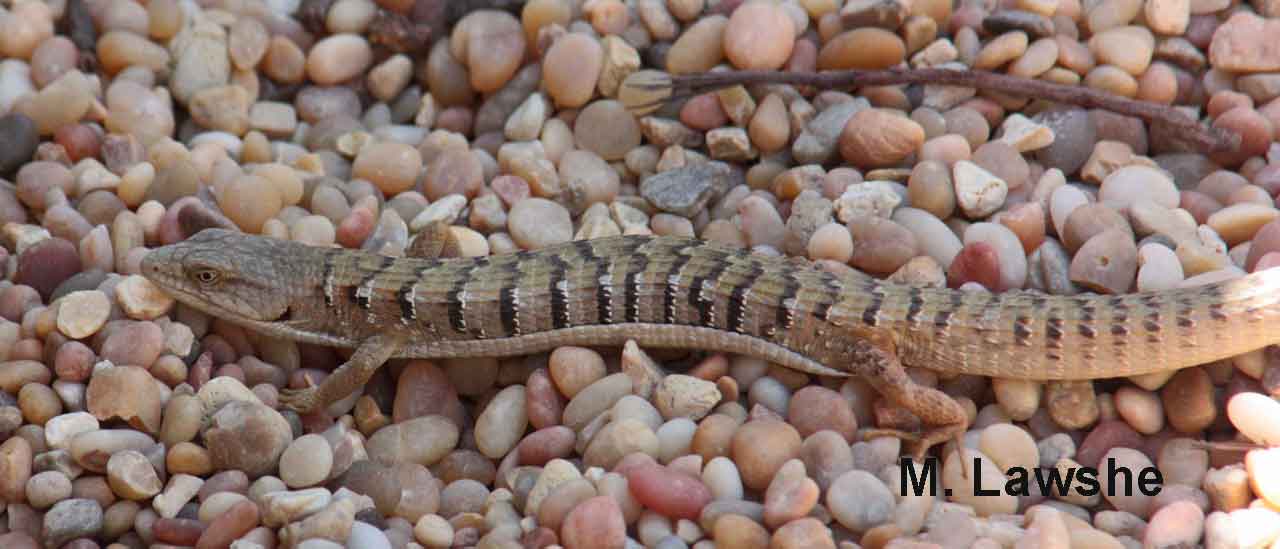
Alligator lizards (Elgaria multicarinata) like the one pictured above, have been resident in our yard since we moved in 19 years ago. But I have never seen these two lizard species interact. 

Fence lizards are sun lovers, frequently basking out in the open. They communicate with each other visually with displays of head bobbing and revealing their blue chests. The alligator lizards, on the other hand, are shy creatures slipping through the shadows and feeding into the night on warm summer evenings.

This morning I happened upon an adult western fence lizard and a sub-adult alligator lizard. The fence lizard was trying to chase the alligator lizard out of its territory. The alligator lizard (about the girth of a pencil and 7"-8" long) took refuge on a branch in a bush about a foot off the ground. It turned, like its namesake, with an open mouth and hissing. It tried to scare off the fence lizard.

It was a miniature primeval world moment - wild lizards unencumbered by the actions of people. I ran to get the camera, but only got a picture of the fence lizard. While the fence lizard is primarily an insect eater, a larger alligator lizard could prey on the two-inch-long western fence lizard hatchlings. 

If you just take a moment to observe, you'll be surprised what you can discover close to home. This August Discover yourself.

(Australian wild lizards, Turkish wild lizards)


Tuesday, April 16, 2013

Pocket Gopher - Villain or Hero?

Ahh! They are back. A pocket gopher has tunneled its way to the lower area of my front yard and undermined one of my native Douglas iris. In the past this area has been beyond their reach, but not any more.
 
Of course, the destructive gopher hones in on what it prefers, my native plants. 

The Douglas iris in the upper left is the current gopher target.
Previous gophers have eaten the roots and rhizomes right off of my native iris in the backyard. I’ve put metal screen boxes underground around plants. I’ve planted narcissus bulbs as alleged gopher deterrents. I’ve even joined my dog in digging them out. I curse the gophers, but they do have a purpose.

Our southern-California soil has a lot of clay. 


The gopher is kicking hard-packed clay up from under the sidewalk
This element of our soil was vital to the adobe bricks that built our missions and the clay tiles of Malibu and Catalina Tile Companies. The industrious, and hungry, pocket gopher tunnels through the hard soil searching out the roots of plants. 

As it builds its underground highway it aerates the soil and mixes the sediments. It creates underground pathways for water to flow and roots to follow. The gopher’s earthen works even provide a protected highway for other animals such as worms, arthropods and especially amphibians.

The underground tunnels of pocket gophers enable salamanders and frogs to travel in a moisture controlled environment without the threat of dehydration. Remember in southern California we have six or more months without rainfall. Gopher tunnels enabled California slender salamanders to travel from my backyard down into the lower areas of the front yard.

Even sections of collapsed tunnel create homes for western fence lizards and alligator lizards.

If only the pocket gopher would eat plants I don’t want. Well, here’s the rub, it is. The root and bulb of this noxious oxalis (an African invasive) has been sheared off by the gnawing teeth of the pocket gopher.  


underside of oxalis with root sheared right off
Living underground, pocket gophers were one of the few animals that survived the volcanic eruption of Mt. Saint Helens. Tunneling activity brought nutrient rich soil up through the volcanic ash layer creating opportunity for plants to reestablish. Just as in my yard, amphibians traveled back into oases of habitat through the gopher tunnels. When large animals, like elk came into the blast area from its edges, their feet broke through the gopher tunnels mixing soil with elk droppings thereby adding seeds and nutrients to the soil.

At Mt. Saint Helens, the pocket gopher is a hero. It would be a hero in my yard if...and here is the big if... if there were a medium-sized predator to control their overpopulating and devouring my entire garden. The coyote, red-tailed hawk and great horned owl seem to be focusing their efforts else where. That leaves me the task of being the predator controlling the gopher population. If the native iris are to survive–out comes the gopher trap.


Friday, July 20, 2012

Green Lynx Spider Stalking Yellow Jackets

What killed this yellow jacket wasp?
Yellow jackets are a kind of wasp and many people fear them. Their black and yellow coloration is mistaken for honey bees and people are afraid of being stung. 


We have a low number of yellow jackets in the yard, but when you see them at a protein food source, like a hawk cast, it appears they are numerous. Video. When we first moved to this house 18 years ago, we couldn't eat on our patio without being harassed by 10-20 yellow jackets. We put out traps for them.


The problem was that we didn't have a balanced ecosystem. The previous owners sprayed for insects, baited for snails and planted mostly non-native plants. Gradually we have restored a more natural flora, which in turn attracts native animals–from insects to raccoons.


The Cooper's hawks are feeding their youngsters in the backyard. The young hawks are dropping bits of meat, this feeds the yellow jackets. But the yellow jackets are also eating the caterpillars that show up on my tomatoes. And the yellow jackets have a predator too.
Green lynx spider feeding on a beetle

This lovely green lynx spider prowls the vegetable garden leaving behind the dried exoskeletons of yellow jackets and other insects. Egg sac. We do less and the natural balance of biodiversity does more.

More on California spiders:
red jumping spider
trashweb spider
trapdoor spider 
cobweb spider 

Saturday, July 14, 2012

Insects Feeding on Hawk Leftovers

The young Cooper's hawks are becoming the center of their own ecosystem. Their overworked parents bring food, drop it off and leave again, just that fast. With four juveniles that eat as much as they do, each parent is having to catch three times its normal prey. 


They aren't restricting their hunting to birds, they are bringing back whatever they can find. Rats have definitely been on the menu.


The juveniles eat their fill and then, similar to owl pellets, they cough up clumps of hard to digest bones and fur.


These "casts" are a bit gory, but they are in turn providing food to carnivorous insects like the yellow jackets in the video here. Listen and you will hear one of the young hawks calling in the background. Ants and flies are eating the leftovers, while western fence lizards are then pouncing on both species of insects. Spiders also will benefit. The ring-necked snake benefits from the success of the lizards.


Our yard is alive with biodiversity. Thanks to Eclipse-1 Media.

Friday, June 22, 2012

Small Blue Flower in Garden

The small bracted dayflower (Commelina erecta) on the hillside creeps close to the ground and is inconspicuous to humans. But it’s fleshy leaves are enjoyed by the tortoises that live with us. The tiny flowers bloom for 1-4 days attracting the native carpenter bees and pollinating flies.

It grows in disturbed soil and is a highlight of our garden in dry shady areas. Finding a ground cover for dry shade is not easy. The intensity of the blue flowers is like the burst of flavor from a ripe blueberry.

Thursday, June 21, 2012

California Spiders

On this longest day of the year, I'm looking for biodiversity.
American house spider
Rachel Carson wrote in Silent Spring that in a healthy environment there should be at least one spider within 3 feet of you at all times. Spiders are the Earth’s dominant predators. On any day I can surprise myself with the variety of spiders I can find.

Look for the fragile webbing strung under this dead flower.

A small American house spider (Achaearanea tepidariorum) has constructed a web beneath a spent bird-of-paradise (Strelitzia reginae) bloom.
While a trashweb spider (Cyclosa turbinata) may stay hidden, but it’s web is purposefully visible stretched between the branches of a dwarf lime tree. Several generations of this spider’s great grandmothers have called this tiny tree home. The collection of debris in the center is wrapped with silk that reflects ultraviolet light waves and is therefore believed to attract flying insects. This spider truly lures in its prey.

These spiders are important predators eating insects, providing spider web that is used by many birds in constructing nests, and the spiders are in turn eaten by larger animals.  If you have spiders you are on your way to healthy habitat.

Wednesday, June 20, 2012

Discovery in the Garden

For the past few weeks I’ve been crazy busy with work, tasks generated by the wants of people. It sucks you in until it seems important, urgent, even vital. But in reality the pushing of paper from one pile to another, the sprinkling of well-placed words and the measuring of spaces between lines of text is a never-ending job without surprise or discovery. In other words, most of us humans are engaged in lifeless pursuits.

This morning, I went out into the yard for just a few minutes and watched two different species, a valley carpenter bee and an Allen’s hummingbird drinking nectar from the same “lipstick sage.” The amazing thing was they each approached the plant in a different way. The hummingbird drank directly from the red trumpet flower. The bee grabbed onto mature flowers that had turned white and licked at the outside base of the bloom. When it did this, the flower trumpet dropped under its body and the bee was put in a position where its legs went into the flower thereby delivering pollen.

The variety of species that are living in this small suburban plot of land has increased dramatically since I first started documenting and replacing “traditional” landscaping with plants and features that would create habitat. (hummingbird territories)

Discovery is a daily occurrence in a natural habitat; and that natural habitat doesn’t have to be a distant rainforest. Everyday the habitat that surrounds my home offers me real moments of life–survival, birth, death, discovery and change.

Monday, January 23, 2012

Look At the "Wonderful World"

At long last it is raining. But it does mean that going out into the world today is more difficult.


If rain or snow, work or obligations have you trapped indoors today, take a beautiful walk out into the wonderful world with David Attenborough and the photographers of BBC One.


Follow the link to the short video: http://www.wimp.com/wonderfulworld/

It will make you think again about what is beautiful and valuable.

Friday, April 22, 2011

Earth Day Gift

Happy Earth Day!


I've been too busy lately; busy at the computer, busy with projects. I haven't taken my own advice. I haven't been out in the yard. 

This morning the dog was barking at something and I went up the hill to see what had attracted her attention. It could have been a rabbit, a coyote, a raven. I didn't see anything but then, there on the ground was a butterfly clinging to the dirt. The mourning cloak butterfly, with its wings closed, looked like a dead leaf.

Was it dead or alive? I picked it up. It was motionless, but gripped my finger with surprising strength. I headed toward the house to take a picture. As I held the butterfly on my finger it started to vibrate, just slightly. It was like a shiver. It only lasted a moment, but before I reached the house the tiny creature shivered two more times. Each time the strength and length of the shivering increased. It was waking up.


Of course the batteries in the camera were dead and I couldn't find the extra set.


With a final quivering the mourning cloak awakened from its nighttime torpor, a mini hibernation. In the 50 degree evening temperature, the butterfly had gone into resource conservation mode. It's resting place, on an eastern-facing slope, had it positioned to warm up with the morning sun. But I had come along and disturbed it. 


Before I could get new batteries in the camera, the mourning cloak began to flutter its wings. I quickly scooped it up and released it outside. It flew up into the Chinese elm tree. Mourning cloak caterpillars.


The Bewick's wren chicks are begging for food from their haggard parents. The first lesser goldfinch chick of the season is learning to fly. And I held a wild butterfly on my finger and watched it wake up. Go outside and the wild creatures will show you what life is really about. Happy Earth Day!