Showing posts with label butterflies in Southern California. Show all posts

Tuesday, June 15, 2021

Monarch Caterpillars!


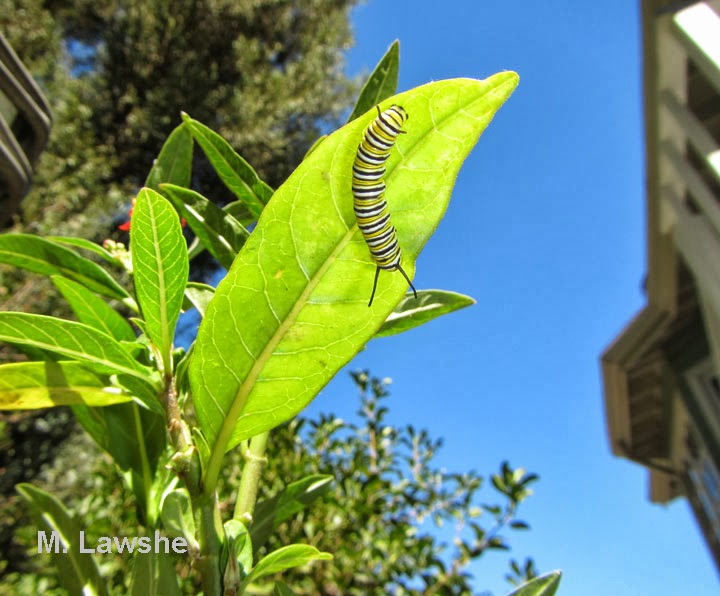
What a surprise this morning, monarch caterpillars! And they are an inch and a half long.

We've been seeing an adult monarch butterfly (Danaus plexippus) a couple of times a week. The last few years we have been growing native narrow-leaved milkweed (Asclepias fascicularis) and the introduced tropical species (Asclepias curassavica) that is readily available at garden stores.

We've had little caterpillars in the past, but they seemed to get eaten by either a bird or a predatory insect. This is the first time that we have had caterpillars reach this size in years.

The group of monarch butterflies that live in California (west of the Rocky Mountains) do not migrate to Mexico with the main population from the southern Central and Eastern part of the U.S. This Pacific population overwinters along the coast in Southern California down into Baja. 

Loss of milkweed habitat has caused declines in this population. Most butterfly species lay eggs on a specific plant species and their caterpillars are dependent on that plant for food. Native milkweed can be a challenge to grow. I didn't realize that narrow-leaved milkweed dies back each winter. I thought I had killed it and took it out. Now I understand that it will grow back in the spring. Until my native milkweed is established, I supplement with the tropical species in a planter, to avoid it becoming invasive.

These hot days, with temperatures above 100 degrees are a challenge for plants and wildlife. I hope that our caterpillars make it to chrysalis. It would be great to contribute to a new generation of monarch butterflies.

Other caterpillars you might see in your CA yard

Backyard Butterfly Quiz

Mourning Cloak Butterfly

Monarchs and Jerusalem Crickets

Tuesday, March 12, 2019

Painted Lady Mass Migration in So. California


They are back! Thousands of painted lady butterflies migrating overhead. Right now 72 butterflies a minute are passing over our house and down into the San Fernando Valley. Isn't that amazing! In an hour that will be more than 4,200 butterflies!

The winter rains have created the perfect conditions for masses of these medium-sized butterflies to take to the air. 

Where are they coming from? Probably somewhere near the California-Mexico border or down in Mexico.

Where are they going? They are headed in a northwest direction. When this happened in 2012, scientists were trying to follow the painted ladies to see where they went. Michael tells me that they are going to Oregon. What a long way for these butterflies to travel.

Go outside look up or 10-20 feet off the ground. It is a fantastic natural phenomenon, a mass migration of butterflies. Go take a look, who knows when or if it will happen again. 

More local butterflies: Butterfly Quiz
Mourning Cloak
Monarch
Anise Swallowtail
Caterpillars

Friday, May 06, 2016

What's That Butterfly?


This butterfly was recently in our Southern California garden. Do you know what it is?

Look at the general size and shape of the wings. It is resting on a lemon leaf. Look for unusual markings. Note the color, but remember color can fade with age or vary regionally. Pay more attention to pattern.

Check your answer:

How to bring more butterflies into your yard.

Watch a variety of butterflies in Illinois on a summer day and butterflies in the tall grass prairie.

Wednesday, April 09, 2014

Mourning Cloak Caterpillars

I first noticed them as a small mass of black threads high in the ornamental plum tree–black caterpillars about the thickness of a pen.

They were clumped together munching on the purple leaves. It has been a while since we have had mourning cloak caterpillars, but I recognized them immediately–bristly black caterpillars with spots of deep red. With all of the nesting birds gathering food for chicks, the caterpillars were fortunate not to be spotted in the top of the tree.

Mourning cloak butterflies are one of the few species, like monarchs that overwinter as adults. A tattered adult frequented the yard a few weeks ago. It must have been a female that laid eggs on the newly emerged plum leaves.

A few days later I saw them again, but the clump had become more dispersed and they seemed plumper. 

On Sunday, I just happened to see one "wandering" up the front of the house. It had trekked down the tree, across the ground, across the walkway and started up the wall. Wandering is the phase of a caterpillar's life when it leaves the food resource it has matured on and goes in search of a quiet place to start its metamorphosis into a butterfly. The caterpillar didn't know how lucky it was, I also spotted an alligator lizard waiting at the trunk of the tree and feasting upon some of the caterpillar's less lucky siblings.

Monday, I watched a second caterpillar troop up the wall of the house.

This individual attached itself to the bottom center of our "Welcome" sign. For about 24 hours it hung there, upside-down, in a "J" position.

But yesterday afternoon I was lucky enough to catch the moment when it dropped its spiky black outer skin and became a chrysalis. For a few moments it twitched and shuddered, hanging from the tiny base of silk that attached it to the ceramic sign. Then it became very still.

In the next 10-14 days it should emerge as a butterfly. How exciting! 

We planted nectar plants to attract butterflies and it seems to have worked. Hopefully, this is just the first of several butterflies species we will have this year.

Tuesday, October 15, 2013

Planting CA Natives in Fall

I love the autumn weather in California. The hot dry summer has come to an end and the promise of rain means it is time to plant native vegetation.

This past weekend we traveled north to the Santa Barbara Botanic Garden to take advantage of their Fall Plant Sale (going on through Nov. 3). It is a wonderful place to see the enchantment of native plants and the habitat they create for animals; We saw a variety of birds, butterflies, lizards, a gray squirrel and two deer. We strolled through areas of the garden most like our yard and looked for plants that would thrive in a few of our problem areas: dry, sunny slope and dry partial shade under oaks.

We've discovered that native plants from the Channel Islands, especially San Nicolas Island and Santa Cruz Island, seem to do well on our dry, sunny slope. This beautiful pink yarrow is from San Nicolas Island. We planted yarrows between the Mexican mountain marigold and the San Nicolas buckwheat that we planted two years ago.

This native aster is a low-growing ground cover that we hope will thrive on our front slope.

With the buckwheat, sage, yarrow and milkweed, the front slope is becoming a nectar garden for butterflies.

In the spring, I always have itchy fingers to put plants in the ground, but too often, the summer heat pounds those plants and they do not survive. Autumn is California's season of renewal. Plant now and tender new plants will have nurturing winter rains to help them establish.

A monarch butterfly has been visiting our newly planted milkweed!

Saturday, September 28, 2013

An Oasis of Habitat in Los Angeles

Food, water and shelter–these are the three requirements for all living things. Provide them in your yard and you will create a vital oasis for wildlife.

Taking a suggestion from The California Wildlife Habitat Garden by Nancy Bauer (book review), last weekend I planted a drift of milkweed (Asclepias curassavica). This species of milkweed (also called “blood flower” according the Western Garden Book) is actually native to South America, however it is the easiest species of milkweed to find at garden centers. I planted five plants on a slope, between some native sage and California fuchsia.
 

caterpillar on the underside of leaf
Milkweed is a host plant for monarch butterflies and apparently my plants came with tiny caterpillars already on them. I found the inch-and-a-half-long caterpillar, pictured above, on the underside of a leaf. (Yellow arrow points to leaf with the caterpillar just visible on the underside.) Because the caterpillars eat the plant leaves, placing several plants together in a “drift” creates a sustainable habitat for the future butterflies.


young white-crowned sparrow in background

This week we also had migratory birds arrive. Three white-crowned sparrows flew in: an adult and two youngsters. I would love to know if the adult is one of the white-crowns that spent the winter here last year. This small family of white-crowns has arrived about a 2 weeks earlier than in past years. I thought they might be traveling through, but they have stayed all week.


'sooty' fox sparrow
A second sparrow species, a ‘sooty’ fox sparrow arrived on Friday. 

This is the first time we’ve had a fox sparrow in the yard since 2000. It seems to have settled in, searching for food under the coffeeberry and hollyleaf and Catalina cherries. The native plants provide habitat that other plants do not.

Especially in the dry weather, the water in the bird bath and the fountain provide much needed water for migrating and local birds. Even birds of prey need a drink in hot weather.

It always amazes me when these migrating visitors stop in our yard. How do they find us? Do they see other birds going in and out of the yard? Do they hear or see the running water in the fountain? Are they attracted to the reptiles or native insects?

Do the butterflies smell the bloom of their favorite plants? This morning a bright yellow butterfly traveled through the yard investigating the milkweed and the flowering mallow. In the past, we have occasionally seen monarch butterflies. Perhaps with our addition of the milkweed we will become a habitat oasis for these butterflies as well.

Wednesday, March 21, 2012

Painted Lady Butterflies Migrating Through LA

What a perfect way to mark the first days of spring. It's beautiful and mild. The recent rain has washed the foliage clean and nudged flowers into bloom

A spring migration is happening and here's your chance to see a wonder of the season. Go outside and stand facing north or east. Look toward open spaces, down the street, over the back yard. See if you don't spot a small to medium-sized butterfly flitting from south to north. It will be traveling, not stopping to feed, so look 10 - 20 feet off the ground.


The painted lady butterflies appear to be migrating through the San Fernando Valley again this spring in numbers easy to notice. It may not be the wave of butterflies that we saw in a few years ago, but there are enough that they are noticeable. 


Just stand still and watch the world for a moment; just five minutes. These two-inch butterflies are traveling from somewhere down south toward a specific destination to the north that remains a mystery to mere humans. They're traveling through my neighborhood right now and they are probably going through yours as well.