Showing posts with label monarch butterfly. Show all posts

Tuesday, June 15, 2021

Monarch Caterpillars!


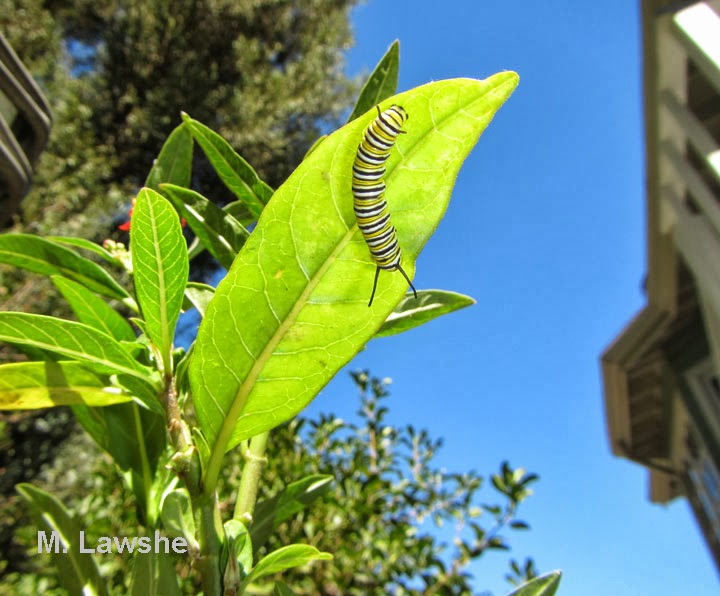
What a surprise this morning, monarch caterpillars! And they are an inch and a half long.

We've been seeing an adult monarch butterfly (Danaus plexippus) a couple of times a week. The last few years we have been growing native narrow-leaved milkweed (Asclepias fascicularis) and the introduced tropical species (Asclepias curassavica) that is readily available at garden stores.

We've had little caterpillars in the past, but they seemed to get eaten by either a bird or a predatory insect. This is the first time that we have had caterpillars reach this size in years.

The group of monarch butterflies that live in California (west of the Rocky Mountains) do not migrate to Mexico with the main population from the southern Central and Eastern part of the U.S. This Pacific population overwinters along the coast in Southern California down into Baja. 

Loss of milkweed habitat has caused declines in this population. Most butterfly species lay eggs on a specific plant species and their caterpillars are dependent on that plant for food. Native milkweed can be a challenge to grow. I didn't realize that narrow-leaved milkweed dies back each winter. I thought I had killed it and took it out. Now I understand that it will grow back in the spring. Until my native milkweed is established, I supplement with the tropical species in a planter, to avoid it becoming invasive.

These hot days, with temperatures above 100 degrees are a challenge for plants and wildlife. I hope that our caterpillars make it to chrysalis. It would be great to contribute to a new generation of monarch butterflies.

Other caterpillars you might see in your CA yard

Backyard Butterfly Quiz

Mourning Cloak Butterfly

Monarchs and Jerusalem Crickets

Saturday, September 28, 2013

An Oasis of Habitat in Los Angeles

Food, water and shelter–these are the three requirements for all living things. Provide them in your yard and you will create a vital oasis for wildlife.

Taking a suggestion from The California Wildlife Habitat Garden by Nancy Bauer (book review), last weekend I planted a drift of milkweed (Asclepias curassavica). This species of milkweed (also called “blood flower” according the Western Garden Book) is actually native to South America, however it is the easiest species of milkweed to find at garden centers. I planted five plants on a slope, between some native sage and California fuchsia.
 

caterpillar on the underside of leaf
Milkweed is a host plant for monarch butterflies and apparently my plants came with tiny caterpillars already on them. I found the inch-and-a-half-long caterpillar, pictured above, on the underside of a leaf. (Yellow arrow points to leaf with the caterpillar just visible on the underside.) Because the caterpillars eat the plant leaves, placing several plants together in a “drift” creates a sustainable habitat for the future butterflies.


young white-crowned sparrow in background

This week we also had migratory birds arrive. Three white-crowned sparrows flew in: an adult and two youngsters. I would love to know if the adult is one of the white-crowns that spent the winter here last year. This small family of white-crowns has arrived about a 2 weeks earlier than in past years. I thought they might be traveling through, but they have stayed all week.


'sooty' fox sparrow
A second sparrow species, a ‘sooty’ fox sparrow arrived on Friday. 

This is the first time we’ve had a fox sparrow in the yard since 2000. It seems to have settled in, searching for food under the coffeeberry and hollyleaf and Catalina cherries. The native plants provide habitat that other plants do not.

Especially in the dry weather, the water in the bird bath and the fountain provide much needed water for migrating and local birds. Even birds of prey need a drink in hot weather.

It always amazes me when these migrating visitors stop in our yard. How do they find us? Do they see other birds going in and out of the yard? Do they hear or see the running water in the fountain? Are they attracted to the reptiles or native insects?

Do the butterflies smell the bloom of their favorite plants? This morning a bright yellow butterfly traveled through the yard investigating the milkweed and the flowering mallow. In the past, we have occasionally seen monarch butterflies. Perhaps with our addition of the milkweed we will become a habitat oasis for these butterflies as well.