Showing posts with label western fence lizard. Show all posts

Monday, August 12, 2013

Desert Tortoise with a Friend

This discovery in the garden made me laugh. Our young male California desert tortoise has a friend. Can you spot it?


Yes, there is a young western fence lizard sitting on the tortoise's back. They were both basking in the morning sun. You might think the lizard had mistaken the tortoise for a rock. But I don't think so. When the tortoise walked, the lizard held on. Later in the day, the two were in a different location by side-by-side.


 Interested in turtles and tortoises? I recommend Life in a Shell.

Sunday, August 04, 2013

Social Life Among Fence Lizards

We think of lizards as individual creatures, loners. For some lizards that lifestyle is true, like the lace monitor that we saw in Australia. Yet the social life of most lizards is unknown.

Western fence lizards are thought to be territorial, keeping other individuals out of their area unless there is reproduction in the air. But I am starting to wonder about the notion of lone individuals.


These two lizards not only have been sitting on the wall together, when they dashed off the wall they went in the same direction. Baby fence lizards hatched out of their eggs over a week ago after weeks of incubation. Are the adults still in the mating mood? I'm not sure.

More investigation is needed here.

Saturday, August 03, 2013

A Lizard in the House!

Today, a lizard found me again - this time in the house!

hatchling western fence lizard
This hatchling western fence lizard was in the doorway to my office. Though he is only about two inches long, he looks pretty plump. I'm not sure if he has been eating spiders in the corner of my office or if he just wandered in this morning.

We carefully scooped him up and relocated him to the back yard. In Southern California we don't have any lizards that are dangerous. In fact, this little guy is highly beneficial as an insect predator. We want him around, though not in the house.

What's really amazing is how clearly you can see this little guy's "third eye" or parietal eye. It is the small yellowish dot in the center of the back of its head. This slight depression has light sensitive cells that help lizards protect themselves (it alerts them to shadows passing overhead), its provides seasonal information with the amount of daily sunlight and it is important for stimulating hormones and timing reproduction.

A lizard in the house can be surprising, but it is great to have them as part of our healthy ecosystem. 

Thursday, August 01, 2013

When a Fence Lizard and an Alligator Lizard Meet

When you're traveling, discovery comes easily. But wilderness in our own backyards and neighborhoods can offer discovery as well.

I went out this morning looking for something unexpected and two lizards found me. 

Lizards in my yard are not unexpected. Western fence lizards (Sceloporus occidentalis) have become abundant over the last 10 years. This year we have already seen at least three new babies. The more native California vegetation we have, the more we attract native insects and the greater the resources for the lizards.


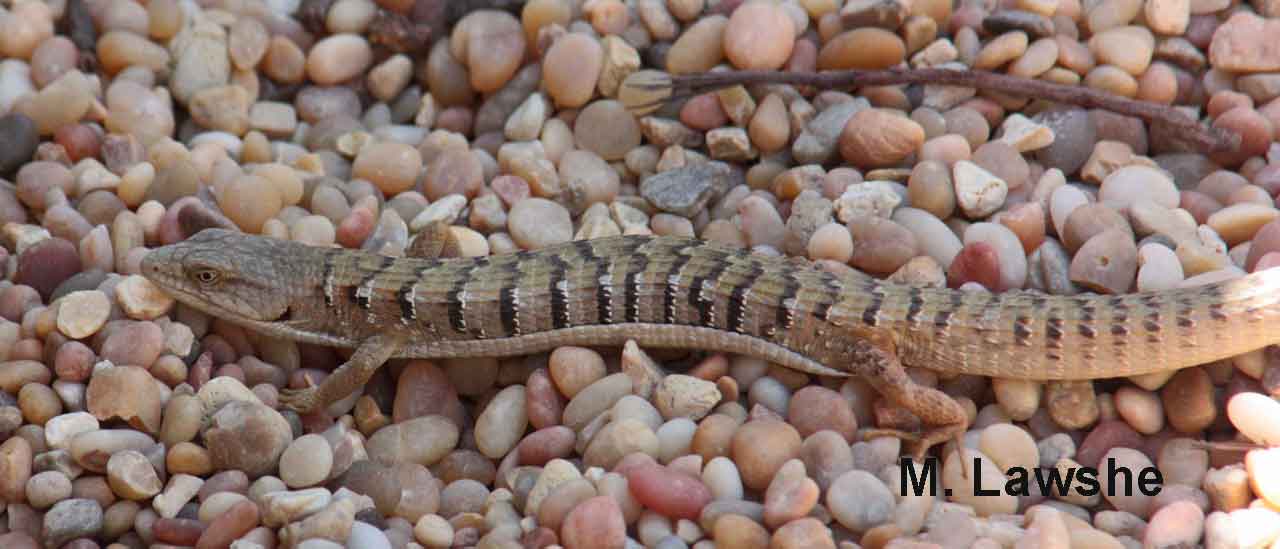
Alligator lizards (Elgaria multicarinata) like the one pictured above, have been resident in our yard since we moved in 19 years ago. But I have never seen these two lizard species interact. 

Fence lizards are sun lovers, frequently basking out in the open. They communicate with each other visually with displays of head bobbing and revealing their blue chests. The alligator lizards, on the other hand, are shy creatures slipping through the shadows and feeding into the night on warm summer evenings.

This morning I happened upon an adult western fence lizard and a sub-adult alligator lizard. The fence lizard was trying to chase the alligator lizard out of its territory. The alligator lizard (about the girth of a pencil and 7"-8" long) took refuge on a branch in a bush about a foot off the ground. It turned, like its namesake, with an open mouth and hissing. It tried to scare off the fence lizard.

It was a miniature primeval world moment - wild lizards unencumbered by the actions of people. I ran to get the camera, but only got a picture of the fence lizard. While the fence lizard is primarily an insect eater, a larger alligator lizard could prey on the two-inch-long western fence lizard hatchlings. 

If you just take a moment to observe, you'll be surprised what you can discover close to home. This August Discover yourself.

(Australian wild lizards, Turkish wild lizards)


Tuesday, May 25, 2010

The Foundation of Habitat

Creating habitat for bird life means starting from the plants and working up.

A well-planted yard provides shelter for birds, but quality habitat requires natural food sources as well.

Native plants like this anemone not only provide shelter, they attract native insects.

When you think of an important pollinating insect you probably think of a honey bee. But the European honey bee is not native to California (or North America for that matter).

Locally we have several species of large carpenter bees and bumble bees that pollinate plants, but many native plants are pollinated by less glorified insects – flies, beetles and moths. You can see the fly feeding on the pollen on the lower area of the flower.

Most native insects can only feed on the pollen of native plants. These insects are important food for larger insects, lizards and birds.


Creating habitat for birds means establishing an environment safe for insects–flies and beetles, as well as the more beautiful butterflies. See crane flies.

Plants and arthropods are the
foundation of habitat. Arthropods include insects, spiders and crustaceans (those little "c-shape" creatures that hop about on the ground when you lift up a pot, and yes, they are related to shrimp). Birds and lizards can establish thriving populations if your yard offers these vital resources. John Fitzgerald of Cornell University spoke last week in Los Angeles on bird conservation. He pointed out that the areas where eastern wood thrushes have declined coincide with areas of increased acid rain. The acidic rain kills the native crustaceans in the plant undergrowth, thereby removing an important food source for the wood thrush. Having a healthy population of creepers and crawlers, supports a healthy population of runners and fliers.

This western fence lizard not only eats its share of insects it also is makes your yard more healthy for you (fence lizard and Lyme's disease). Healthy fat lizards are also potentially a food source for red-shouldered hawks, shrikes and other birds.

If you want to help birds, you need to reexamine your ideal garden. Paradise isn't sterile. The Earth's garden is filled with abundance and diversity, including spiders, aphids and grubs.

Thursday, August 14, 2008

A Bird Feeder in Every Yard

A red-shouldered hawk rises from the ground with a large fence lizard clutched in its talons. This isn’t a scene from a nature documentary, this is the view from my kitchen. I don’t live in rural Montana, but rather in the suburbs of Los Angeles, two blocks from one of the busiest freeways in North America, if not the world. How am I so lucky to see wildlife dramas on a daily basis? One main reason – ten years ago, I put out a bird feeder.

I know what you're thinking. “Wait a minute, hawks don’t come to bird feeders and neither do western fence lizards.” And you would be absolutely right, but putting out a bird feeder influenced our entire outdoor living space.

  1. It attracted birds to the yard in a visible way so that I could begin to learn the local bird species.
  2. New knowledge about what different birds were eating encouraged me to reconsider the plants I planted in the yard. I began to relandscape with native plant species to attract birds and butterflies.
  3. We stopped using all forms of toxic pesticides and herbicides in and around our house. Native insects reduced pest insects, lizards and bats moved in to eat the insects.
  4. We added a water feature to provide dependable water to wildlife during drought seasons, a greater variety of birds, including hawks, and rabbits arrived.

Putting out a bird feeder was the beginning of creating a habitat in my yard that supports a wide range of biodiversity. Seven species of birds now nest here - see our hummingbird babies. Two species of lizards reproduce in our garden; western fence lizard. Check out some of the creatures that share our suburban space - Backyard Biodiversity Project.

As I look out my window over the rooftops of track homes, past the Ventura Freeway and the growing amount of pavement and concrete, I take heart in knowing that my yard is an oasis for wild creatures. As cities expand, wild habitat is lost. Birds and animals lose important living, hunting and breeding territory. But it doesn’t have to be that way. You can make a difference. Put out a bird feeder. Begin offering a safe place for wild birds to find dependable food.

  • How do you decide on a bird feeder?
  • What food should you use?
  • What about water?

Each week AnimalBytes will take on an elemental question of how to start and be successful in creating habitat. We’ll start with bird-feeder basics.

Around the globe, wild animals are facing survival challenges as human populations expand and climate change alters weather patterns. If you make your yard, patio or even balcony a safe habitat, together we can change the world for the better.

Wednesday, July 18, 2007

The Creatures of Summer

Summer meanders through hot days and warm windless nights. A new visitor appears against the screen in the bathroom. It is a chocolate looper, identifiable by its rich brown color and the distinctive white spot on its wings. The book claims it looks like a “man’s slipper;” a perfect example of how one person’s perception can become attached to a creature for decades. It doesn’t look like a “man’s slipper” to me. Who wears slippers?

A native moth, the chocolate looper should have been outside feeding from one of our native plants. We found two and released both back into the night.

The baby birds have all hatched and left their nests, but there are still new babies appearing. Sitting in the morning sunshine, someone new has appeared in the garden. Can you see it in this picture? Look closely right in the center of the picture at the top edge of the cement bricks, just to the right of the seam. This baby is only about the size of your little finger.

It’s a young Western fence lizard. We’ve had two pairs of adult fence lizards this year. The pair living closest to the house appears to have been successful in producing at least one youngster.

Western fence lizards are a boon to the garden. Find out why they are Superheros.

We’ll be watching for this little guy as he grows up.

As evening creeps across the hillsides and the freeway traffic drones, a desert cottontail wriggles under the fence and feeds on the grass that I was thinking about pulling. I’d rather watch him eat it.

Allen's and Anna's hummingbirds race to visit the nectar feeders one more time before bed and the hooded oriole has returned for a late snack. (See the Allen's hummingbird family)

As the evening sky darkens, two big brown bats swoop and circle through the streetlight glow, snacking on a variety of insects. Bat Video.

Bats consume mosquitoes and moths and other insects all night long. Perhaps that’s why the chocolate loopers took refuge in the house.

Wednesday, July 04, 2007

4th of July Audio Play

Happy Independence Day !

It's 100˚F in the shade, but still cooler than yesterday. While I'm happier in the house, the Western fence lizards and the alligator lizards are frolicking.

To celebrate the 4th of July, my husband Michael Lawshe (soundzgood.info) researched historical documents and eyewitness-accounts and prompted me to write an audio-play. We gathered some friends and neighbors and reenacted some of the historical events leading up to 1776. We call our LIVE CAST recording "Prelude to Revolution."
(1 hour in length)

CLICK HERE to link to Eclipse-1.com and hear the voices and events on the road to American Independence. (Yes, we did really reenact the New York Riots and the Boston Massacre in our living room.)

Why is my personal Liberty important to the lizards in my backyard? It means with my voice and my vote, I can support conservation issues and environmental protection.

As more and more of the world is degraded by human activity, it becomes increasingly vital that we stand up and speak out to preserve our democracy. If we do not, if our government is owned by the highest bidder, we will not have the ability to stop those who would threaten the entire planet for temporary profit.

Monday, April 23, 2007

Western Fence Lizard - Super Hero


Spring doesn’t just warm up the ground for seeds to grow and flowers to bloom. The sun heats the rocks and gravel and invites the lizards to emerge from their winter hiding spots. The most visible lizards in our yard are Western fence lizards (Sceloporus occidentalis). There is a pair in the herb garden and this large individual in the driveway. They seem to prefer elevated basking sites where they can keep an eye on their territory and watch for insects.

The female in the garden frequently jumps up several inches to catch flies. She’s an efficient insect eliminator and fun to watch.


You may know these lizards as “blue-bellies.”
Males, especially, have bright patches of blue on their bellies and sometimes at the throat. The fence lizard does push-ups displaying his bright breeding colors to admiring females. The brighter the blue, the healthier and more attractive the male is as a mate.


We haven’t always had lizards in our yard. When we first moved in, garden snails infested the African daisy planted along our front hillside. Blindly, we used the box of “snail bait” poison left behind by the previous homeowners. Did it get rid of the snails? No. It would decrease them for a while, but then they would multiply and return in greater numbers.


When the poison ran out, we tried beer traps, copper strips and a variety of organic methods. After several years of “Earth friendly” snail deterrents, we began to notice there were fewer snails but it wasn’t because of anything we were doing. Something was eating them.


Now that our snails were “clean” and tasty, predators were picking them off. A skunk was crunching them on the porch and alligator lizards (Gerrhonotus multicarinatus) moved in to dine as well.


As we remove the African daisy and replaced it with native plants, we have less and less non-native garden snails. The snails don’t like the thick waxy leaves of the ceanothus or the aromatic taste of sage. But these native plants have attracted native insects.


In May of 2004, we spotted the first western fence lizard in the yard.
Since then, there has been at least one batch of youngsters. Rock piles and concrete walls soak up the sun’s rays and create warm stopping places for lizards. The nooks and crannies between the rocks make it easy for a lizard to hide from a hungry red-shouldered hawk.


A place to live and a safe food source were all the lizards needed to move in.
Western fence lizards patrol the herb garden, eating a variety of bugs. They warm themselves on the driveway and run up the walls, clinging with their long strong toes.


But these western fence lizards are doing something else for us besides insect patol. You see the western fence lizard is a Super Hero. Not only can they run straight up a wall, they fight disease.

Lyme’s disease has made its way to Southern California from the east coast. But this debilitating illness is less of a threat to humans here than in other places. Why? Because of the western fence lizard. The tick’s that carry Lyme’s disease are small, tiny actually. These ticks will hop on a western fence lizard as easily as a mouse or a person. And here is where the Super Hero comes in: If a tick carrying Lyme’s disease bites a western fence lizard, something in the the lizard’s blood neutralizes the disease. When the tick leaves the western fence lizard it is no longer a carrier of Lyme’s disease.

If you have western fence lizards as neighbors, they are protecting you from potential disease. What other wonders are these lizards capable of? Who knows. Perhaps they carry a natural antibiotic in their blood like Komodo dragons or American alligators that could be beneficial to humans.

For now, I’m happy to watch them basking in the garden. And to inspire them to stay we’ve created a few more rock piles and added some novel resting places. The female fence lizard has moved into a dark-colored, resin gargoyle-shaped drain spout. For a lizard it’s a cool place to live.