Monday, March 26, 2007

Allen’s Hummingbirds Take to the Air

It was only 20 days from the first tiny hummingbird emerging from its egg to Saturday, March 23 when the pair tried their new wings and took to the air.

Just two days before flying the youngsters were still in the nest.

Allen's hummingbirds 3/03/07 when they hatched, first week, second week.

I’ve watched this transformation from minute oval egg to flying wonder before, but it never ceases to amaze me.

The young ones are buzzing about the yard. They are noticeable by their clumsy landings, their lingering at the feeder, and the fact that their mother still allows them to share a perch near her. By next week they will be hard to distinguish from the other hummers.


Empty Nest

From blueberry-sized pearls
Hatched, naked
Blind, earth babies
Wrinkled brown skin
Scarce tufts of down

Silently they huddled in
Half walnut-shell bower
Waiting for mother's
Blossom-kissed tongue

In a breath of days
Stubby beaks
Grew long and slender
Silken-thread tongues tasting
Leaves and branches

Rubbery appendages transformed
To pulsating wings
Hovering, in first baby-step flight
Then a dip, a dive
A streak across the garden

How quickly life can
Form before your eyes
Lull you into complacency
Leave you hungry for its miracle
When the nest is empty

Copyright Keri Dearborn 2001

Friday, March 16, 2007

Trapdoor Spiderlings and Hummingbirds

Babies, babies, babies. Imagine my surprise when walking through the yard yesterday I discovered an open trapdoor spider burrow. When I looked inside I found 100 to 200 spiderlings.


Down in the burrow there were BB-sized bumps on the wall of the tunnel. When I brushed them slightly with a piece of straw, the bumps moved. A flashlight revealed the ‘bumps’ were the abdomen’s of baby trapdoor spiders.

Here is where the tale gets unusual, the trapdoor that should have been closed and protecting these young spiders had been surgically removed. It was laying intact beside the opening. There did not appear to be any obvious signs of force to open it. It’s silken hinge had just been neatly severed.

About four inches to the left was another trapdoor spider burrow of the same size tightly sealed, its resident safe behind its closed door.

Was the door to the spider nursery removed by a predator? If so, there were a lot of spiderlings that not been eaten. In fact I just checked on them, and 24 hours later, they are still clinging to the side of the tunnel, though some seem to be down lower in the tunnel, probably to escape the heat of the day.

Was their mother eaten? I don’t know. If so, will these spiderlings starve or be eaten without her protection?

Or is their mother living in the tunnel next door? Perhaps this was the nursery burrow. I have noticed that a number of larger trapdoor spider burrows seem to have an equal-sized neighbor right next door.

Perhaps these spiderlings are just big enough be introduced to the world and mom has literally opened the door for them to go. I really don’t know and haven’t been able to find anything that might explain this mystery.

I will keep an eye on them and see if they do start to head out on their own.

Meanwhile the Allen’s hummingbirds are growing. Their feathers are coming in and their beaks are beginning to elongate. (When they hatched and first week)

The spiderlings have been developing all winter, the hummingbirds will be out of the nest in weeks. Amazing what you can run across on a warm spring day.

Monday, March 12, 2007

Two Hummingbird Nestlings !

Yes, there are TWO!

Here you can see there are two nestlings and they nearly fill the nest. Their heads are toward the right and their two little backs with the tiny wings along the sides are pointing down toward the left side.

You can’t deny that spring has come when the baby Allen’s hummingbirds are doubling their size weekly.

Mother hummingbird is working hard to feed her two hungry youngsters, a job made much easier by the rapid blooming of many flowering plants. Last week she was focused on catching a lot of insects, whether that was for protein for the tiny hatchlings or to rebuild her own resources after her time sitting on the eggs, I don’t know. Now she seems to prefer nectar.

Two other female Allen’s hummingbirds are also nesting in the adjacent area.

One of them has her nest hidden in a photinia bush. This morning I saw an unexpected possible predator in the same bush–a one-foot-long alligator lizard basking in the sun on a branch about four feet off the ground. Hopefully, mother hummingbird has placed her nest out of the lizard’s reach.

Two days ago, I watched a pair of bushtits working very hard to pull building materials from a hummingbird nest that was used two years ago. They’ve come back to the abandoned nest several times to gather fluff for their current nest.

Last year’s Allen’s hummingbird nest, from which the hatchlings were taken by a predator, was a site of great interest yesterday for a group of 20 bushtits. Initially, the group of tiny birds scouted out the old nest where their relatives have been gathering materials. Then one at a time, three individual bushtits came down within a foot of last year’s nest. There was a great deal of chatter.

After a short hunt for insects, several bushtits returned to the area above the abandoned nest. Two birds each came down within an inch of the empty nest and looked at it closely. Again there was a great deal of chatter. As the bushtits moved around in the shrubs they got within five feet of the new hummingbird nest. Mother hummingbird had had enough of the visitors. The bushtits are about the same size as the hummer, and no real threat, but she loudly chastised them and chased them off. I imagine within a few days, pairs of bushtits will be back to begin collecting their own building materials from the abandoned hummingbird nest.

Last year’s red-shouldered hawk nest has also been reduced to a thin layer of twigs. The red-shouldered hawks, ravens, crows and band-tailed pigeons have all been pilfering the sticks and twigs to build new or to renovate old nests.
Birds are efficient recyclers. We could learn a lesson from their sustainable use of resources.

Sunday, March 04, 2007

Baby Hummingbird Hatches!


The Allen’s hummingbirds have hatched!

Look closely and you will see a yellowish-orange triangle deep in the nest on the right-hand side. This is the beak on one of the hatchlings. There were two eggs. When I went to check this morning, there were no eggs visible.

My first thought was, “Oh, no. The wind yesterday or last night knocked the little eggs out of the nest.” I should have known better. The hummingbird mother would have never left the nest in the night.

Initially, I couldn’t tell for sure if there was anything in the nest. With the camera on macro and holding it at arms length, I was finally able to snap a picture where I could just make out one hatchling.

Is there a second one? I’m not sure.

Remember how small they are. The nest is only an inch and a half wide. The tiny hatchling is about the size of the fingernail on my pinky finger. The nest is nearly an inch deep, so it is possible that there is a second hatchling that I couldn’t see.

Babies are always exciting, but baby hummingbirds are uniquely special. The mother hummingbird was frantically busy all day gleaning insects so she could supply a high protein meal for her tiny ones. Stay-tuned and we will watch them grow up.

Friday, February 23, 2007

Love Letters and Mate Gifts

Spring is in the air. At Fallbrook Square in the San Fernando Valley, the male raven is offering sticks for the remodeling of the pair’s nest on the “L” of the Kohl’s sign. The titmice and the Bewick’s wrens are checking out the bird house. While overhead the red-tailed hawks are soaring with their feet extended ready to clasp talons mid-flight to reinforce their mate bond.

Is it love? Hard to say. The raven offers a stick, the red-tailed hawk offers a freshly caught gopher, while for St. Valentine’s Day chocolate and flowers are the primary human offerings. Humans claim to express romantic “love,” but many birds mate for life and work together as a pair raising multiple families of offspring. Hmmm, what’s more romantic than a delicately offered mouse you caught yourself?

Expressing ardor with voice is a typical bird action. Song birds like white-crowned sparrows and the Bewick’s wren sing to their mate and to delineate territory. While some humans sing, we are more likely to express romance through the written word. Up until the advent of e-mail, humans frequently wrote love letters.

For Valentine’s Day a group of us humans did a live reading of famous love letters.

You can download the readings at
Love Letters

http://recordings.talkshoe.com/TS-6184.mp3

Listen on your computer or download to an iPod or other mp3 player. You might be surprised at the romantic writings of Napoleon and the devotion of John and Abigail Adams. Next year maybe we’ll have to include some bird song.


Did we count birds for the Great Backyard Bird Count?

You bet 320 individual birds. Stay tuned for our Birding From Sepulveda Basin Podcast.

Tuesday, February 13, 2007

AnimalBytes at Sepulveda Wildlife Refuge

Sunday, February 18, 2007 at 8:00 AM

This weekend is the Great Backyard Bird Count.
AnimalBytes will be at the Sepulveda Wildlife Refuge.

Bring your binoculars and Come Join Us.

We will be counting birds for Cornell University Lab of Ornithology. Last year we documented over 100 double-crested cormorants, flocks of red-winged blackbirds and a kettle of turkey vultures. The Sepulveda Dam area brings together water fowl and song birds. This year we hope to tally even more individual birds and species.

We will meet at the cement sign at the north entrance to the wildlife area between 7:45 AM and 8:00 AM.

The Sepulveda Wildlife Refuge is accessible from the 405 FWY, the 101 FWY and the Metro Orange Line (Woodley Station).

To access the parking area, enter the park from Woodley at the same driveway as the Japanese Gardens. Stay to the right and follow the road east along the wall. The road ends at a parking area with a public restroom. The cement sign and the entrance path are just before you come to the public restroom. Well-behaved children are always welcome, they have the best eyes and are our next generation of conservationists.

You can count at home in you backyard too.

Remember Every Bird Counts.

For more information about GBBC and to enter your own bird counts go to the GBBC Website

Monday, February 05, 2007

Great Backyard Bird Count 2007


The 10th Annual Great Backyard Bird Count is just around the corner.

Over four days, February 16-19 2007, people across North America will count birds in parks, refuges, city streets and backyards to create a snapshot of avian populations and biodiversity.

Typically, 75 % of all North American bird species migrate. But last year, warm weather caused some birds to skip their normal winter travel. Still other species were recorded further north than usual. Species like the California towhee, pictured, are found only in regional locations. If volunteers don't count in southern California, there is no record of these birds. While some birds like the American goldfinch showed increases across the country, others like the American crow recorded another year of decline. All of this information was captured by Great Backyard Bird Count (GBBC) observers.

The Cornell University Lab of Ornithology and Audubon host this annual event to collect important scientific data. Birds are travelers and their movement can tell us a great deal about the effects of climate change, urbanization and conservation efforts. GBBC is the perfect family outing, scout or youth project or a way to enjoy your backyard and contribute to important biological science.

Counting birds for GBBC is fun and easy.

To Count on Your Own:
Visit the Great Backyard Bird Count website for simple instructions and information. (www.birdsource.org/gbbc)

To Count with a Group:
  • The Los Angeles Zoo and Botanical Gardens will be hosting two Bird Walks in conjunction with GBBC. Wed. Feb. 14 and Sat. Feb. 17, 8:00 AM - 10:00 AM Both Bird Walks are open to Zoo members free of charge. The Wed. Bird Walk will teach you how to count so you can count on your own over the weekend. While on the Saturday Bird Walk you will be helping Zoo Docents complete a count of wild birds on Zoo grounds. Reservations are required for both walks. To make reservations send an e-mail to sanderson@lazoo.org; put “Bird Walk” in the subject line and include in your e-mail: the number of people in your party, your phone number and your Zoo membership number.

  • AnimalBytes also invites you to come out and count with us at the Sepulveda Basin Wildlife Refuge. Sunday, Feb. 18 at 8:00 AM. Last year we counted 29 species, including 122 double-crested cormorants, 47 red-winged blackbirds and a merlin. We will meet at the cement sign at the north entrance to the wildlife area. To access the parking area, enter the park from Woodley at the same driveway as the Japanese Gardens. Stay to the right and follow the road east along the wall. The road ends at a parking area with a public restroom. The cement sign and the entrance path are just before you come to the public restroom. Well-behaved children are always welcome, they have the best eyes and are our next generation of conservationists.

Whether you are an experienced birder or casual observer, science needs your help. Even if you only count the five mourning doves on your lawn, EVERY BIRD COUNTS.

Every bird is important.
You can make a difference.
Participate in the Great Backyard Bird Count.

Wednesday, January 31, 2007

Cambria Audio Adventure

LISTEN to the PodCast

Over New Year’s, Michael and I visited three wonderful natural sites along California’s central coast.


The Elfin Forest
in Los Osos


The elephant seal rookery near Piedras Blancas Lighthouse


Moonstone Beach, Cambria.


To hear the sounds made by the large male elephant seal ...


and the calls between the females and their pups...


Or to hear why it is called Moonstone Beach
and why the boardwalk is so important.


LISTEN to the PodCast -
Cambria Audio Adventure


The Central Coast is a great get away for a long weekend. The birding is fantastic and the elephant seals will be in residence through February.

Tuesday, January 30, 2007

Delisting the Gray Wolf


Yesterday, January 29, 2007, the United States Federal Government delisted the gray wolf in the lower 48 states. Since 1974, the gray wolf has been protected as either “threatened” or “endangered” under the Endangered Species Act. But today, that protection is gone.

As Americans populated the continent, they saw the gray wolf as a threat and competitor. Whether it was wolves preying on naive domestic animals, hunting prey humans wanted for themselves or because wolves would not relent to human domination, these top predators were exterminated from the Atlantic to the Pacific. In California, the last known wild wolf was trapped in Lassen county in 1924.

Since an experimental reestablishment of wolves began in Yellowstone National Park in 1995, there have been avid supporters and vitriolic opponents. While the humans debated, the wolves multiplied and reestablished balance in the ecosystem. In short, they did what humans could not. They controlled the elk population by eliminating the sick and weak. They resurrected damaged plant communities by reducing an overabundance of browsers. And they helped a growing list of species recover in the Park–song birds, beaver, fox and others–because of the improvement to the habitat.

But while the Park was returning to a wild balance, wolves were leaving to colonize beyond its boarders. In Minnesota and Wisconsin, Canadian wolves were crossing the boarder to colonize the areas, long devoid of top predators, that offered prime habitat. While the movement of these wolves is good for the natural environment, human fear of a top predator has again taken over rationality.

Now that the gray wolf is no longer designated as an “endangered species,” states will be able to “manage” wolf populations as they see fit. Idaho, Montana, Wyoming, Minnesota, Michigan and Wisconsin will decide if wolves will be protected, shot on sight, poisoned, trapped or shot with a license as trophy game. Residents of Alaska have been trying to express their desires to their public officials for years regarding rational treatment of their wolves, yet despite votes to stop it, gray wolves are still shot from planes because of the power of the hunting lobby.

What will be the fate of the gray wolf in the 21st century. Will 21st-century humans use their intellect to learn to live with a top predator for the betterment of the land and ecosystems or will we react with primal fear and greedy short-term gain to once again drive the wolf to near extinction?

Is living with a large predator difficult? Yes. But we conservation-minded Americans expect Africans to share space with the African lion and Indian villagers to find ways to live with the Bengal tiger. We haven’t pressed as hard to save gray wolves in Europe or Mexico. Maybe it is because we secretly know it would be hypocritical.

All of our eyes should be watching these states where wild wolves are now in the cross hairs. The Great Lake states have been allowing their wolves to recover naturally, the Rocky Mountain states seem poised to stop wolf recovery.

Will we repeat the bloody past or will we find ways to live beside America’s top animal predator? We should all be ready to speak up.

Monday, January 22, 2007

Native Plants Beat the Freeze

Cold weather has destroyed citrus and other agricultural crops across California. Frost damaged plants can be seen in most residential yards. But if you look past the destruction, there is something important to note: the native plants are fine.

When I began to investigate the damage in our yard, I was struck by the resilience of the native plants. Not only had they survived the frosty cold, but some, like the white flowering currant (Ribes indecorum), were blooming and happy.

In this photo you can see the cascading white currant flowers, while the blackened foliage at the bottom of the picture is one of many frost damaged spider plants (Chlorophytum).

On January 13, 2007, Los Angeles recorded its lowest winter temperature. In Woodland Hills, we had several nights between 26 - 30˚F. On the morning of the 13th there was a quarter inch layer of ice across our bird bath. I removed the layer of ice and put it on the ground. Throughout the day, the ice never melted; unheard of in sunny California.

Not only was the disk of ice still on the ground the next morning, the water in the two-inch-deep bird bath was frozen solid. The band-tailed pigeons were walking on their own ice rink, quite mystified.


Throughout the yard, even in protected areas, exotic species, like the Mexican agave (Agave attenuata), were drooping with frost damage. While only two feet away, the newly planted native Channel Island tree poppy (Dendromecon harfordii) was unscathed.


On the exposed hillside, the California holly or toyon (Heteromeles arbutifolia) thrived, unconcerned with the bitter temperatures.

Even in the more protected front of the house, it was quite obvious that the brilliant green foliage of the “Yankee point” California lilac (Ceanothus gloriosus horizontalis) was unharmed by the frost while the African daisy (Osteospermum fruticosum) turned yellow and wilted.

If creating habitat around your home for native animals isn’t enough of a reason to change your landscaping over to natives, consider the changing weather. Native plants are not only more adapted to the dry hot California summers and require less water, they also are more resilient to freezing cold.

Be water wise, habitat wise and climate wise, plant natives.

Tuesday, January 16, 2007

The Gift of Trapdoor Spiders

Not every spider builds an aerial masterpiece like Charlotte in “Charlotte’s Web.” Many spiders stay close to the ground and some, like tarantulas and trapdoor spiders, live underground.

Trapdoor spiders are found worldwide, from Africa, Australia, and China, to North and South America. On our hillside in Los Angeles, we are fortunate to have a colony of California trapdoor spiders (Bothriocyrtum califonicum) a native Pacific Coast species. The heavy adobe soil poses a gardening challenge, but creates prime real estate for burrowing spiders. The native clay is structurally strong, while the hillside slope allows rapid runoff of water. This combination has prevented humans from planting exotic landscaping, which in turn has allowed these trapdoor spiders to thrive.

This photo shows the first trapdoor home I discovered in our yard. Though the spider camouflages its door with dirt and debris, the large size of this protective door allowed me to spot the distinctive “D”-shaped covering.

The back edge of the “D” creates the web-constructed hinge, which allows the spider to open it’s door when it detects prey on its doorstep. The spider lifts up the door, grabs the cricket, spider or other unwary arthropod, and pulls in down into its tunnel. Layers of webbing make the eight-inch deep tunnel a cozy home for the California trapdoor spider.

The door also provides protection. From inside, the trapdoor spider can hold the door tightly closed. The precision of the door’s closure makes it almost impossible to open without damaging the door. This was the first time I was able to open this door. Unfortunately, it was because the large adult female spider must have passed away. Female trapdoor spiders are believed to live up to 12 years. I have known this spider to reside in this large tunnel for 13 years.

Trapdoor females are homebodies, preferring to spend their lives in one location. Males may wander past her door, but the female spends her life quietly underground. She is also a good mother, raising her spiderlings in her web-lined tunnel. She protects them and provides them with food for a year until they are large enough to strike out on their own.

All around the hillside matriarch there are tunnels and doors of younger trapdoor spiders. Some are eaten by other predators and their tiny doors have broken off to reveal the narrow tunnel without an owner.

Others are approaching the size of their mother’s tunnel.


Spiders are ancient creatures. The fossil record shows evidence of spiders 350 million years ago, long before dinosaurs or the first mammals. How long has this colony of trapdoor spiders lived on this hillside? Probably, long before humans lived in this valley.

The experts don’t believe the shy and secretive trapdoor spider lives in the built-up city of Los Angeles anymore. But in little fragments of native habitat, these ancient creatures survive. I am in awe of this colony of spiders. I am careful not to plant too many plants on the bare earth they prefer. I knock on human neighbor’s doors when their overwatering threatens to flood the spiders. I try to preserve their plot of hillside so their colony can continue on long after I am gone.

Native wildlife is a treasure, a gift. Big or small, plant or animal, this year make it your mission to preserve and protect.

For great PICTURES of trapdoor spiders, including a mother with her young, visit

www.dbc.uci.edu/~pjbryant/biodiv/spiders/Bothriocyrtum%20californicum.htm

Monday, January 08, 2007

Live Holiday Trees

Yesterday we packed up all the winter holiday decorations and stored them away for another year. One thing we didn’t have to worry about was stuffing the holiday tree into the recycle bin, because this year we had a live tree.

January is the perfect time to be thinking about a live tree for next year. Trees that were too small or just didn’t find homes are now reduced for clearance. Last year, I purchased two small spruces for $ 5.00 each.

While my little trees were still too small for this year, they are growing well. Because they are in pots, I can move them around in the yard to find the best seasonal location. Growing under my care in an organic backyard, these future holiday trees are not sprayed with insecticide or chemicals. When they come into my house, I know what they bring with them.

Have there occasionally been insects on the trees? Yes, and when insects are apparent, I move the trees into an open area where the birds frequent. Our native titmouse, bushtits and ruby-crowned kinglets are more than happy to scour the trees of bugs.

This fall we did purchase a larger tree, a six-foot Colorado blue spruce (Picea pungens glauca). Weighing over 200 lbs. in its large black plastic tub, the tree had to be slid on a ramp into the house, but it was well worth the extra effort. Instead of a gradually drying dead tree, our living tree delighted us and our visitors with brilliant green growth. It was amazing to watch the unfurling buds at the tip of each branch.

Tomorrow, the blue spruce will go back outside with its smaller brethren I’ll miss it greeting me each morning when I come downstairs. My grove of living holiday trees are not just winter decorations, they have become members of the family. Each species is slightly different in color, stature and texture, but when they come into the house, they all succeed in bringing the outdoors in.

Some of our growing holiday trees:
  • Giant sequoia (Sequoia gigantea); seed from 2000, a mighty giant in its infancy (10 inches tall, 3 inches growth in a year)


  • Black Hills spruce (Picea glauca ‘Densata’) spruce with somewhat soft, deep green needles; growing well (22.5 inches tall, 4 inches in a year)


  • Dwarf Alberta spruce (Picea glauca ‘Conica’) short stiff needles; not growing robustly (22.5 inches tall, 1.5 inches in a year)


  • Colorado blue spruce (Picea pungens glauca); beautiful blue green with chartreuse new growth (6 feet tall); this year's Holiday tree in the house.

Thursday, December 21, 2006

Last Minute Gift


Today is the shortest day of the year. Have you been outside today? Did you take a minute to stop and revel in the splendor of the natural world around you?

Whether it is a geranium in winter, a wisp of white cloud or a relationship with a loved one, life is fragile. The soft gray mourning dove on the bird feeder today may be a Cooper’s hawk’s lunch tomorrow.

It is easy to take for granted the tree you walk by every day, the spider in the corner, the family member that is only a phone call away.

If you are rushing to buy those last minute gifts, ask yourself “Why?” If your answer is “To prove you love them.” Stop.

Love doesn’t come in a box.

Love is time together. Love is listening. Love is placing value on a relationship itself.

In the new year, put your efforts toward protecting and preserving the things you cherish–your family, friends and this planet that nurtures us all.

Wednesday, December 06, 2006

Podcast Bolsa Chica Wetlands - Part 2


Recently we spent two Saturdays at Bolsa Chica Ecological Reserve birding for shorebirds. 75% of the bird species in North America migrate and a large number of these species are shorebirds. Part of what makes Bolsa Chica so exciting is the variety of birds that pass through or who come to spend the winter. Some of these birds fly all the way from Canada and Alaska.

You might ask, “What is so special about a reddish egret?”


“What does a little island of dry ground with sandpipers have to do with Bolsa Chica?”


Or “What are those willets doing?”


Listen to
our first PodCast - Bolsa Chica Audio Adventure and find out.

Click Here to listen to the Podcast!

Bolsa Chica located along Pacific Coast Highway in Huntington Beach, CA.

The pathways are easily accessible and the birds are close. Give the Gift of Tranquility - Take your loved ones to go watch the birds for an hour.

Monday, December 04, 2006

Bolsa Chica Wetlands - Part 1

Bolsa Chica Ecological Reserve in Huntington Beach, California is a one of Southern California’s birding gems. We spent a morning there learning to identify the variety of shorebirds. Sometimes this can be a tricky task because many of these migrating birds are visiting Southern California when they are in their drab non-breeding coloration. That means you have to look harder at their behavior, their beaks and feet.


Some birds like the long-billed curlew have a very distinctive feature.
The long downward curving beak on this large shore bird helps it stand out in a crowd. To the far left of the two curlews is a willet in its winter plumage. A somewhat larger sandpiper, gray with a medium-length, straight beak, the willet may not stand out at first, but in flight they flash very distinctive bands of black and white on their wings.

The whimbrel is the most widespread member of the curlew family in North America. It’s long bill also droops downward, but it isn’t as long as the long-billed curlew and the lower mandible or lower part of the beak is pinkish at the base. The whimbrel typically forages alone and, while small groups may fly together, they do not tend to mix with other species. We saw this individual foraging on its own. The whimbrel has two bold dark stripes separated by white at the crown of the head. The whimbrel also tends to probe around with its beak more than the other curlews as it looks for food in the mud.

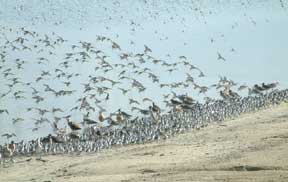
Tiny sandpipers like the western sandpiper and the least sandpiper can be a real challenge. The large flocks at Bolsa Chica that swirl like schools of fish, are mostly western sandpipers. Westerns tend to flock in larger groups than the least sandpiper. But a large flock can sometimes have several different species milling together. If you see them feeding on the shoreline, the western sandpiper has black legs while the least sandpiper has pale greenish-yellow legs. Both are brownish on the top and white-bellied.

CLICK HERE to WATCH a flock of sandpipers.

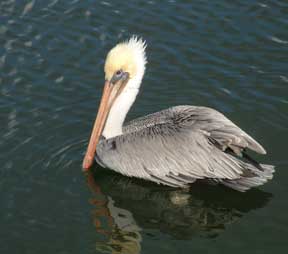
Bolsa Chica is a wonderful place to experience sandpipers, ducks, pelicans and more. Give the Gift of Adventure this Holiday Season. Take your loved ones to a nature preserve and explore.

More Information and Directions to Bolsa Chica Ecological Reserve.

Next week we’ll post our first
AnimalBytes PodCast - Bolsa Chica Audio Adventure

Tuesday, November 21, 2006

Birds and the Art of War

There is wisdom in an owl sitting motionless in a tree, wisdom and a lesson to be learned.

It was a seemingly quiet morning. A few mourning doves and house finches dabbled at the feeder. A band-tailed pigeon perched on the precarious tip of a slender cypress along a nearby driveway. Up the hill in the neighbor’s yard, a lone scrub jay called with urgency.

The jay’s alarm squawks became frantic, a second scrub jay joined in. Then a harsh “caw” took up the warning. Within minutes a single crow became a mob of 20.

High in the upper branches of a young eucalyptus tree perched a dark brown figure. Crows rushed the dark villain. Their sleek black bodies plunged toward the still figure but always maintained a safe six-foot distance. Other crows sat like glossy sentinels in adjoining trees cawing raspy threats. The air became a kaleidoscope of black wings and pointed beaks.
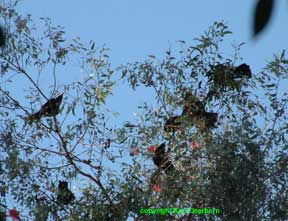
At first I thought one of the red-shouldered hawks was using the tree as a vantage point; frequently crows will mob a hawk and drive it off. But the shadowy bird in the tree didn’t move, didn’t give any ground.

The crows grew to a murder of 40. Black voices raked through the air.

This threat was personal, it was a great horned owl.

HEAR the Crow Alarm Calls.

The great horned owl is one of the few creatures that poses a threat to crows. In the dark of night, this large bird of prey can steal a sleeping crow right off its perch. Identifying danger in their midst, the crows were determined to drive away the predator while the light of day still offered them protection.

And here is where the situation became more than just black birds squawking. Typically, scrub jays do not share space with crows by choice. Crows, after all, are known to take the hatchlings of smaller birds as food for their own youngsters. Similarly, crows and ravens compete for territory. I have watched the local family of 15 - 20 crows mob the pair of ravens that have been checking out real estate in our neighborhood. Jays, crows and ravens are all intelligent birds and they prefer to keep their distance from the competition.

But in the owl, these birds had a common foe. The pair of scrub jays did not have the size or number to drive off the great horned owl. The jays not only attracted the attention of the crows, they continued to work alongside the crows aiding in the harassing cacophony. The crows sent for reinforcements, extended family members arrived, expanding their usual number well beyond 40. If the mob could press the owl out of the tree and into the air, they could drive it off, chase it out of their territory.

After an hour of constant effort, most of the crows moved on. But the owl was not forgotten, four stouthearted defenders perched in the tree encircling the threat. Throughout the day, crows arrived to take their turn at the watch.

The owl moved closer to the tree trunk, its tawny feet with dagger-like talons gripping the smooth gum bark.
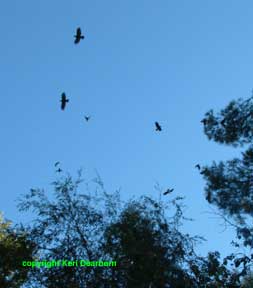
By 3:00 PM the day was slipping away. The approaching night brought renewed urgency. The black mass returned and they brought with them the calvary, ravens. Bigger and bolder, one raven flew right into the treetop. With menace it croaked and waved its pointed beak within a foot of the owl. Several times it rushed the quiet predator, while crows raucously filled the air. Still, the owl did not move.

Here it was, two forces in direct opposition. Each side knew themselves and their abilities. The jays, crows and ravens looked danger in the face and declared its presence. They put aside their conflicts of similarity and banded together against a shared threat. The crows had the strength of numbers. If they could maintain their harassment of the enemy, they might be able to unsettle the owl, press it to make a mistake and take to the air. On the wing in daylight, the owl would be playing by the crows’ rules, they might gain the upper hand.

But the owl knew the best strategy for a lone predator was patience. Its back was safely against the tree trunk. Its sharp talons and beak posed a great enough threat to keep even the large raven at bay. If the owl could maintain its position, it was safe. The harassment and threats never ruffled its soft brown feathers.

On this day the owl prevailed, it stayed on its eucalyptus perch until evening drove the crows to roost.

Know your enemy and know yourself. Fight your battle, not your opponents. Study the travails of others, bird or human, strategy is strategy.

Wednesday, November 08, 2006

Project FeederWatch

It’s that time of year again! Not Halloween, not autumn, not back-to-school.

It is FeederWatch time!

All across North America, backyard scientists are cleaning up their bird feeders, restocking their bird seed and preparing for a winter of counting native birds for Cornell University’s Project FeederWatch.

Project FeederWatch offers a unique opportunity for anyone with a willingness to participate: the chance to be a citizen scientist collecting valuable scientific data on wild birds. In backyards and school yards across the continent, people like you are vital to gathering information on migratory bird movement and population density.

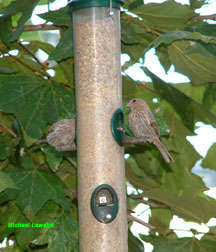
Field biologists can only be in a limited number of locations, informed citizens can provide valuable eyes and ears for science. Data collected by school children and birding hobbyists for Project FeederWatch has identified specific bird species expanding their territory north in response to climate change. Last year varied thrushes were documented further east than ever before and western hummingbird species were spotted on the east coast. Observations at bird feeders typically identify the first outbreaks of avian disease and provide vital information on the pattern by which the disease spreads.

Scientists around the world use Project FeederWatch’s 20 years of data to study population cycles, migration patterns and the effects of human activity on the natural world.

Can you make a difference counting birds visiting a feeder on your apartment balcony? YES!


When your sightings are combined with those of thousands of other FeederWatchers, every bird you see, or don’t see, helps scientists have a more complete picture of bird populations across the country.

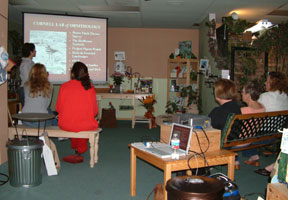
Even if you are just beginning to recognize your local birds, your observations are valuable. In October I gave a workshop on how to participate in Project FeederWatcher at the Wild Birds Unlimited store in Woodland Hills, CA.

In its 20th year, Project FeederWatch needs you more than ever. Whether you count on a ranch, an office balcony or a school yard, information on wild birds is vital to understanding the effects of global warming, how avian flu might travel across the country and, most importantly, the health of our planet. Wild birds travel around the globe, they are “the canaries in the coal mine.”

The effect of West Nile virus is decreasing in my neighborhood. How do I know? Because I have been a FeederWatcher for six years. We went from seeing scrub jays every time we counted to recording NONE for 2 years. Now, we see an occasional young pair. The scrub jays are making a come back. The ruby-crowned kinglet has returned for the winter, but this time it has a friend. I have come to know the birds that visit my yard as neighbors and individuals. Get to know your wild neighbors and Make A Difference–count birds for Project FeederWatch.

“To learn more about Project FeederWatch or to register, visit www.birds.cornell.edu/pfw or call the Lab toll-free at (800) 843-2473. In return for the $15 fee that supports the program ($12 for Lab members) participants receive the FeederWatcher’s Handbook, a poster of the most common feeder birds, a calendar, complete instructions, a subscription to Cornell Lab of Ornithology’s newsletter, BirdScope, and the FeederWatch Winter Bird Highlights. The season runs from November 11 to April 6, and participants may join at any time.

It’s our 20th year, and we’re counting on citizen scientists to help us track birds for the next 20 years.”