Saturday, January 29, 2011

Winter Blooming Flowers

While much of the rest of the country is white with snow, Californians can still delight in a variety of winter-blooming flowers.


In Zone 1, along the walkway and protected by the front steps, winter-blooming bergenia (Bergenia crassifolia) sends up flower stalks in January. This isn't a native plant. However this small patch was planted here when we moved into the house years ago. A native of the Himalayas, they thrive in poor soil and tolerate drought in a shady location. Under the steps seems the perfect location for them, and occasionally, native slender salamanders can be found in the leaf litter that builds up beneath the plants.


Zone Map

Friday, January 21, 2011

Mapping Hummingbird Territory

Before I can gather new biodiversity data, I have to format my data collection and tabulation. That means creating a species data base, determining the data to be collected and finalizing the areas where data will be collected. I've already updated my Zone Map.

But this time around I've decided to map out the territories of my resident hummingbirds. I plan to update these territory maps monthly. As we start off this January, one of the males, FIK, has expanded his territory.  I have a special connection to FIK a male Allen's hummingbird. He was hatched in 2008 in the same plum tree that is the center of his territory. When he was a chick, a predator attacked the nest. His sibling did not survive, but FIK fell 20 ft. to semi-safety in the foliage below the tree. My dog, Inali, found him and with a little bit of ingenuity, she and I saved this tiny fellow. The whole story.

In 2009, FIK bred with a number of females and we had over a dozen chicks. Only one of the females in the yard, DR, has been here as long as FIK. 
Last year FIK was the dominant male and he spent so much energy breeding, by the end of summer 2010, he was spent. His son, BIF (blue), almost pushed him out of his territory.


Now with the warm weather, the male Allen's hummingbirds are beginning to perform their breeding displays for the females. FIK is back up to fighting strength and he has reclaimed his former territory. His territory (green) is once again the largest. At the front of the house, he has the greatest visibility to visiting females.


DR is the oldest female and she has the largest territory of the girls (red), however, she does not have the prime territory. There is no feeder in her territory. However, she does have nectar-bearing and insect-attracting plants, and two native Catalina cherry trees where she has nested successfully for two years. 2010 nest.


A daughter of the long dominant "A" family of females, A-Spot, holds the prime female location with a feeder (orange). A young female, F, who's first attempts at nesting failed last year, maintains a small territory (yellow).


With three adult male Allen's hummingbirds, all in their prime, we could be in for territory challenges. Canyon (purple) also a chick from 2009 and probably a son of FIK, maintains a small territory at the back of the yard. And there is a newcomer, an immature Anna's male that has established his territory at the back of the yard (lime) next to Canyon.


More males, most likely will mean fewer females will nest here. But there is a large area of hillside territory with nesting locations that is unclaimed. Will a new female move in? It should be a fascinating spring.

Friday, January 14, 2011

Mapping the Backyard Biodiversity Project

The first step in documenting the biodiversity in our backyard ecosystem is dividing the landscape into Zones.

I have mapped the yards (front and back) into 18 Zones with an additional Garage Zone and House Zone.

These Zones are determined using physical separations (walls, fences, concrete walkways, gravel paths) and by clumping the natural microhabitats. For example, Zone 1 includes a planter against the house and a concrete walkway with stairs. This area is heavily used by people going in and out of the house. This activity has an effect on the plants and animals willing to live there. I have examined Zone 1 in detail before. Zone 1, 2007

Zone 2 has changed dramatically since I first documented the species living there in 2001, 2004 and 2007. This Zone is a raised planter in front of the house stretching from the sidewalk to the walkway and extending to the western corner of the house. It is landscaped and receives moderate sun in the summer. It was my observation of alien plants attracting alien pest species and creating a dead zone for native animal species that first inspired me to remove the African daisies in this planter and replace them with native plants. It will be interesting to see how the biodiversity in this area compares with ten years ago. Zone 2, 2007

Zone 17 is the lower end of the driveway at the side of the house and a small planter that typically only receives rain water. But this area has offered surprises in the past. Zone 17, 2007


Creating Zones provides manageable areas of observation and also allows comparison between areas that are similar or dissimilar in terrain, physical attributes and water availability. Off to a good start.

Monday, January 10, 2011

New Year's Cleaning - Bird Houses

A pair of oak titmouses are checking out the bird houses for a spring nesting site. I've been trying for 5 years to get them to nest in our yard so this year I'm cleaning out the bird houses early. Last year a number of bird species nested unusually early in the yard because of changing climate patterns. (Climate Change in California).
The Bewick's wrens love this rope bird house, but they won't reuse it if I don't clean it out. They fill it to the brim with nesting material to make it cozy. Unfortunately, they won't come back unless all of the previous year's debris is removed.


Cleaning out the titmouse bird house I discovered a western bumble bee nest


If the changing climate alters when the birds begin looking for nest sites, I have to alter when I prepare the bird houses. 

Cavity nesting birds like the titmouses and wrens can have a difficult time finding appropriate nesting sites in cities. Providing suitable housing opportunities for them helps to maintain their populations. Many cavity nesters are insect predators, eating many of the bugs we consider to be pests. Offering them an appropriate bird house invites them to be your neighbors and gives you the opportunity to watch them raise their families.

Friday, January 07, 2011

Backyard Biodiversity Project 2011

Around the world biologists are gathering information on animal and plant biodiversity in wild places, but I can’t help but wonder how much we are missing in our own backyards. We raise money to save distant rain forests and try to change the daily lives of people in far away lands but what actions do we take to positively impact the ecosystems where we live?


I’ve seen amazing transformations in small areas of my yard by removing introduced exotic plants and restoring native plants to the landscape. Native Plants. The Mexican mountain marigold (pictured) provides food for pollen-eating insects even in the winter. I keep trying small gestures to provide more opportunities for native species. Bee Box.


Just in the last two months we’ve seen an amazing biodiversity in spider species without really trying: red jumping spider, trapdoor spider, green lynx spider. In the past I’ve found small areas around the house are home to numerous spider species. Here Be Spiders.


This afternoon I checked on the green lynx spider egg casing. It has survived the December rains, but for the past week the mother protecting the egg sac has been gone. Did she perish in the cold weather? Temperatures have been in the mid-30s to 40s at night. This spider species only lives about a year and adults typically do not survive winter weather.


According to several university websites, females lay their eggs in an egg sac in autumn. We saw this egg sac in the second week of November. The female guards the eggs for 2 weeks until they hatch. The mother opens the tough webbing of the egg sac to release the spiderlings and she provides protection and sometimes food for the next 2-3 weeks. See University of CA, Irvine photos. When the young spiders disperse, her job is done. The youngsters will overwinter, but their mother will die.


Last year we had an unusually warm December and early January. We discovered our first green lynx spider in the yard with her egg sac on the scented geraniums in the vegetable garden. By February, drenching winter rains destroyed the egg sac.


This year it has been almost 2 months since I first discovered the green lynx spider and her egg sac, but again the spiderlings have not hatched. I don’t know if the female realized the eggs were not going to hatch and abandoned them or if she died. Typically, a female will guard her egg sacs until she perishes from starvation. Last week the female was looking very thin.


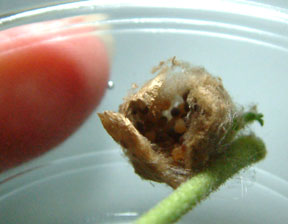
What happened to these eggs? I decided to open up the egg sac and see whether or not the eggs were viable. Looking through my microscope I could see that about a third of the eggs seemed infertile, they were dark and showed no development. Another third or more appeared plump and ranging from an orangy-yellow to pale white. A few appeared to have been forming into spiderlings, the shape of the carapace was somewhat apparent. But these embryos on their way to becoming spiderlings, seemed slightly dried-up. 


Considering we had nearly a week of rain in mid-December, this seems odd. But something with the weather was not right for these eggs to develop. For a second year in a row beautiful green lynx spiders have failed to reproduce in the garden.


Are there more green lynx spiders in the yard and I’ve just missed them? Are their other spiders failing to reproduce? This leads me back to the Backyard Biodiversity Project.


Are there creatures to waiting to be discovered right here in a backyard in Los Angeles, California? I think so. I plan to take a scientific look at the creatures and plants living in our small yard in one of the largest cities in the world. I’ve started the Backyard Biodiversity Project before only to be interrupted by acceptance to graduate school. Now I’m plunging into the year with the intention of spending the next 12 months on this project.


What’s in your backyard?

Monday, December 20, 2010

Red Jumping Spider - Backyard Tiger

I love spiders. They are fascinating in behavior. Their webs are works of art. Females are devoted mothers, risking their lives for their offspring (Green lynx spider, trapdoor spider). Yet I have to admit this large jumping spider startled both my husband and me.


Jumping spiders in California are typically the size a pencil eraser. They prowl the rosebush like ocelots stalking prey in the forest. With the best eyesight among spiders, most books say they can see up to two feet away from themselves, in vivid color. And when they call them jumping spiders, they are referring to their ability to jump about six inches, leaping rapidly to grab any insect prey before it can escape. 


But this red jumping spider (Phidippus formosus) surprised us with its size and capabilities. It was climbing up the outside of the house when it decided to walk across the second-floor bathroom window. When you compare it to the corner of the window, you can get an idea of its size. It would have easily covered a quarter with its body and legs. (It was close in size to the trapdoor spider that came in the house a few months ago.) The brick red of the top of its abdomen identifies it as a red jumping spider. If a typical jumping spider is like an ocelot, this spider was more like a tiger.

We got a great look at its underside and then it spotted us. It looked at us through the window and when I approached it outside, it spotted me coming when I was at least six feet away (3 times further than the books say they can see). It struck a defensive posture like a boxer, holding its pedipalps up in front of its eyes. I didn't really want to see how far it could jump.


Once it realized I wasn't a threat it continued its journey up the side of the house. I don't know where it was going. They supposedly build their burrows at ground level. This large female was headed toward the peak of our second story roof. Fast moving and on the prowl, she was climbing toward a golden polistes (Polistes fuscatus aurifer) wasp nest at the roof line. I don't think I would have wanted to be a wasp facing off with this voracious spider. But that is what natural balance is all about and the more we create a chemical-free habitat with native plants, the more biodiversity we are seeing in our backyard wildlife sanctuary.

Sunday, December 19, 2010

Building a Native Bee Box

I've been wanting to do this for over a year, build a nesting box for native bees and other insects. My friend Doug Welch from A Gardener's Notebook had sent me various plans and ideas. I had a wooden wine box with a sliding lid and it seemed perfect.


Finding the western bumble bee nest in one of my bird houses finally prompted me to just do it.


I drilled holes of 3/8", 1/2" and 5/8" in the lid. Different bee species prefer different size holes. Then I filled the box with hay and dog hair. These were the kinds of fibers in the bird house that the bumble bees had liked.


I mounted two hooks on the back of the box so I could hang it on the fence at the side of the garden. 

In this location we can see any activity at the nest box, it is near the vegetable garden, but it is out of the way enough that people won't be crossing any bee traffic. We probably won't see any action until spring, but we finally have our bee nest box up.

Friday, December 17, 2010

Western Bumble Bee Nest

When I went to clean out one of the bird nest boxes, I was surprised to find that a western bumble bee (Bombus occidentalis) had made its nest inside. Typically this kind of bumble bee makes its nest in the ground. But here was the clump of waxy cup-shaped cells described in the books nestled in the dog hair and sticks that the Bewick's wrens had been using to build their nest. (This could explain why the wrens decided to move out and rebuild their nest in the pot next to the back door.)

Alarmingly, all of the bumble bees, adults and juveniles, still developing in their wax cells, were dead. What killed them? Was is the cold weather snap we had in October/November? There was a garden spider in among the corpses. Had this small spider preyed on the bumble bee nest? I can't imagine that it could have gotten to the juveniles in their waxy cells. Was there some kind of mite or fungus that caused the death of all ages? I don't know.

During the winter the queen bumble bee hibernates in a protected location all alone. She will emerge in the spring to start a new colony and then usually die. I hope that there was at least one survivor from this western bumble bee nest. (More on bumble bees: xerces.org) Our native bees are vital pollinators and typically are not susceptible to the same diseases and environmental conditions that threaten European honey bees. Most are not aggressive and are not a threat to people.

We have noticed carpenter bees nesting in the yard before but this is the first time for bumble bees. I've wanted to create a native bee nesting site for some time. It seems now is the time to finally take on that project.

Thursday, December 16, 2010

Wild Christmas Tree

Last December I did 31 days of Green Holiday Actions. One of my favorites is our live holiday tree. This is our 5th year with our live spruce tree. (2nd Year photo)


Is she a little wild looking? Yes. And we love her all the more for it.


Has she grown over the five years? Yes, and this is probably the last year we will be able to bring her in. But when you consider we have invited her in for five years, she was a great investment financially and environmentally. She is a carbon sink, storing carbon in her wood as she grows. How to bring in a live tree.


If you are thinking about a live Christmas or Holiday tree, take the plunge. The Earth will thank you.

Wednesday, December 15, 2010

Missing Ladybugs

Ladybugs are insects that even a toddler can identify. Their red and black markings are distinct and their rounded shape appears nonthreatening. As predators of aphids and other garden leaf-eaters, ladybugs have one of the most positive insect profiles. Everyone loves ladybugs.

But across the country native ladybug populations are declining. What is happening to these important and beloved insects? Citizen scientists can play an important role in helping scientists sleuth out this environmental problem.

Go looking for ladybugs or just keep your eyes open and aware during your daily activities. When you see a ladybug, take its picture and report it to the Lost Ladybug Project

I spotted this ladybug on a lavender plant on December 9th. Ladybugs hibernate over the winter as adults and typically they group together in a protected location. One year we cut down a live Christmas tree and brought it into the house only to find that there were about 100 ladybugs hibernating in a clump at the center of the tree. The ladybug I took a photo of was out in the warm winter weather. (Climate Change in California) If it gets caught without a protected place to stay when the temperature turns cooler, as it is expected to do this weekend, will it survive the colder temperatures?


Scientists need your eyes to help solve this mystery of Missing Ladybugs.
Other Citizen Science Projects.

Tuesday, December 14, 2010

Climate Change in California

I know most people think of Southern California as having year-round warm weather. And while it is true that we don't have snow in the lower elevations, we do actually experience cooler winter temperatures with a winter rainy season.


Over the past few years I have been noting the signs of autumn: leafing out of the wild currants, ripening of the toyon berries. The winter hibernation of the western fence lizards and desert tortoises mark the seasonal change as well. While the tortoises are fast asleep, this morning I saw a young fence lizard out warming itself in the sun.


I've also been recording signs of spring: hummingbird nesting, blooming of the manroot and more.


Last year the Allen's hummingbirds in our yard started to seriously nest in January. The earliest date we have recorded. A lone chick survived from these early nests because winter storms did arrive in early February. Winds tossed youngsters out of nests and sudden cold temperatures overwhelmed young chicks. The one Allen's hummingbird chick was the earliest recorded wild bird hatchling in North America in 2010. 


This year we had some early autumn rains, cold weather and then December has had some record warm days. Last year we recorded the manroot blooming the first week in January. On Sunday, December 12th I took these photos of the manroot not only emerging from the ground, but getting ready to bloom. Will this plant survive to fruit in summer if it emerges so early from the ground?


The male hummingbirds are performing breeding displays. Will we see nesting even earlier this year? If so, will the chicks survive when winter temperatures return?

Thursday, December 09, 2010

Green Holiday Decorations

Are you looking for a unique and green way to decorate for the holidays? How about lighting your tree with eel power?


Check out the following story and video on LiveScience.com "Christmas Eel Makes Tree Lights Electric."


For other ideas that are a little less fishy and closer to home:
Bring a Living Tree Inside
Living Trees
Recycled and Artificial Trees 
What's Wrong With Mylar?
Creating Holiday Decorations From Your Garden

Tuesday, November 30, 2010

Identifying Individual Hummingbirds

I had a comment the other day regarding how I tell the difference between the different hummingbirds in the yard. It is somewhat true that they look alike. However, we have been fortunate enough to have a small group of resident Allen's hummingbirds. While some of the marking are slightly different between individuals, especially females, behavior is the main clue to the individual identity of these tiny birds.


The Allen's hummingbirds have divided up the yard into specific territories.


This is "P" (Patio) on her nest. She was a resident for one summer.

Each male has a specific home tree and 3 or 4 specific places that it perches to watch over its territory. Fik was rescued as a fledgling. He knows me and trusts me. I can approach him and get quite close, he in turn will come up to me. He has perched on the same branch, in the same tree, since the first day he learned to fly. Bif perches on the tip of a succulent, he's the only one in the yard that will do that. Canyon is the most timid of the males and rarely comes down in the lower part of the yard.


The females are specifically territorial about nesting sites. These Allen's hummingbird females will nest in the same tree / shrub time and again, especially if they are successful. If it isn't the same tree, it usually is within 10 feet of that tree. One female, DR, (DRiveway) tends to rebuild directly on top of her old nest. She is the only female that has shown this behavior in my yard.


If I saw Fik a block away feeding from some flowers, would I recognize him? Probably not. Coloration can change on birds, from juvenile to mature, from breeding to molting. I have a small group of eight very enigmatic Allen's hummingbirds that live in my yard. They each have their own personalities and behaviors in the yard, that is how I tell them apart.


My friend has 30-50 hummingbirds visiting her feeders during the day. Telling them apart, without bands, would be a completely different matter.

Monday, November 29, 2010

California Native Plants Flowering in Late Autumn

While cold weather and snow are settling in across the country, late autumn is awakening the California natives.


The native wild currant has burst its first blooms. Our rain comes in autumn and winter, so now is the time for our native plants to produce fruit or blooms for a summer crop. Many like the toyon have been holding their fruit in a green stage for months and are now ripening just in time to feed winter migratory birds.

The wild currant lost its leaves in the summer heat and now has regained its green adornment. The natives are bursting to life while the exotic plants are dropping their leaves and going dormant. It is a strange mixture really. Perhaps this is why so many people don't think we have seasons in California, they don't realize that the green of summer and the green of winter are provided by completely different plants.

On New Year's Day, people see our green hills rising behind the Rose Parade and they think that we have beach weather all year round. The reality is that we have cold winter days, but this is the only time we have real rain. Plants that want to survive in our climate have to be frost and cold tolerant. The cold season is the only time they can really grow.

Friday, November 26, 2010

Allen's Hummingbirds Staking Territory

Brisk days have ratcheted up the territorial behavior of the Allen's hummingbirds. Each feeder has its own despot determined to possess its liquid energy.

We have had a complete change over in most of our backyard Allen's hummingbird population. "A," who nested in the yard for several years and was hatched here, has either moved on or has vanished (A's nest). Three of the four feeders are now the domains of resident males. That means that females are battling over one feeder. I'm afraid that we may see fewer nests this coming spring, because the females are competing with the males for resources. 

For years we rarely saw males, now they are the dominate characters.

Fik is entering his third winter. He has been the dominant male since 2009. (Fik as father; Rescuing Fik) He is growing older and sometimes I worry about his sons pushing him out of his territory. Fik was so busy breeding this spring that by summer he was nearly worn out.

Bif and Canyon, his two sons were both hatched in 2009. This is Canyon at his feeder.

The weather has been warm then cold, warm and then cold. Already Bif has been performing breeding displays. If the females are convinced to breed this early, they may lose nests to erratic weather and rainstorms. Last year, we documented the first successful nest in North America. (DR's Feb. nest). Unfortunately other early nestings were not successful. I'm hoping that the weather stays consistent so that the females will resist starting their families too early and losing their chicks to an unpredictable climate.

Tuesday, November 23, 2010

Thanksgiving Toyon

There is a special reward for planting native plants: watching habitat being restored in front of your eyes.

Five years ago I planted a 3 gallon toyon (Heteromeles arbutifolia). It started out just 2 foot tall. Today it is about 8 foot tall. The dark green leaves are prickly and in late autumn its berries ripen to a brilliant red. It's no wonder European immigrants to California were reminded of holly and called it "California holly" or "Christmas berry."


In fact this is the holly that gave the name to "Hollywoodland" and therefore Hollywood. (Decorating with toyon)

The native Chumash, Ohlone and other coastal peoples in California roasted or dried the berries and ate them. They also used the strong, rot-resistant wood for a variety of implements and ceremonial markers. But people weren't the only species that depended on the toyon. Numerous animals eat the berries as well, rodents, foxes (including the endangered island fox), probably the extinct southwestern grizzly bear did as well. A wide range of birds also look for this easy-to-spot, chaparral delicacy. 

Sunday morning I watched the hermit thrush picking one red berry at a time and swallowing it down. A hermit thrush has been coming to my yard every winter for the last seven years. I believe it is the same bird, but I don't absolutely know that for sure. For the second year in a row it arrived with a friend. I wonder if the thrush has been waiting for the toyon to grow up and become the beautiful berry-producing plant that it is now?

One thing is for sure, the toyon has created a valuable source of winter food for the hermit thrush, cedar waxwings and other berry-eating birds. The hermit thrush seemed to be thankful for its bountiful meal and I was heartened that I had made a positive difference for the local wildlife and migratory birds.

Now is the season in California to plant native plants, they are the Foundation of Habitat. Plant a few natives and help make a positive difference.

Friday, November 19, 2010

Discovering Sepulveda Basin Wildlife Refuge

great egret and coot by Michael Lawshe
Take a mini-bird walk through Sepulveda Basin Wildlife Refuge.
Click on the link below for a 4 minute video that was shot for "One Day On Earth" 10/10/10. Video courtesy of Michael Lawshe and  Eclipse-1 Media.

Mini-Bird Walk

Turkey Vultures at Sepulveda Basin

Tuesday, November 16, 2010

Something Lurking in the Garden

 The warm autumn weather has brought a few surprise encounters. The photo shows a pair of mating praying mantises. Notice how the male (on top) is slightly smaller and measurably slighter in build. He also appears to have much longer antennae.

I came across this pair at dusk as I was running out of the house. I wasn't the only one startled by the large insects. Fik, one of our male Allen's hummingbirds, was quite disturbed to have the pair on his feeder.

I'm not sure why the large female praying mantises tend to hang out on the hummingbird feeders. Are they hunting insects that might come to the feeders or are they really set on grabbing a hummingbird? Fik wasn't taking any chances, he stayed on the far side of the feeder.

I know you are probably wondering, did the female mantis consume her male companion following mating? I don't know. I took the photo and had to run. I saw the female the next evening, but have yet to locate her egg casing. I wonder if she is one of the offspring that emerged in the back yard in June. Praying mantises.


Meanwhile a new mother-to-be has attached her tan-colored egg sac to the scented geranium, a green lynx spider. This is the second year that one of these free-living predators has stopped to have a family on the geraniums in the garden. Last year, winter storms destroyed the egg sac despite the mother's attempts to keep the nursery safe and dry. It will be interesting to see what happens this year. 

Wednesday, November 10, 2010

"Alex and Me" by Irene M. Pepperberg

Alex and Me; How a Scientist and a Parrot Discovered a Hidden World of Animal Intelligence–and Formed a Deep Bond in the Process

Irene M. Pepperberg. (2008). HarperCollins Publishers. NY

Did you know Alex? If you saw this intelligent African gray parrot on television or read about Irene Pepperberg’s avian cognition studies with this amazing bird, you may have felt that you did know Alex. I know I did. Apparently thousands of other people did as well because Pepperberg’s book opens with the outpouring of affection and communal loss expressed when Alex died suddenly in 2007.

If you didn’t know Alex, the combined personal emotion plus the attention from international media upon his death creates a basis for you to understand the importance of this bird; not everyone has their obituary published on the front page of the Economist.

When you sit down with Alex & Me, it is as though you are sitting down with a friend telling you about her work with an insightful colleague. Pepperberg takes you through the origin of her interest in avian intelligence and weaves her scientific findings with Alex into the story. While I occasionally wanted more specifics about the science, the story format allows Pepperberg to include examples of Alex’s understanding and intelligence that occurred outside of structured research.

One thing is certain, if you think “bird brain” means dumb or unable to use higher cognitive powers Alex and his avian colleagues will challenge your assumption. Humans frequently hold up the size of our brains as proof of our intelligence, but not all brains function in the same manner and the researchers are always a step behind with structuring studies to delve the capabilities of Alex and his “walnut-sized brain.”

What made Alex so unique was his ability to vocalize his thoughts and understanding in a way that humans could comprehend. When the hermit thrush and the ruby-crowned kinglet reappear each October in my small yard in Woodland Hills, I am always struck by the fact that they have found their way back. Do I know these are the same individual birds? Yes, because both of them announce themselves to me specifically upon their return. This year the kinglet came right up and nearly perched on my hand. Where did they spend the spring and summer? What did they see and experience on the trip? How did they navigate their way back?

Unfortunately these birds can not speak in a language I can understand. But there is intelligence here that goes unexplored. Alex was not bred to be an avian genius, he was just taught to speak clearly so that humans could have insight into his avian intelligence. Alex & Me will make you laugh and cry, it also will challenge you to appreciate the intelligence of non-human animals.


Other Book Reviews:
The Geese of Beaver Bog
Survival of the Sickest

Monday, November 08, 2010

Amphibians of Autumn

A cool autumn day and a nighttime shower, this is my favorite time of year and a time for California’s precious amphibians.

We think of cold-blooded or ectothermic creatures as sun lovers, but amphibians must balance temperature with moisture. Summers in California are hot and dry, but our autumn and winter climate is moderate with occasional showers.

On these mild nights rain invites amphibians out of their hiding places to frolic. This California toad has been visiting a friends’ yard.

We’ve spotted our young garden slender salamanders born last spring. And students of mine have seen Pacific tree frogs and a different species of slender salamander in their yards. 

This species of slender salamander has distinct rings along its body giving it a striking resemblance to an earthworm. It is much larger and stockier than the garden slender salamanders in our yard.

Amphibians are part of our local wildlife, but too frequently they disappear first when development or human impacts alter nature’s delicate balance. Frogs, toads and salamanders eat insects and other arthropods. They also are an important food source for mammals and birds. An ecosystem without amphibians is missing a main pillar of balance.

There is something remarkably resilient about amphibians. They have evolved from an ancient line of creatures that first left the primordial seas to live on land. They’ve survived major cataclysms including the end of the dinosaurs. Shouldn’t your yard be safe for them?

The next time you reach for insecticide or herbicide, pause for just a moment. If your yard isn’t safe for amphibians, is it safe for you and those you love?