Tuesday, July 30, 2013

Find Your Self This Summer

Summer is a time for reconnecting with your true self. It's not how far you travel, just how open you are to listening and seeing. 

Since I was a child, Alaska and the Yukon Territory of Canada have been a touchstone of pure joy for me. The vast forests and interconnecting waterways offer exploration of nature and spirit. 

We left behind cell phones and computers and traded them in for bird calls and sunsets. 

Some of our discoveries were old friends, like the chocolate lily. The first article I sold to a magazine was about Alaskan flowers and highlighted this contrary lily. Alaskan winters are too harsh for most bee species. Many flowering plants of the north depend on other insect pollinators. The chocolate lily is beautiful, but its scent is horrible. Its aroma of decaying flesh attracts pollinating flies.

Some of the animals we went looking for were huge, but the best way to find the humpback whales was to turn off the boat engine and listen. In the calm air of Icy Strait, just outside Glacier Bay National Park, we could hear the blast of whale spout (their exhalation upon surfacing) over two miles away.


As more and more of us live in cities around the world, we lose touch with our natural state of being. We are part of the ebb of tides, the change of seasons, the gathering of creatures that collect fall berries. The only thing that separates us from the whales and chocolate lilies is that we think we are different. 


Take a walk or sit outside and watch evening fall across the world. Find your touchstone that takes you back to your best self.

Friday, June 07, 2013

Fingerling Potatoes

I love it when something is more successful than I hoped. Voila a bowl of fingerling potatoes.

Sometime in March I discovered the last few potatoes in a bag were a bit beyond eating. I hate that. I hate when food goes to waste.

My friend Douglas Welch at A Gardener’s Notebook stuck a few old potatoes in the ground in his garden and the plants were growing well. So I decided there was nothing to lose. (See our adventure to a local Garden Show).

My six old potatoes were cut into pieces with visible eyes (the beginnings of new plant growth) and stuck in two rows in my raised beds.

I’ve watered them occasionally and added additional soil around them as they grew. Really, it was minimal care. About a week ago some of the plants started dying back. So this morning I went potato digging and what did I find? Fingerling potatoes!


I only dug up about half of the plants and I already have more than twice the amount of potatoes I put in the ground. Potatoes are amazing. And perhaps this is a lesson for me: Potatoes seem to grow well in the soil and amount of light in my vegetable garden. Perhaps this is a crop I should plant more often.
 

This is what sustainability is all about. Reducing waste, growing food in a minimal footprint. Tonight we will have fresh potatoes for dinner. It is a good start to the day.

Tuesday, June 04, 2013

Allen's Hummingbird Builds Summer Nest


Look what's taking form in the garden.

Yesterday I spotted one of our Allen's hummingbird females working diligently on a new nest. June seems a little late, but the on-again off-again summer weather may have spurred this little female to try a brood before the heat of July and August.

Typically, we see hummingbirds nesting February through May. 
 

In March, these two Allen's hummingbird chicks took their first flights just a day after this photo. (A nest a few years ago in Jan /Feb.)

This female is obviously availing herself of the natural cotton in our "Nature's Nest" natural nesting material. She has been weaving the beige cotton fibers with spider webbing and decorating it with pieces of leaves and sticks. The natural cotton plant fiber is moisture resistant and helps keep chicks cool even as the weather heats up. 

The nesting material has become rather frayed at the edges as a variety of bird beaks have plucked and tugged at it. We've seen not only Allen's and Ann's hummingbirds, but lesser goldfinches and oak titmice using the Nature's Nest.

Interestingly, this new female Allen's is building her nest in the same low branches of the photinia that one of our long-term resident females used to build in all the time. Hummy raised several broods in nests built in this same location. That female hummingbird passed away or moved on in 2005. One of her daughters, "A," held the territory for five years, but for the last two summers no one female has held the territory or nested in this location. 

I can't help but wonder: Is this one of A's daughters or granddaughters? Or is this location and the upturn of these branches just ideal for Allen's hummingbirds to nest in?

Monday, May 06, 2013

Mosaic Project #2 - Lizard

It began with the mosaic bird house and continued into yard art. Making mosaics is relaxing, creative and fun. I especially like taking a hammer to break-up the tile!


I wanted to do a lizard on a rock, but didn't want to spend the day breaking tile into tiny bits, so I roughed out the largest part of the body. Using an exterior adhesive, I arranged the tiles and tumbled stones on the rock.


Then I applied gout around them. 


After a few days of drying, I painted in the detail of the lizard with acrylic paints and sealed it all. 


Now our western fence lizards have their own art to sit on. And even during the winter, I know there will be one lizard visible in the garden.

Saturday, May 04, 2013

Mosaic Bird House

Birds live and nest in my yard. Cavity nesting species can have a difficult time finding natural cavities in an increasingly human altered landscape. Dead trees are quickly removed for fire prevention or because people don't like dead plants. Unfortunately most people don't realize the diversity of life that can continue to live in a dead tree.


I've been putting up birdhouses around my yard for several years. The Bewick's wrens have taken advantage of these dwellings on several occasions. The oak titmouse pair inspects the real estate, but have yet to move in. There is the wine cork house, the lariat house, the wooden nestbox and the chicken pot, which wasn't supposed to be a bird house but the wrens thought otherwise.

The inspiration from my recent visit to a local Garden Show, spurred me to finish this mosaic birdhouse. The structure is a wooden birdhouse purchased from a local craft store. I made a point of looking for a shape and entry size that were attractive to my wrens. 

Bits of leftover tile, glass beads and polished stones were glued onto the structure with a tile adhesive. I topped it with a glass bird that had broken off of a swizzle stick provided by my friend Kim. Grout filed the spaces between the tiles and then the whole thing was sprayed with a sealer.

The intent was decoration, but the Bewick's wren pair are inspecting it already. They've just fledged their second clutch of kids this year. Maybe their third will grow-up in the mosaic house.

Thursday, May 02, 2013

Propagating Epiphyllums

The flower diversity at the Southern California Spring Garden Show prompted Douglas Welch of A Gardener's Notebook and I to talk about plant propagation.

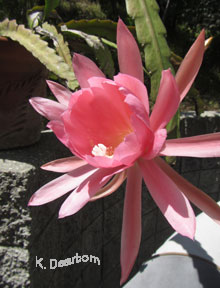
I've successfully grown two variety of epiphyllum for years. The Sunset Western Garden Book gives the common name of "orchid cactus" for epiphyllum. Epiphyllums are a type of cactus with long flat stems that are scalloped along the edges and give the appearance of leaves. The few spines are at the base of these scallops. 

These plants naturally come from the forests of Central and South America where rain is frequent. It is odd to think of forest cactus, but that is what these plants are. They have small shallow roots and typically settle into the nooks and crannies in trees and between rocks. Here in pockets of leaf litter, they thrive on rain water and nutrients washing off the surrounding plants.

The wild plants have large, mostly white-or-cream-colored flowers that bloom at night with a heavy scent. They are pollinated by bats and they produce a fruit that is also eaten by mammals, who then disperse the seeds. Hybridized plants come in a broad spectrum of colors (ESA display at Garden Show) and they tend to flower during the day.

I'm going to share my plants with Douglas. Following the advice of the Epiphyllum Society of America, I cut off a blade and let it heal in a dark dry place for up to 10 days. One of the sections I selected already had a root forming when I cut it.

Douglas can now plant these in a loose soil of bark, sand and potting mix. Let it sit without water for 2 weeks then gradually begin to water occasionally. Once rooted they should be kept moist but not wet. I've found clay pots hold moisture during our hot summer without keeping the plants too wet.  It takes about 2 years for a cutting to bloom.

just about to bloom
To get the right amount of air flow, my pots are up on the edge of a wall in partial shade. The second perk to this location is that the sprinklers just lightly reach them.

While epiphyllums are not native to Southern California, the large valley carpenter bee will visit the blooms. Western fence lizards appreciate the elevated location and linger in the pots. And when the blooms open I am reminded how their shape is perfect for hugging a nectar eating bat. 

Tuesday, April 30, 2013

Finding Inspiration at the Southern California Spring Garden Show

Display by Don Davidson and Fiesta Parade Floats
Last weekend I dashed off to the Southern California Spring Garden Show at the South Coast Plaza with friends. There is something inspiring about the colors and shapes of plants and flowers even when they are showcased indoors.

The colors and textures were dazzling.


notice how the blocks of color are a blend of flowers

The Epiphyllum Society of America illustrated how variation in one plant can make for splendor.


The display gardens were filled with wondrous ideas. "Paint by the Numbers" presented by Living Landscapes (www.LivingLandscapes.us) demonstrated the power of color. (Even though I was looking for some native plants that would also provide habitat.)

"The Art of Exterior" presented by The Garden Gallery highlighted the art of humans and nature. (www.theggallery.com)

While the display garden by the Orange Coast College Horticultural Club & Architecture Technology (www.occhorticultureclub.wordpress.com) integrated natural forms with a complex structure that complimented the organic elements and created airy height.

I've never seen so many different kinds and colors of orchids anywhere in one location. Everywhere you looked there were inspirational shapes, colors, textures, combinations and the simple reminder that nature is rejuvenating.


Visit a local garden show, go for a walk in a local park or nature center. Take in the tonic of spring.

For more inspiration visit my friend Douglas Welch's blog A Gardner's Notebook for video and photos of the Southern California Spring Garden Show. Toward the end of the video, I promise there is a purple orchid like nothing you have ever seen.

Monday, April 29, 2013

Worm? Lizard or Snake?

How many times have you found a dried-up worm on the sidewalk? That was my first guess when I saw this desiccated, long-bodied shape on the steps in the backyard. But the body seemed too thick for the worms we typically find in our ground.

My heart sunk. Had someone stepped on one of our slender salamanders? But there were no little legs. Slender salamanders have tiny, but always visible legs.

When I picked it up I knew I was definitely looking at not a worm and not a salamander. This is a reptile. Now the question was lizard or snake?

This is a reptile because small scales are visually apparent. Worms and amphibians are creatures with soft permeable skin, no scales.

The specimen is not a full body. There is no head and no real torso. Some natural predator ate the front portion of this reptile. There are no legs, but I didn’t have much of the body and some lizards are legless. Turning it over instantly told me this was the back section of a snake, specifically a ringneck snake.


 How did I know that? If you look at the belly or dorsal side you can see elongated scales that go across the width of the belly. These are the scute scales that enable the snake to make its way across the ground without having legs. The scute scales end at the cloaca, the opening that serves both reproductive and elimination systems. So we are looking at the last 4-5 inches of a small snake.

The clue that this is a ringneck snake is the vivid orange color on the belly with numerous black spots or flecks. The ringneck snake is the only local California species with this coloration and this is most likely a San Bernardino ringneck snake (Diadophis punctatus modestus) the subspecies typical to our area.

I saw a live adult ringneck snake in the yard almost exactly a year ago. They never get too large, just 10-30 inches. The individual snake I saw was larger than this. Perhaps they are breeding in our oasis of native habitat. There are plenty of salamanders or western fence lizards and their eggs for these small snakes to eat.

I’m sad to see this beneficial and non-threatening snake dead. I’m not sure who ate it. Possibly either the raccoon, skunk or opossum that circle through our yard on a regular basis. I’m hoping that there are more of them hiding in the undergrowth–a healthy habitat needs small predators like snakes.
 

Wednesday, April 17, 2013

"The Next Big Thing"

I was tagged! 

My friend and poetry teacher Julie Williams tagged me to participate in "The Next Big Thing" or Blog-o-sphere Project. "It is a fun way for writers all over the world to connect and share information about their current writing project or upcoming book."


Julie is a published poet and the author of a young adult novel-in-poems called ESCAPING TORNADO SEASON (HarperCollins). Her new YA novel, ALL THE WORLD'S A JUMBLE will be out next year (Roaring Brook Press, Macmillan). You can read more about her projects and see her multi-media art at http://juliewilliamsimagesandwords.blogspot.com/


Read Julie's "Next Big Thing" interview at Diane Kendig's blog
 
So now that I’m tagged here’s my secret - I have a book waiting in the wings.


What is the working title of your book?

Animal Tales; How Animals Taught Me to Laugh

Where did the idea come from for the book?

When my extended family gets together there is a tendency to tell stories. Typically, these tales involve animals in some way and the storyteller isn’t really doing their job if the yarn doesn’t end with everyone teary-eyed from laughing. It struck me that these stories were too good to let them disappear in the verbal ether. I started to write them down.

What genre does your book fall under?

Family humor with a bit of non-fiction.


Which actors would you choose to play your characters in a movie rendition?

I can see Steve Martin as my dentist uncle faced with the conundrum of disposing of a dead goat in the middle of the city and Jack Black as my dad bottle-feeding a baby rabbit and training it to sit on his shoulder like a parrot.

What is the one-sentence synopsis of your book?

Growing up surrounded by animals can profoundly influence how you find humor in the unexpected.

Will your book be self-published or represented by an agency?

I think I’m going to publish this as an e-book.

How long did it take you to write the first draft of your manuscript?

It started out as a few short stories, but gradually over several years it became a collection of tales.

What other books would you compare this story to within your genre?

I think it is a cross between James Harriot’s “Dog Stories” and “Cat Stories” and James Thurber’s “My Life and Hard Times.”

Who or what inspired you to write this book?

My Uncle, who is a wonderful storyteller, and my parents who brought a menagerie of animals into our home and taught me that all of these creatures were part of our family.


What else about your book might pique the reader's interest?

Animals, animals, animals.


Stay tuned for the writers I'm tagging.

Tuesday, April 16, 2013

Pocket Gopher - Villain or Hero?

Ahh! They are back. A pocket gopher has tunneled its way to the lower area of my front yard and undermined one of my native Douglas iris. In the past this area has been beyond their reach, but not any more.
 
Of course, the destructive gopher hones in on what it prefers, my native plants. 

The Douglas iris in the upper left is the current gopher target.
Previous gophers have eaten the roots and rhizomes right off of my native iris in the backyard. I’ve put metal screen boxes underground around plants. I’ve planted narcissus bulbs as alleged gopher deterrents. I’ve even joined my dog in digging them out. I curse the gophers, but they do have a purpose.

Our southern-California soil has a lot of clay. 


The gopher is kicking hard-packed clay up from under the sidewalk
This element of our soil was vital to the adobe bricks that built our missions and the clay tiles of Malibu and Catalina Tile Companies. The industrious, and hungry, pocket gopher tunnels through the hard soil searching out the roots of plants. 

As it builds its underground highway it aerates the soil and mixes the sediments. It creates underground pathways for water to flow and roots to follow. The gopher’s earthen works even provide a protected highway for other animals such as worms, arthropods and especially amphibians.

The underground tunnels of pocket gophers enable salamanders and frogs to travel in a moisture controlled environment without the threat of dehydration. Remember in southern California we have six or more months without rainfall. Gopher tunnels enabled California slender salamanders to travel from my backyard down into the lower areas of the front yard.

Even sections of collapsed tunnel create homes for western fence lizards and alligator lizards.

If only the pocket gopher would eat plants I don’t want. Well, here’s the rub, it is. The root and bulb of this noxious oxalis (an African invasive) has been sheared off by the gnawing teeth of the pocket gopher.  


underside of oxalis with root sheared right off
Living underground, pocket gophers were one of the few animals that survived the volcanic eruption of Mt. Saint Helens. Tunneling activity brought nutrient rich soil up through the volcanic ash layer creating opportunity for plants to reestablish. Just as in my yard, amphibians traveled back into oases of habitat through the gopher tunnels. When large animals, like elk came into the blast area from its edges, their feet broke through the gopher tunnels mixing soil with elk droppings thereby adding seeds and nutrients to the soil.

At Mt. Saint Helens, the pocket gopher is a hero. It would be a hero in my yard if...and here is the big if... if there were a medium-sized predator to control their overpopulating and devouring my entire garden. The coyote, red-tailed hawk and great horned owl seem to be focusing their efforts else where. That leaves me the task of being the predator controlling the gopher population. If the native iris are to survive–out comes the gopher trap.


Tuesday, February 12, 2013

Bright Yellow Flowers in Winter

It's hard to believe that while the east coast is digging out of several feet of snow, our winter along the California coast means flowers. 

The giant coreopsis (Coreopsis gigantea) in the front yard is blooming for the first time. This Dr. Seussian looking plant is unique to the California Channel Islands and coastal areas from San Luis Obispo to Los Angeles. Each summer the thick gray stalks appear to be dead multi-armed creatures. Yet if our Mediterranean climate delivers a cool wet winter, then feathery green leaves start to emerge in January followed by big floppy daisy-type flowers in radiant yellow come February.

This yellow has a tinge of blue hovering like an aura. The vibrant color sings with ultraviolet attracting carpenter bees and skipper butterflies.
Why is the giant coreopsis blooming this year? I think it is finally big enough, both above and below ground. In other words the root system is now stable enough to absorb the amount of water needed to produce blooms.
Plus I think the frost we had a few weeks ago kind of goosed it. Frost followed by warm equals spring for California native plants.
 

It can be difficult to successfully grow a garden of natives. Gophers seem to regard my native Douglas iris as candy. A fungi in the ground has now killed both a small coast live oak and an island ironwood tree. Invasive fox squirrels have twice eaten the tops off two rare Santa Rosa pine seedlings. But the native plants attract a variety of native insects, spiders and birds

Our front hill slope continues to be a challenge but the giant coreopsis, sugarbush, Catalina cherry, toyon, San Nicolas Island buckwheat and chamise are all doing well. Native plants survive drought, heat and frost all while creating habitat. They are worth fighting off the gophers.

Monday, January 21, 2013

What Did You Hear In President Obama's Speech?

Perception resides in the individual.

We see or hear, smell, taste or feel, what we expect, what we hope, what we fear.

In President Barrack Obama's speech this morning I heard something important to me: The mention of climate change and acknowledgement that this is a real challenge we must face.

When I travel to other places in the world, I am always struck by the knowledge and desire in other countries to actively work toward reducing carbon levels. They seem to see the potential impact on humanity if we do not. For too long, Americans have looked away from this reality. It is time to look again without fearing change.

                                  Green Spirit

                                  She stood
                                  Verdant and golden
                                  Light clinging
                                  As she jumped
                                  Forward into dark.

                                  Her fiddle head,
                                  Green with idealism,
                                  Boldly understanding
                                  Each day unfurls.
                                  Tender in innocence,
                                  Her resilient stem
                                  Was fibered by
                                  Challenges of eons.

                                  The slightest breeze
                                  Raced through
                                  Her leafy wings.
                                  She met the Sun’s
                                  Invitation to dance
                                  With
                                   e
                                   n
                                   t
                                   h
                                   u
                                   s
                                   i
                                   a
                                   s
                                   m

                                   a
                                   n
                                   d

                                   t
                                   r
                                   u
                                   s
                                   t

Tuesday, January 08, 2013

The Real Hollywood - Toyon

If you need evidence that Southern California has received less rain than normal, all you have to do is look at the plants.

Toyon (Heteromeles arbutifolia) is a native shrub in our chaparral. The dark green, toothed leaves and red berries in winter resemble holly. Newcomers to southern California called it California holly. "Hollywoodland," the name a real estate developer first used to market homes built into the foothills northwest of Los Angeles, refers to the red-berried toyon plants that were on the hillsides. When the letters spelling "land" fell down what remained was the "Hollywood" sign.

This year the toyon is demonstrating just how little rain has been available to the natural habitat. Consider these two photos of toyon. 

This photo with plump red berries is of a plant that receives biweekly irrigation year-round.


This photo is of a plant that is dependent on natural rainfall. The berries are small and have not ripened.

In 2010, this same bush flourished.
 
Migrating birds like cedar waxwings, American robins and hermit thrushes as well as our local year-round residents like the northern mockingbird, depend on the toyon's fruit during the winter. When our rainfall stays at an annual 12-14 inches, food resources for local and migrating wildlife is reduced. 

While this is an average normal amount of rainfall, the key here is "average." Our Mediterranean climate requires years of flood mixed with years of drought for plants to really thrive. 

See the last time we really had flood precipitation.    

Still the toyon is hardy. It survives frost and it will survive our low rainfall, but the animals that depend on its fruit will have a more difficult time.

Thursday, December 06, 2012

Wild Mushrooms in a California Yard

fairy ring mushrooms
After a few days of misty drizzle there is a burst of bloom in the yard; not flowers–mushrooms.

Winter (and sometimes spring) is a time for mushrooms in California and the variety is quite amazing. Mushrooms and lichen are still an area of exploration for me, but I got out my fungi book and tried to figure out what they all were.

 
I tried to blame the compost we spread in the yard for the outbreak of these small buff-colored shrooms, but it seems they are more likely from a fungus that has been growing underground for some time. The fairy ring mushroom (Marasmius oreades) is, in fact, growing in a circle about four feet across. As the fungi grows underground it spreads out looking for nutrients. The mushrooms are a bloom, like a flower, the reproductive, spore-carrying part of the fungi. In California, this mushroom blooms year round under the right conditions and some rings have been found to be 600 years old.

At the base of the blue spruce there was a cluster of these small mycena (Mycena arminta?), a fragile mushroom that is typically found in connection with decaying wood.


This lovely white mushroom is probably a member of family Agaricus. It could be a pleasantly edible mushroom or a highly deadly one. This is the challenge of identifying mushrooms. You have to really know what you are doing to collect wild mushrooms for eating.

There were brown mushrooms 2-4 inches across in the areas of the yard with pine needle debris. And here is another challenge of identifying mushrooms: They change in appearance as they mature. The bell shape of this species gradually becomes a flat, classic toad-stool shape. I believe these are shingled trich (Tricholoma imbricatum) but here again they are very similar to other mushrooms species, some of which are highly toxic if eaten.


For the novice, like me, it is best to admire these blooms in the garden. This bounty of biodiversity will not be visible for long. The sun has come out and mushrooms are much shorter lived than flowers

Go native with your yard and create habitat.