Wednesday, June 17, 2026

Chipmunk's in the Santa Monica Mountains?


I've lived in the San Fernando Valley my whole life. Chipmunks are not part of our wildlife community.  Typically, chipmunks are found at higher altitudes in established pine and oak forests. 

Last week, when my husband reported that he thought he saw a chipmunk in the backyard under our bird feeders, I found his identification of the possible rodent highly questionable. Then, a few days later, I saw it too!

There was no question. This tiny member of the squirrel family had the distinctive white and dark stripes on it's face characteristic of chipmunks and the stripes of dark brown and white down it's back. It's exceptionally long tail was another identifier. We set up the wildlife camera to capture images of our unexpected visitor.


I hauled out the mammal ID books. Mammals of California by Tamara Eder details 13 species of chipmunks in California, but none in the Santa Monica Mountains. 

Santa Monica Mountains National Recreation Area's website reaffirms chipmunks are not found in our low-lying coastal mountains. Yet, on INaturalist, I found recent sightings of chipmunks in Topanga State Park and in Bell Canyon in the Santa Susana Mountains. When I started sending photos to friends, a long-time zoo docent friend quickly responded that she had seen a chipmunk in her backyard in Burbank, earlier this spring.

The individual in our yard looks most like Merriam's chipmunk (Tamias merriami). This makes sense as this species is found in the Angeles Forest and Los Padres Forest–the higher altitude mountains to the north of Los Angeles. Are these wandering chipmunks fire refugees from the January 2025 firestorm that swept down from the Angeles Forest into Altadena and Pasadena? If they are, they've traveled tens of miles. 


"Chip" has become a regular morning visitor, but this single individual would have to find a mate to continue its wandering lineage. Will Chip stay or head out in search of a mate? For the moment, we are just appreciating that we have offered refuge to a wayward chipmunk.

Non-native fox squirrels 

Bird habitat 

Tuesday, March 19, 2024

Ceanothus - California's Native Version of Lilac

Ceanothus, commonly called wild lilac, is a chaparral plant that takes the form of a shrub. The clumps of small flowers arranged on the tips of its branches create inflorescences similar to lilacs, but that's where the similarity ends. True lilacs are deciduous and thirsty, while ceanothus are evergreen and drought tolerant.


Ceanothus can also take a variety of shapes: ground-hugging prostrate subspecies, like the popular 'Carmel Creeper', or  shrubs like 'Yankee Point'. Their blooms can range from white (like the 'Snow Flurry' pictured above) to a deep blue-purple ('Julia Phelps').


The ceanothus hybrid 'Ray Hartman' can be shaped into a small tree and this one spent a December indoors in a pot as our decorated holiday tree before it was planted in the yard. In three years, it has nearly tripled in size and is helping provide a natural screen between yards. A prolific bloomer, it attracts a range of bees and butterflies and as it branches out it's creating more shelter for birds.


 The 'Ray Hartman' has become one of my favorite ceanothus and a dependable spring bloomer.

Friday, March 08, 2024

Early Spring Flowers in Southern California


Throughout the yard, winter rains are promoting early California flowers. The Mexican redbud (Cercis canadensis var. mexicana) showcases lush magenta blooms on naked branches.


Inflorescences of tiny bright blue flowers tip the spreading arms of the 'Ray Hartman' ceanothus.

These are the shapes and colors of the kinds of flowers we typically find beautiful, but they aren't the only flowers. 


The California coffeeberry (Rhamnus californica) unveils clouds of rusty-brown star-shaped flowers. They aren't the flowers of bouquets, but they will attract pollinators and hopefully produce fruit for birds and other wildlife. If you look closely you'll see specks of pollen spilled across the coffeeberry's leaves. 

This large mushroom is a fungi flower–the fruiting body of an underground web of life. 


Identifying mushrooms is challenging, but I think this is a giant leucopax (Leucopaxillus giganteus).

Since the beginning of the rainy season, we've had just under 28 inches of rain. Generally, in the Los Angeles area we hope for 12–18 inches over the course of a year. The abundant moisture has promoted the growth of pincushion moss (Leucobryum glaucum). Our north-facing garden walls look more like England than dry Southern California.


Mosses reproduce via spores rather than seeds. The fringe of tiny stems rising up from the moss are the sporangium, the pods holding the spores. They aren't your typical flowers, but these too will bring new growth.   

Wednesday, February 28, 2024

A Fresh Bumblebee

An unexpected creature sat warming itself in the sun on the patio this morning: a yellow-faced bumble bee (Bombus vosnesenskii)


Its long yellow "hairs" and textured black body appeared fresh and new, as if it had just emerged into adulthood. No pollen clung to its body. Every wing and limb shone iridescent black in the sunlight. Where did it come from? 

Bumble bees typically nest in a cavity in the ground. Waxy cells, each packed with food resources, house the eggs and then developing larva. Once, 14 years ago western bumble bees nested in a birdhouse.

Where did this yellow-faced bumble bee emerge from? This area of the patio is edged with a concrete brick wall along one side and the house on the other. The cold bee was not able to fly; it would've had to walk a distance of 10 or more feet to find this dappled place in the sun.

The large bumble bee sat basking for a good 10 minutes before its body was warmed up enough to fly. Then off it went.

Identifiable by its fuzzy yellow head and a black abdomen with a narrow yellow band on the fourth section (nearly the tip), the yellow-faced bumble bee is a valuable pollinator. Like all bumble bees, however, they struggle to find suitable habitat. The mother of this bumble bee must have appreciated the native plants and undisturbed areas of soil that could provide for her offspring.

On this cool February morning, it seems early for bumble bees to be leaving the safety of their nests. Yet, the morning also brings the spring's first western swallowtail, fiery skipper, and California sister butterflies down into the yard. I wish the bumble bee well and hope we will see it among the sage and coffeeberry. 

Thursday, December 01, 2022

What's That Duck?


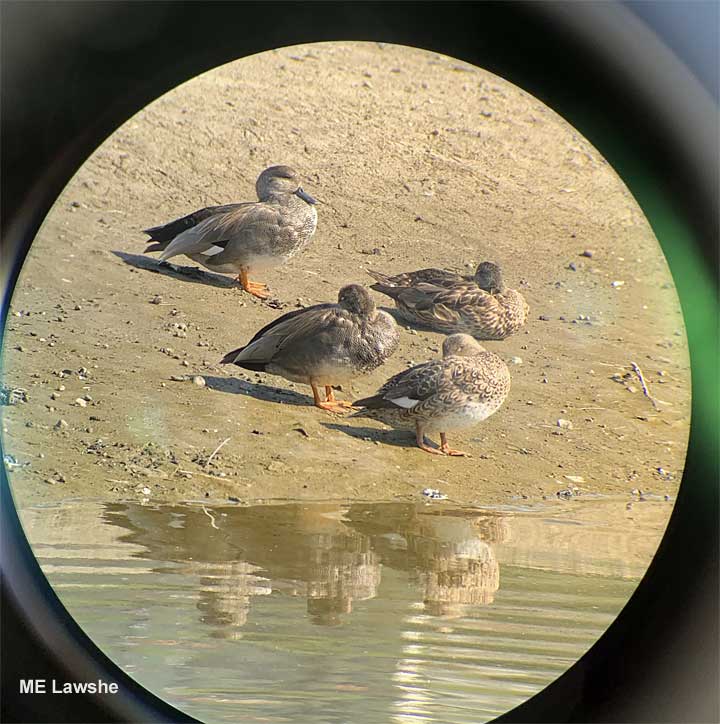
One nice thing about a spotting scope: it isolates your focus down to one or a couple of individual birds. If it's on a tripod, you can hold a birding book in one hand, while you look for distinguishing characteristics.

At a glance, what stands out:

  • orange yellow legs
  • black beak (on the one that is visible)
  • dark eye
  • a fairly large rounded head that is a bit squared at the back
  • a black rump on the two brighter individuals
  • two sets of a bright individual and a drab individual, so possibly two pairs
  • a white patch on the secondary wing feathers–near where the wing is close to the body; both the possible males and females have this white wing patch
  • and if the two brighter ducks are drakes (males), they are not flashy and colorful like mallards

It doesn't seem like a lot, but it is. Additional important info is the location and the time of year.

Malibu Lagoon on the Southern California coast in February.

A quick paging through ducks in my Sibley Guide to Birds finds just a few typical western ducks with bright yellow orange legs:

  • mallard: But the beak is yellow. Males have black at the tail area, but with white tail feathering, and of course males have distinctively dark green or blue iridescent feathering on the head. In addition, they have a white line above and below iridescent blue feathers on the secondary wing feathers. There is no blue visible here.
  • gadwall: Black rump and white wing patch. Male has black beak in breeding coloring. But the book notes "puffy head" on the breeding male and darker gray chest feathering. Hmm.
  • northern shoveler: Male has a black beak in breeding colors, but both the male and female have large wide beaks–hence the name "shoveler." The beak is longer than the length of the duck's head. In his breeding colors the male is high contrast with a black iridescent-green head, yellow eye, white chest, back and reddish brown flanks. No white wing patch, but there is a thin "bar" of white.

While everything isn't perfect, it's pretty clear that the ducks we're looking at are two pairs of gadwalls. The males have yet to completely don their breeding plumage, but they aren't mallards or shovelers.

Don't be afraid to try and identify the birds you see. Note the visual or behavioral characteristics that stand out. Those bright yellow-orange legs or a white wing patch can be the key to ruling out other species. 


Other Bird Identifications:

Raven or Crow

Juvenile hawks

A California Towhee and Its Call

What kind of Junco

Bright Red-Orange Bird in Los Angeles

What's that Bird on the Ground


Tuesday, March 22, 2022

Raven or Crow?

A black bird lands on your backyard fountain. Is it a raven or a crow?

courtesy of K. Meyer
 

There are a couple of physical traits I look for to help me make the identification:

Size - Is the sitting bird generally the size of an 8"x11" piece of paper from its feet to the top of its head? Or is it smaller? Ravens are big birds. Crows are medium-sized birds. But size can be tricky without something to use for comparison. 

Wing to Tail - When perched, a raven's folded long wings will reach nearly to the tip of its tail. A crow's wings are shorter, proportionately, so the tail appears longer. In the photo above, the bird's wing tips almost reach to the tail. Hmm

Beak - Both crows and raven have feathering onto the upper edge of their beak. The beak of a raven however is large and thick. Its also longer than the head. A crow's beak is long, but not longer than the depth of the head.


Throat - Ravens have shaggy looking feathers under their throats. They can fluff up their throat feathers. They also can hold those feather smooth to the body. The raven, pictured at right, has its throat feathering fluffed up while calling to a mate.

Stance - When sitting, a raven's tail and wings tend to stick down well below their perching feet. Notice in the raven to the right, that the tail is hanging long below the branch. A crow's tail is less long. When sitting, the crow's tail is not far below the feet. See crow below.

Crows also have a greater tendency to flick their tail and wings while sitting. (Notice how the crow's beak is as long as the head is wide.)

So the question remains. Is the bird on the fountain a raven or a crow? It's a raven.

There are differences when these birds are in the air, too. More on that later.

To really get an understanding of the size, see a blue bird on the same fountain.

More on crow behavior

More on raven behavior


Tuesday, January 25, 2022

New Birds in Your Yard?

I don't know why, but today new birds were showing up in my yard and in the yard of friends. In both cases the newcomers were at water features.

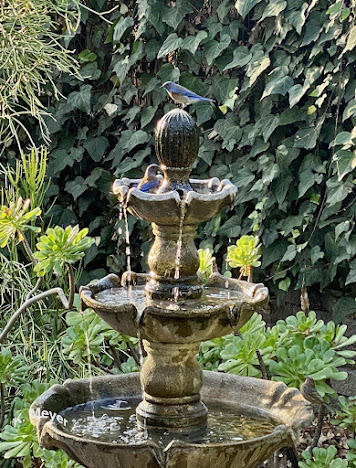
This lovely photo taken by our friend Kathy shows the two western bluebirds (Stalia mexicana) drinking from her fountain. The male is at the top and the female is in the top tier of the fountain. (I love the house finch that is down at the right looking up at the new visitors. You can really see that the bluebirds are bigger than the house finch (Haemorhous mexicanius).

Bluebirds are cavity nesters. They would like to move into a nest in a tree trunk created by a woodpecker. Bluebirds can't create the cavity themselves, so they are dependent on older trees with abandoned cavities. That is hard real estate to find in a sprawling city like Los Angeles. Nest boxes, however, can make all the difference in the world for these birds. Across the U.S., bluebirds depend on nest boxes to raise their chicks.

Learn more about bluebird nest boxes, including plans for one you can build at Audubon: https://www.audubon.org/news/how-build-bluebird-nest-box

We also had new visitors; a pair of northern flickers (Colaptes auratus). Interestingly the female was a western red-shafted subspecies and the male was a yellow-shafted subspecies, typically seen more to the north and east. They came and sipped water from our fountain with their long tongues used for eating ants.

You don't have to put out birdseed to attract birds. Especially in Southern California, water is an important resource for wildlife.

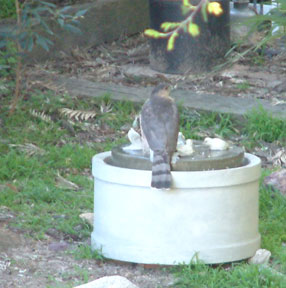
While we had December rain, the past few days have been dry and windy. Both the bluebirds and the flickers were attracted to flowing water in fountains. In the morning our fountain is frequently visited by hummingbirds, warblers, finches, and on occasion a Cooper's hawk (like the one pictured).

A water feature doesn't have to be big to be important to birdlife; it just has to be clean and reliable. Provide water in your yard or on a balcony and you might be surprised who comes to visit.

Monday, November 22, 2021

Rat Spill

I learned a new term this weekend "rat spill."

Santa Rosa Island, Channel Islands Nat'l Park

Think of an oil spill and then replace the oil with introduced black or brown rats flowing onto an island and threatening the entire natural habitat: animals and plants.

It's quite an image and appropriate for the environmental damage that can occur when these large rat species are introduced to an island ecosystem. California's Channel Islands are constantly threatened by the potential of rat spill. 

Black rats (Rattus rattus) and brown rats (Rattus norvegicus) are the number one cause of extinction for reptile and bird species on islands. These large rodents reproduce rapidly and eat everything, including eggs and hatchlings.  


Because islands are primary nesting locations for seabirds, rat spill can take out entire populations. Brown pelicans, oyster catchers, western gulls, and rare species–like ashy storm petrels and Scripp's murrelets–all nest on California's Anacapa Island. Prior to 1940, however, a rat spill introduced hungry rodents to the island with devastating impacts. Some of the bird species were headed toward extinction.

Beginning with efforts in 2001, Channel Islands National Park spent millions of dollars eradicating the rat spill. The effort was successful, but the process wouldn't be feasible on larger neighboring islands with small endemic mammals–like the island fox and island spotted skunk live.


While you might think an island fox could prey on a large rat, the fox's small size and the rat's aggressive self-protection, make this rodent a difficult catch for the diminutive island fox. Additionally, rats are a disease vector and can bring viruses, which threaten the fox's survival. 

more about island foxes

Across the Channel Islands prevention is the goal. Just like with oil, it is much more cost effective to prevent a rat spill, than to clean up the damage and hope you can restore a habitat. 

Take a virtual visit to the Channel Islands 

Tuesday, November 09, 2021

The Fight to Relist Wolves As Endangered

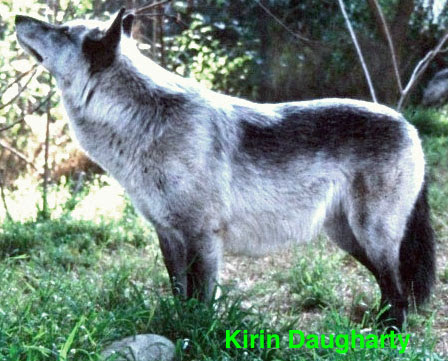
Today a trial begins in Ventura County seeking a court order for the Biden Administration to relist the gray wolf as an endangered species. A private individual and several conservation organizations are arguing that gray wolves once existed across North America and people have a right to see this icon animal in the wild. They argue wolves should be protected until their numbers and range have recovered from centuries of extermination.

Ironically, a single radio-collared gray wolf arrived in the northern reaches of Ventura County earlier this year. This lone male wolf has dispersed from the California/Oregon boarder where a small family of wolves have re-established territory.

Yellowstone's Hayden Valley

There is no doubt that the environment needs the return of this large predator. The return of wolves to Yellowstone National Park has had a transformative impact on the ecosystem. Wolves outside of the Park, however, have often met with persecution and slaughter.

Have wolves recovered across North America? No. Should they continue to have Endangered Species status? States with large natural populations, say 'No.' A single wolf in Southern California, surely deserves some protection. He also deserves the possibility of finding a mate, not a life of perpetual wandering to find a female that doesn't exist.

Do I want a wolf in my backyard? We have a pack of coyotes, now. They were very vocal last night. When there are eight to ten coyotes out in the darkness, our fifty pound dog can't go out into the yard alone. There have been several occasions when he has come face-to-face with them at the edge of the patio. Is he slightly bigger than the coyotes? Yes, but he is a retriever breed with rounded teeth that  give him little defense against a coyote pack. These coyotes have changed their natural behavior to try and fill the niche of wolves. They hunt in a pack, rather than in pairs.

The Endangered Species Act can't be a one size fits all protection. There needs to be a way to address species protection locally that is integrated into a national effort. Such an effort would require people coming together and that seems harder now than it did ten years ago. For every person who claims it is their constitutional right to see wolves in the wild, there is a person who will say it is their right to let their dog, cattle, sheep, etc out of an enclosure into an area safe from attack by wolves. The emotional turmoil around wolves.

Because wolves are a species across a wide and diverse range, it is time to rethink how we approach their protection and reintegration with humans. Those who love wolves can't litigate those who hate wolves to change their minds.

Tuesday, October 26, 2021

What's Happening in Wisconsin?

A new bill has been proposed in the Wisconsin Statehouse: SB-620. It would expand hunting for a range of wildlife, including sandhill cranes (Antigone canadensis).


I've seen sandhill cranes in Yellowstone National Park and Seedskadee National Wildlife Refuge in Wyoming. Notice something in common between these locations? Federally protected land. The only other place I've seen these North American cranes is flying over the Rock River at sunset in Wisconsin.

whooping crane
Baraboo, Wisconsin, is home to the International Crane Foundation, an organization that began with two young biologists determined to save the whooping crane (Grus americana) from extinction. In 1950, there were only 34 individuals in the wild. The total whooping crane population in 2021 numbers just over 800. (There were more students in my high school graduating class.) 

The International Crane Foundation has become a leader in crane conservation around the world. They not only breed these magnificent birds, but the organization mitigates conflict between people and the fifteen species of cranes around the world.

black-necked crane
Now conflict has come to their front door. Wisconsin is one of the southern-most breeding areas for sandhill cranes. Some breed as far north as Alaska and Eastern Siberia, most breed in Canada. Seen across North America, sandhill cranes migrate south as far as Texas and Mexico in the winter. More about sandhill cranes. State Bill 620 would have people believe that shooting sandhill cranes is the only way to reduce their impact on some corn crops in Wisconsin. But there are other non-lethal options that ICF has implemented in other parts of the world. ICF's statement on SB-620

This bill isn't about cranes. It isn't about science or practical ways to resolve issues between farmers and wildlife. This is about a small group of people who want to force their privilege to do whatever they want despite the costs or consequences. It's about politics, not corn or cranes.

blue cranes

Cranes need a voice. We have developed their habitat, drained their wetlands. If farmers in third world countries can find ways to share the land with cranes, surely we can too. 

Cranes mate for life. They are lucky if they raise a chick to adulthood every third year. What can seem like a large population today can be quickly decimated. Support conservation that works. Raise your voice with the International Crane Foundation.

Tuesday, October 19, 2021

Protecting the Urban Forest

Anna's hummingbird
A week ago the ironbark tree across the street burst into bloom. It was one of the few ironbark or eucalyptus trees in the neighborhood that was doing well. Most have been severely impacted by CA's continuing drought.

The blooming tree was an oasis for migrating birds - Hutton's vireo, Anna's hummingbirds, yellow-rumped warblers, Townsend's warbler, a black-throated gray warbler, and ruby-crowned kinglets. All of these species were documented in a single morning last week. The resident Allen's hummingbirds were also imbibing of the flower nectar. This single tree was providing natural food and sanctuary.

This morning the ironbark and its neighboring red gum eucalyptus are savagely reduced to skeletons. The red gum has been poorly trimmed before. Because of it, its shortened limbs have been forced to send out new growth that is unstable and tends to break off in winds. To reduce the dropped limbs the home owner made the same mistake again, repeating a cycle of mismanaged trimming that will cause this tree to regrow fragile limbs and result in shortening its life. Each chopped off limb is now open to insect and fungal invaders. It is a cycle I have witnessed throughout my neighborhood for twenty-five years.

Twenty-five years ago our neighborhood was renowned for its tree-lined streets. We were typically cooler than other neighborhoods. Today 90% of our large trees are gone and Woodland Hills frequently records the hottest temperatures in the west San Fernando Valley.


In the remnant of a single blooming branch a small Hutton's vireo sat bewildered. (circled in green)


How do we stop deforesting our urban forest? How do we teach people the value of their trees and the shade they provide? What steps can we take to plant trees that both provide habitat for native wildlife and are compatible with urban needs?

Who speaks for the urban forest?

Friday, September 24, 2021

Water - A Vital Resource for Wild Birds

This morning we awoke to this...


... a swirl of ash on the water dish on the ground. A bird coming south from the fires in northern and central California, stopped for a bath or at least a drink.

Especially in the dry weather we are having water is a vital resource for wildlife. On an especially hot dry day, two weeks ago, we even had this great horned owl drop in for a drink.

great horned owl in ground water dish
  

For long-distance travelers, known stop overs are vital to successful migration. In the past week we've had a female western tanager and a male black-headed grosbeak. Two other migratory birds arrived here in the last 48 hours: a white-crowned sparrow and a male Townsend's warbler. The white-crowned sparrow stopped for food and water, but the warbler stopped to take a bath in our fountain this morning. The native plants may provide him with an insect snack, but we don't directly provide warblers with food. Water and shelter in native vegetation are the draw. 

CA towhee on raised birdbath

You can make a difference for long-distance traveling birds. 

A running fountain, a raised birdbath, or even a shallow dish of water on the ground. 

Different birds and animals have different preferences. Always make sure that the location is safe from domestic cats.

While I was writing this a Cooper's hawk came and drank from the dish. It may be one of the youngsters that spent hot summer days here in 2019. Sitting with their feet in the cool water helps birds cool down. The red-tailed and red-shouldered hawks prefer the raised bird bath. Rabbits and desert tortoises prefer the ground dishes.

Juvenile Cooper's hawks
 

Climate change challenges wildlife survival. Provide clean water and give back to the natural world. (Still water should be replaced every day or every other day.)


Wednesday, June 23, 2021

Unexpected Wild Carrot - Native or Introduced?


Gardening with native plants can be a challenge. Natives don't always thrive in the site you assign them. For example, the sedge below is growing, but it isn't thriving. Right beside it, the coyote mint (Monardella villosa) pictured above is thriving. 


This toyon grew from seed on its own and is the most robust toyon in our garden.

I noticed the lacy-leaved plant, below, coming up last winter and I let it grow, because I wasn't quite sure what it was. It was sprouting from the dirt of a nursery raised native that had petered out.

It got bigger and bigger. I've tried to let go of the term"weed," sometimes native plants come and they grow where they're suited, not where we want them. It looked too pretty to be a weed, but what was it?


It reminded me of a plant I had seen in wild meadows, commonly called: Queen Anne's Lace. 

 As it started to bloom, the answer was clear: wild carrot (Daucus carota) also called Queen Anne's Lace.

With a little investigation, however, I discovered wild carrot is an introduced plant from Eurasia. It is indeed the ancestor of domestic carrots and most likely came with early European immigrants to North America. The USDA Plant Database map reveals that it is found throughout the North East to the Mississippi Valley, expanding into the South, and all along the West Coast of the U.S. Some sources site it as growing in all fifty states. In some states, according to the Invasive Plant Atlas of the United States, it is considered an aggressive invasive. Like the carrot in your refrigerator, it has a thick taproot, difficult to pull out.

Some states villainize it and make it illegal to transport or sell the seeds. At the same time researchers are investigating the possible health benefits of its volatile oil. Wild carrot has long been considered a medicinal herb with diuretic properties. 


Where did this lovely specimen in my yard come from? I have no idea. Most likely, birds transported the seed, which have tiny burs on their edges. Birds occasionally bring black nightshade into the yard. Or maybe it was in the soil that came with that nursery plant. 

Will I remove it? The biggest claim against it is that it takes hold in disturbed soils and out competes native plants or grasses grown for livestock. It can be mildly toxic to livestock, in other words: this plant has evolved to protect itself from grazing animals. Because of its deep root, it holds unstable ground, but after several years all sources say that it gives way to the natives. Controlled burning doesn't reduce it, because it grows back from the deeply established root. 

Right now it is beautiful and somewhat contained. I think I'll leave it. We'll pick the flowers and not let it go to seed.

Another surprise nonnative - lawn shrimp 

April was Native Plant Month

Tuesday, June 15, 2021

Monarch Caterpillars!


What a surprise this morning, monarch caterpillars! And they are an inch and a half long.

We've been seeing an adult monarch butterfly (Danaus plexippus) a couple of times a week. The last few years we have been growing native narrow-leaved milkweed (Asclepias fascicularis) and the introduced tropical species (Asclepias curassavica) that is readily available at garden stores.

We've had little caterpillars in the past, but they seemed to get eaten by either a bird or a predatory insect. This is the first time that we have had caterpillars reach this size in years.

The group of monarch butterflies that live in California (west of the Rocky Mountains) do not migrate to Mexico with the main population from the southern Central and Eastern part of the U.S. This Pacific population overwinters along the coast in Southern California down into Baja. 

Loss of milkweed habitat has caused declines in this population. Most butterfly species lay eggs on a specific plant species and their caterpillars are dependent on that plant for food. Native milkweed can be a challenge to grow. I didn't realize that narrow-leaved milkweed dies back each winter. I thought I had killed it and took it out. Now I understand that it will grow back in the spring. Until my native milkweed is established, I supplement with the tropical species in a planter, to avoid it becoming invasive.

These hot days, with temperatures above 100 degrees are a challenge for plants and wildlife. I hope that our caterpillars make it to chrysalis. It would be great to contribute to a new generation of monarch butterflies.

Other caterpillars you might see in your CA yard

Backyard Butterfly Quiz

Mourning Cloak Butterfly

Monarchs and Jerusalem Crickets

Monday, April 19, 2021

April Is Native Plant Month!


Did you know that the U.S. Senate has found something to agree on: Native Plants!

On March 25th, U.S. Senators Rob Portman (R-Ohio) and Mazie Hirono (D-Hawaii) introduced a resolution declaring April as "National Native Plant Month." Amazingly, the Senate passed the declaration by unanimous consent. They all agreed!

Wherever you live, native plants are vital to your local wildlife. 

Flowering native plants provide the pollen and nectar vital to native insects. 


This mallow was one of the first native plants we grew successfully. It provides food for native insects, which in-turn provide food for the Bewick's wren and bushtits that regularly nest in our yard. 

A family of western fence lizards live in the protection of its branches and leaves.

The mallow also helps hold our hillside. We know it is in the right location because it has grown from a single plant to patch of plants.


This cultivar of California fuchia (Epilobium canum) feeds our Anna's and Allen's hummingbirds. I love the brilliant red flowers.


Ceanothus has long been some of our favorite native plants. Also known as California lilac, they bloom in a range of purple to white flowers. This new specimen is a 'Ray Hartman'. It will grow to the size of a small tree. We used it as a living Christmas tree in a pot this past December and now it is filling out nicely to become a screening plant between us and our neighbors. 

The purple to blue flowers feed a variety of bee species, including valley carpenter bees. It has grown six inches in the past four months. We are thinking of adding a second plant beside it.


The Douglas iris (Iris douglasiana) (in white and purple) are showstoppers in the spring and their ground cover provides a year-round home for a lovely alligator lizard, another insect eating native species.

Native plants are adapted for their location and native wildlife is adapted to interact with them. Planting native plants can change your yard from sterile landscaping to a wildlife refuge.