Thursday, August 29, 2013

Responding to a Common Threat

This morning I awoke to a family of western scrub-jays vocalizing alarm calls. Looking out the window I was intrigued to see a crowd of birds gathering rather than fleeing. Perhaps they only understood the call to mean “trouble” and they wanted to see the source for themselves or perhaps they comprehended specifically what the scrub-jays were alerting and wanted to verify the veracity of the declaration.

Within moments two adult ravens arrived and they took to immediately hazing the threat that seemed to be about 40 ft up along the trunk of a large eucalyptus tree.  Birds of all shapes and sizes–California towhee, spotted towhee, northern mockingbird, Nuttall’s woodpecker, Bewick’s wren and three Allen’s hummingbirds–gathered to see the troublemaker. Some, like the courageous hummingbirds, flew in and out of the foliage near the threat.

My first thought was: great horned owl. A great horned owl has been hooting from the pine tree in the evening and early morning for most of August. We’ve seen the commotion crows and ravens will make as they try to drive a great horned owl out of a tree.

As the ravens took turns diving past the thick growth covering the tree’s trunk, I could hear rustling and occasional strips of bark falling. Then through the foliage I caught a glimpse of the threat: the masked face of a raccoon. An egg thief had been discovered in its daytime refuge and the birds wanted it gone. The young raccoon was slowly making its way down the tree, trying to find a thick patch of branches to hide in for the day. This teenage raccoon has been prowling the area at night.

The political astuteness of birds always amazes me. A scrub-jay poses a predatory threat to a nesting hummingbird. Scrub-jays chase ravens away from their own nesting territory. But here, the birds all saw the raccoon as a greater threat and they quickly banded together in an alliance against a common foe.

If only we humans could trust our long evolved instincts. When one among us breaks the social contract and kills using agents of mass destruction, the benefit of all should be an aligning force encouraging us to make political alliances of the moment. Those who do not act together against such a threat will all suffer the consequences down the line.

Monday, August 12, 2013

Desert Tortoise with a Friend

This discovery in the garden made me laugh. Our young male California desert tortoise has a friend. Can you spot it?


Yes, there is a young western fence lizard sitting on the tortoise's back. They were both basking in the morning sun. You might think the lizard had mistaken the tortoise for a rock. But I don't think so. When the tortoise walked, the lizard held on. Later in the day, the two were in a different location by side-by-side.


 Interested in turtles and tortoises? I recommend Life in a Shell.

Sunday, August 11, 2013

California Praying Mantis

The praying mantis is a vital garden predator; the equivalent of a mountain lion in the chaparral insect world. As a top predator, it helps to keep a natural balance of pollinating, plant-eating and decomposing insects in our restored habitat.

Too often, these predator insects are imported. I have done it myself at times when native species of praying mantis and ladybugs were rare in our yard. I have also guarded egg casings to help make sure that these predators reproduced in our yard.

When I spotted this praying mantis, it looked unusual. The wide abdomen and short wings made me think it was an introduced species–such as a Chinese mantis or Carolina mantis.

Much to my surprise, the deeper I went in to the Bug Guide, the more I realized this is actually a California mantis (Stagmomantis californica). It has been so long since I have seen one of our natives in the yard, I didn't recognize it. I believe it is a female, because of the large size of the abdomen. (male vs female mantids)

Where did I find this native mantis? It was on one of our native sages, hunting for native insects. Native plants are vital to native insects of all kinds.  

Friday, August 09, 2013

Discovery in the Night Garden

Even at night, the yard is filled with biodiversity to be discovered. This common orb weaver spider was getting an early jump on Halloween and building a foot-wide web along the stairway. This wasn't a chance event. This spider specifically was building its web across an area busy with insects attracted to our porch light.

There was another more unexpected visitor at dusk–a young raccoon.

Its glowing eyes prompted us to call it "zombie coon."

The flash from my friend's camera reflected perfectly off of the raccoon's tapetum lucidum. This is an adaptation that allows night-time creatures to see well in the dark. Light that did not directly strike the retina is reflected off of a substance in the back or along the side wall of the eyeball so that it has a second chance to pass through the retina. This allows the greatest amount of available light to reach the optic nerve for vision. 

Tapetum come in a variety of shapes, are located in a variety of places in the eye and are made of a variety of reflective substances. The amazing thing is that this adaptation has evolved in many different nocturnal animals. Alligators and crocodiles, canines (dogs, wolves, coyotes), felines (cats, big and small), ungulates (prey animals like cattle, antelope, deer), rodents and rabbits, sharks, owls and dolphins all have tapedum. 

As members of Order Carnivora, we think of dogs and cats as being closely related to each other. What fascinates me is that the tapetum in a cat (Tabby or African lion) is formed by riboflavin in the tissue along the sides of the inner eyeball, while a dog's tapetum (terrier or wolf) is formed by zinc crystals in the back of the eye. This is a wonderful example of evolution in these two different branches of Order Carnivora.

Raccoons are in the Suborder Caniformia with canines (the same evolutionary branch) and therefore what you see in the photo is the white light of the flash reflecting off the zinc crystals at the back of the eye and streaming back through the pupil. Amazing isn't it? 

In another example of evolution, the tapetum in members of Order Artiodactyla (hippos, deer, antelope and bovines) is formed by collagen in the back of the eye. Whales and dolphins have a tapetum with the same collagen structure. Fossil evidence and DNA have now demonstrated the close evolutionary relationship between whales and hippos.

Most primates, including humans, are one of the few groups of mammals that do not have tapetum. Without fire, or man-made light, humans do not see well in the dark.

Discovery is all around you!

Thursday, August 08, 2013

Valley Carpenter Bee

It may be hard to believe but the 1/2" diameter holes, that have been bored in the trunk of our bottlebrush tree and in a dead apricot stump, were made by valley carpenter bees (Xylocopa varipuncta).

These large bees are not bumble bees, though they do make a loud buzzing sound. And while they are large in size, only the females have a stinger and they are very reluctant to sting. These are bees you should try to attract to your yard. 

male valley carpenter bee
Carpenter bees are native insects and important pollinators. They are more efficient at pollinating than European honey bees, but these native bees are dependent on some of their food coming from native nectar-bearing plants. Many of our sages evolved with these bees.

female valley carpenter bee
There are several species of carpenter bees in the Los Angeles area, but the valley carpenter bee is the largest–typically an inch long. Females are shiny black while the males are a golden yellow.  These large bees are solitary, they do not form a hive.

 The female valley carpenter bee drills into wood, gnawing with powerful jaws. I've watched them and they seem to gradually rotate so that the hole comes out perfectly round. This tunnel into the wood is where she lays her eggs. She places pollen and nectar at the end of the tunnel and lays an egg. Then she closes off the rear section with a pulp wall. In this manner she creates 5-6 small chambers for larva to develop in the tubular nest. When they mature the young bees gnaw their way out of the tunnel and into the world.
female valley carpenter bee arriving at nest tunnel
Females also tunnel into wood to create a hibernation chamber to sleep away the winter. New males will be born in the spring. 

We regularly see several females and an occasional golden-colored male in our garden. They usually follow a regular schedule, visiting specific parts of the yard at the same time each day.

This spring for the first time, I saw two males at the same time. The males were wrestling mid-air struggling over territory. In the end, one of them went off to find a different location.

I love seeing these big bees in the garden. They are gatherers of abundance, yet they are also vital philanthropists spreading pollen as the foundation of tomorrow's garden. 

Plants for native bees:
small bracted dayflower (Commelina erecta)
Fremontia
giant coreopsis (Coreopsis gigantea)
coffee berry 


Tuesday, August 06, 2013

Monday, August 05, 2013

California's Native Cherry

Native plants are the basis for creating wildlife habitat. The scarlet blush spreading across the Catalina cherry fruit alerts birds, insects and even mammals that this important native chaparral fruit is ripening.

Frequently introduced fox squirrels will ravage the fruit before it can ripen, but as more of our native plants mature there is more fruit for all of our wild visitors to discover. Today the house finches, hooded orioles and mockingbirds are beginning to enjoy these plump cherries. And of course the plants themselves provide nesting locations for birds (Allen's hummingbird).

The native cherries of California’s chaparral are related to the bing cherries and other varieties that humans cultivate, but these are wild growing plants. The Catalina cherry (Prunis ilicifolia lyonii) is found across the southern California Channel Islands (Santa Cruz Island). It is closely related to the holly-leaved cherry (Prunis ilicifolia ilicifolia) found along coastal hillsides on the mainland. But as the name implies, holly-leaved cherry has a leaf with holly-shaped prickles. The chaparral plant evolved this protection to reduce browsing by deer and other large herbivorous animals.

We have both holly-leaved cherry and Catalina cherry growing in our yard. Their close ancestry means we also have hybrids of the two. The Catalina cherry has evolved over the last 10,000 years without a large herbivore. In the Channel Island ecosystem there was no need to protect its leaves from large browsing animals, so the plant stopped expending energy on prickly leaves. The edges of the leaves are smooth.

Instead the Catalina cherry put more resources into larger fruit to attract the Channel Island fox (Urocyon littoralis). The small omnivorous fox relies on fruit for much of its late-summer-to-autumn diet. It can swallow the large pit of the cherry and transport the seed to areas distant from the parent plant in its scat.


While the fruit of the Catalina cherry looks similar to a cherry you might eat, I had my own moment of discovery when I tasted one. This cherry has not been cultivated to western human tastes. It is edible. The skin is somewhat sweet, but the pale flesh is astringent. Only when it is almost over ripe does it lose its bitterness and become palatable. According to Jan Timbrook in her book, Chumash Ethnobotany, the fruit of the cherry or “islay” was more valuable to the native peoples than acorns.

The fruit was used two ways. On occasion the thin layer of very ripe flesh was eaten directly or was mashed and dried to create a kind of fruit leather. However the most valuable part of the fruit was the seed or pit. Typically the fruit was collected in large quantities and allowed to rot. The flesh was then removed and the pit was cracked open to reveal the seed kernel inside. Like acorns, these kernels were poisonous if eaten directly and they had to be specially treated. The kernels were washed a number of times, either in hot or cold water, to leach away a form of cyanide. Once the bitter-tasting poison was gone the kernels were boiled, made into a mash and formed into balls or cakes. According to Timbrook’s sources the cakes are bean-like in texture and taste. 

So valued were islay cakes that they were frequently placed as offerings at sacred locations.

I wonder how the Chumash discovered the process to take advantage of this resource? Why did they even think the seed was valuable? Did they observe bear, deer, rodents, birds or other animals that made use of this plant?

I have often seen the pits opened and the kernels eaten out by some animal, but I’m not sure who. Still more to be discovered in my own yard.  

Sunday, August 04, 2013

Social Life Among Fence Lizards

We think of lizards as individual creatures, loners. For some lizards that lifestyle is true, like the lace monitor that we saw in Australia. Yet the social life of most lizards is unknown.

Western fence lizards are thought to be territorial, keeping other individuals out of their area unless there is reproduction in the air. But I am starting to wonder about the notion of lone individuals.


These two lizards not only have been sitting on the wall together, when they dashed off the wall they went in the same direction. Baby fence lizards hatched out of their eggs over a week ago after weeks of incubation. Are the adults still in the mating mood? I'm not sure.

More investigation is needed here.

Saturday, August 03, 2013

A Lizard in the House!

Today, a lizard found me again - this time in the house!

hatchling western fence lizard
This hatchling western fence lizard was in the doorway to my office. Though he is only about two inches long, he looks pretty plump. I'm not sure if he has been eating spiders in the corner of my office or if he just wandered in this morning.

We carefully scooped him up and relocated him to the back yard. In Southern California we don't have any lizards that are dangerous. In fact, this little guy is highly beneficial as an insect predator. We want him around, though not in the house.

What's really amazing is how clearly you can see this little guy's "third eye" or parietal eye. It is the small yellowish dot in the center of the back of its head. This slight depression has light sensitive cells that help lizards protect themselves (it alerts them to shadows passing overhead), its provides seasonal information with the amount of daily sunlight and it is important for stimulating hormones and timing reproduction.

A lizard in the house can be surprising, but it is great to have them as part of our healthy ecosystem. 

Friday, August 02, 2013

A Second Chance for Tomatoes

A glance at the tomato plant and all looks dried and done for the summer. Temperatures over a hundred in June and July tinged much of Southern California in brown.

But the last week of cool mornings, has given the tomato a second lease on life. 


I was about to take these plants out, but now I'll just trim and pamper. With luck this discovery will lead to late summer tomatoes!

Thursday, August 01, 2013

When a Fence Lizard and an Alligator Lizard Meet

When you're traveling, discovery comes easily. But wilderness in our own backyards and neighborhoods can offer discovery as well.

I went out this morning looking for something unexpected and two lizards found me. 

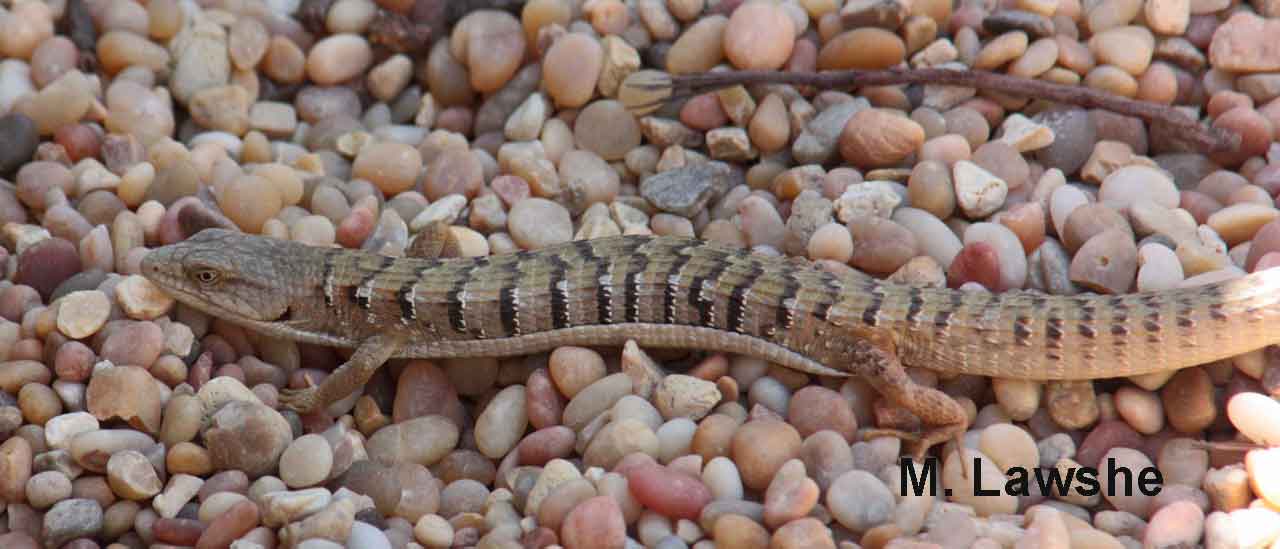
Lizards in my yard are not unexpected. Western fence lizards (Sceloporus occidentalis) have become abundant over the last 10 years. This year we have already seen at least three new babies. The more native California vegetation we have, the more we attract native insects and the greater the resources for the lizards.


Alligator lizards (Elgaria multicarinata) like the one pictured above, have been resident in our yard since we moved in 19 years ago. But I have never seen these two lizard species interact. 

Fence lizards are sun lovers, frequently basking out in the open. They communicate with each other visually with displays of head bobbing and revealing their blue chests. The alligator lizards, on the other hand, are shy creatures slipping through the shadows and feeding into the night on warm summer evenings.

This morning I happened upon an adult western fence lizard and a sub-adult alligator lizard. The fence lizard was trying to chase the alligator lizard out of its territory. The alligator lizard (about the girth of a pencil and 7"-8" long) took refuge on a branch in a bush about a foot off the ground. It turned, like its namesake, with an open mouth and hissing. It tried to scare off the fence lizard.

It was a miniature primeval world moment - wild lizards unencumbered by the actions of people. I ran to get the camera, but only got a picture of the fence lizard. While the fence lizard is primarily an insect eater, a larger alligator lizard could prey on the two-inch-long western fence lizard hatchlings. 

If you just take a moment to observe, you'll be surprised what you can discover close to home. This August Discover yourself.

(Australian wild lizards, Turkish wild lizards)


Tuesday, July 30, 2013

Find Your Self This Summer

Summer is a time for reconnecting with your true self. It's not how far you travel, just how open you are to listening and seeing. 

Since I was a child, Alaska and the Yukon Territory of Canada have been a touchstone of pure joy for me. The vast forests and interconnecting waterways offer exploration of nature and spirit. 

We left behind cell phones and computers and traded them in for bird calls and sunsets. 

Some of our discoveries were old friends, like the chocolate lily. The first article I sold to a magazine was about Alaskan flowers and highlighted this contrary lily. Alaskan winters are too harsh for most bee species. Many flowering plants of the north depend on other insect pollinators. The chocolate lily is beautiful, but its scent is horrible. Its aroma of decaying flesh attracts pollinating flies.

Some of the animals we went looking for were huge, but the best way to find the humpback whales was to turn off the boat engine and listen. In the calm air of Icy Strait, just outside Glacier Bay National Park, we could hear the blast of whale spout (their exhalation upon surfacing) over two miles away.


As more and more of us live in cities around the world, we lose touch with our natural state of being. We are part of the ebb of tides, the change of seasons, the gathering of creatures that collect fall berries. The only thing that separates us from the whales and chocolate lilies is that we think we are different. 


Take a walk or sit outside and watch evening fall across the world. Find your touchstone that takes you back to your best self.

Friday, June 07, 2013

Fingerling Potatoes

I love it when something is more successful than I hoped. Voila a bowl of fingerling potatoes.

Sometime in March I discovered the last few potatoes in a bag were a bit beyond eating. I hate that. I hate when food goes to waste.

My friend Douglas Welch at A Gardener’s Notebook stuck a few old potatoes in the ground in his garden and the plants were growing well. So I decided there was nothing to lose. (See our adventure to a local Garden Show).

My six old potatoes were cut into pieces with visible eyes (the beginnings of new plant growth) and stuck in two rows in my raised beds.

I’ve watered them occasionally and added additional soil around them as they grew. Really, it was minimal care. About a week ago some of the plants started dying back. So this morning I went potato digging and what did I find? Fingerling potatoes!


I only dug up about half of the plants and I already have more than twice the amount of potatoes I put in the ground. Potatoes are amazing. And perhaps this is a lesson for me: Potatoes seem to grow well in the soil and amount of light in my vegetable garden. Perhaps this is a crop I should plant more often.
 

This is what sustainability is all about. Reducing waste, growing food in a minimal footprint. Tonight we will have fresh potatoes for dinner. It is a good start to the day.

Tuesday, June 04, 2013

Allen's Hummingbird Builds Summer Nest


Look what's taking form in the garden.

Yesterday I spotted one of our Allen's hummingbird females working diligently on a new nest. June seems a little late, but the on-again off-again summer weather may have spurred this little female to try a brood before the heat of July and August.

Typically, we see hummingbirds nesting February through May. 
 

In March, these two Allen's hummingbird chicks took their first flights just a day after this photo. (A nest a few years ago in Jan /Feb.)

This female is obviously availing herself of the natural cotton in our "Nature's Nest" natural nesting material. She has been weaving the beige cotton fibers with spider webbing and decorating it with pieces of leaves and sticks. The natural cotton plant fiber is moisture resistant and helps keep chicks cool even as the weather heats up. 

The nesting material has become rather frayed at the edges as a variety of bird beaks have plucked and tugged at it. We've seen not only Allen's and Ann's hummingbirds, but lesser goldfinches and oak titmice using the Nature's Nest.

Interestingly, this new female Allen's is building her nest in the same low branches of the photinia that one of our long-term resident females used to build in all the time. Hummy raised several broods in nests built in this same location. That female hummingbird passed away or moved on in 2005. One of her daughters, "A," held the territory for five years, but for the last two summers no one female has held the territory or nested in this location. 

I can't help but wonder: Is this one of A's daughters or granddaughters? Or is this location and the upturn of these branches just ideal for Allen's hummingbirds to nest in?

Monday, May 06, 2013

Mosaic Project #2 - Lizard

It began with the mosaic bird house and continued into yard art. Making mosaics is relaxing, creative and fun. I especially like taking a hammer to break-up the tile!


I wanted to do a lizard on a rock, but didn't want to spend the day breaking tile into tiny bits, so I roughed out the largest part of the body. Using an exterior adhesive, I arranged the tiles and tumbled stones on the rock.


Then I applied gout around them. 


After a few days of drying, I painted in the detail of the lizard with acrylic paints and sealed it all. 


Now our western fence lizards have their own art to sit on. And even during the winter, I know there will be one lizard visible in the garden.

Saturday, May 04, 2013

Mosaic Bird House

Birds live and nest in my yard. Cavity nesting species can have a difficult time finding natural cavities in an increasingly human altered landscape. Dead trees are quickly removed for fire prevention or because people don't like dead plants. Unfortunately most people don't realize the diversity of life that can continue to live in a dead tree.


I've been putting up birdhouses around my yard for several years. The Bewick's wrens have taken advantage of these dwellings on several occasions. The oak titmouse pair inspects the real estate, but have yet to move in. There is the wine cork house, the lariat house, the wooden nestbox and the chicken pot, which wasn't supposed to be a bird house but the wrens thought otherwise.

The inspiration from my recent visit to a local Garden Show, spurred me to finish this mosaic birdhouse. The structure is a wooden birdhouse purchased from a local craft store. I made a point of looking for a shape and entry size that were attractive to my wrens. 

Bits of leftover tile, glass beads and polished stones were glued onto the structure with a tile adhesive. I topped it with a glass bird that had broken off of a swizzle stick provided by my friend Kim. Grout filed the spaces between the tiles and then the whole thing was sprayed with a sealer.

The intent was decoration, but the Bewick's wren pair are inspecting it already. They've just fledged their second clutch of kids this year. Maybe their third will grow-up in the mosaic house.

Thursday, May 02, 2013

Propagating Epiphyllums

The flower diversity at the Southern California Spring Garden Show prompted Douglas Welch of A Gardener's Notebook and I to talk about plant propagation.

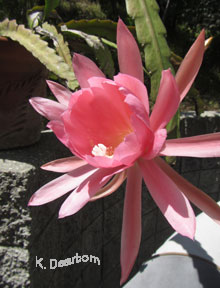
I've successfully grown two variety of epiphyllum for years. The Sunset Western Garden Book gives the common name of "orchid cactus" for epiphyllum. Epiphyllums are a type of cactus with long flat stems that are scalloped along the edges and give the appearance of leaves. The few spines are at the base of these scallops. 

These plants naturally come from the forests of Central and South America where rain is frequent. It is odd to think of forest cactus, but that is what these plants are. They have small shallow roots and typically settle into the nooks and crannies in trees and between rocks. Here in pockets of leaf litter, they thrive on rain water and nutrients washing off the surrounding plants.

The wild plants have large, mostly white-or-cream-colored flowers that bloom at night with a heavy scent. They are pollinated by bats and they produce a fruit that is also eaten by mammals, who then disperse the seeds. Hybridized plants come in a broad spectrum of colors (ESA display at Garden Show) and they tend to flower during the day.

I'm going to share my plants with Douglas. Following the advice of the Epiphyllum Society of America, I cut off a blade and let it heal in a dark dry place for up to 10 days. One of the sections I selected already had a root forming when I cut it.

Douglas can now plant these in a loose soil of bark, sand and potting mix. Let it sit without water for 2 weeks then gradually begin to water occasionally. Once rooted they should be kept moist but not wet. I've found clay pots hold moisture during our hot summer without keeping the plants too wet.  It takes about 2 years for a cutting to bloom.

just about to bloom
To get the right amount of air flow, my pots are up on the edge of a wall in partial shade. The second perk to this location is that the sprinklers just lightly reach them.

While epiphyllums are not native to Southern California, the large valley carpenter bee will visit the blooms. Western fence lizards appreciate the elevated location and linger in the pots. And when the blooms open I am reminded how their shape is perfect for hugging a nectar eating bat. 

Tuesday, April 30, 2013

Finding Inspiration at the Southern California Spring Garden Show

Display by Don Davidson and Fiesta Parade Floats
Last weekend I dashed off to the Southern California Spring Garden Show at the South Coast Plaza with friends. There is something inspiring about the colors and shapes of plants and flowers even when they are showcased indoors.

The colors and textures were dazzling.


notice how the blocks of color are a blend of flowers

The Epiphyllum Society of America illustrated how variation in one plant can make for splendor.


The display gardens were filled with wondrous ideas. "Paint by the Numbers" presented by Living Landscapes (www.LivingLandscapes.us) demonstrated the power of color. (Even though I was looking for some native plants that would also provide habitat.)

"The Art of Exterior" presented by The Garden Gallery highlighted the art of humans and nature. (www.theggallery.com)

While the display garden by the Orange Coast College Horticultural Club & Architecture Technology (www.occhorticultureclub.wordpress.com) integrated natural forms with a complex structure that complimented the organic elements and created airy height.

I've never seen so many different kinds and colors of orchids anywhere in one location. Everywhere you looked there were inspirational shapes, colors, textures, combinations and the simple reminder that nature is rejuvenating.


Visit a local garden show, go for a walk in a local park or nature center. Take in the tonic of spring.

For more inspiration visit my friend Douglas Welch's blog A Gardner's Notebook for video and photos of the Southern California Spring Garden Show. Toward the end of the video, I promise there is a purple orchid like nothing you have ever seen.